Tag Archives: disciple-making

Growth Under Pressure: Rise & Fall of the Western Church

The Rise. Dr. Martin Luther King Jr. stated, “Change does not roll in on the wheels of inevitability, but comes through continuous struggle.” For the early Church, the struggle was between an ungodly world and Christ’s Kingdom. The tension brought Rome’s wrath, whose leaders murdered Christians and severely limited their ability to engage in commerce. Yet, Christianity grew at about 40% per year!

How? Christians understood that adversity is a natural part of the journey and that perfection and hope emerge (Romans 5:3-5; James 1:2-4). They took the mandate to image God through imitation and replication seriously. For the compassionate, newly transformed, there was no other way. Being a costly faith and valuable religion also contributed to growth. Dietrich Bonhoeffer explains this well in The Cost of Discipleship: “Costly grace is the treasure hidden in the field; for the sake of it, a man will go and sell all that he has. … Such grace is costly because it calls us to follow… It is costly because it costs a man his life, and it is grace because it gives a man the only true life. It is costly because it condemns sin, and grace because it justifies the sinner. Above all, it is costly because it cost God the life of his Son.”

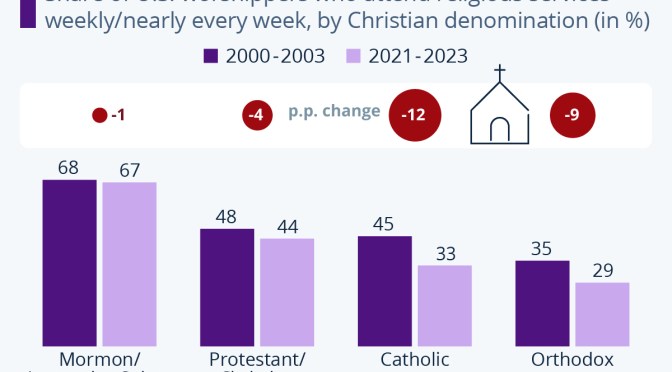
The Fall. Conversely, Western Christianity declines by about 20% each year. Only 5% of churces make disciples who make disciples, and a mere 15% of most memberships live obediently. Spiritual lethargy through passivity has removed tension and stunted growth. Casting Crowns’ song Start Right Here states things well: “We want our coffee in the lobby. We watch our worship on a screen. We got a Rockstar preacher who won’t wake us from our dreams. We want our blessings in our pocket. We keep our missions overseas. But for the hurting in our cities, would we even cross the street?”

Spiritual lethargy and focusing on ‘nickels and noses’ produce a cheap grace that embraces comfort but opposes growth (in numbers or maturity!). Deitrich Bonhoeffer’s take: “Cheap grace means grace sold on the market like cheapjacks’ wares. The sacraments, the forgiveness of sin, … can be had for nothing. … Cheap grace is the preaching of forgiveness without requiring repentance, baptism without church discipline . . . Cheap grace is grace without discipleship …”

The Cure. Growth would require a shift that naturally creates tension between our ungodly world and Christ’s Kingdom introduced through Christ-followers. No more immoralities. No more business-minded attractional buildings, programs, or religions—just discipleship-born imitation, replication, and growth out of adversity.

Summary. The early Church grew astoundingly because of discipleship’s imitation, replication, and growth from persecution. Today’s Western Church will die if it doesn’t do the same. The Thanksgiving holiday is coming, so let’s explore it next time. Until then, fight the good fight, struggle victoriously, and embrace change.

God’s blessings and peace,

Dr. Ron Braley, MDiv, DMin.
A Church of House Churches

Early Christians met in house churches to learn, encourage, and worship interactively. There were no inside-the-church preachers, priests, buildings, tithes, or religious dogma. Potential converts came to the Faith because of observed Christian behavior and compelling evangelism outside church walls. Members upheld covenantal vows and communal expectations.

No one person ruled anyone. Elders provided oversight but weren’t elevated. Preachers and evangelists taught outside church walls; pastors shepherded and taught inside and were equal to everyone else and unpaid. Everyone shared testimonies, burdens, songs, biblical texts, and resources. Not today.

Today’s pursuit of “nickels and noses” derails disciple-making and transformation. Western Christianity declines about 20% per year, and churches close at an alarming rate. The remainder focuses on attracting consumers, and 90% or more of church income goes toward expenses. Only 5% of Western churches claim to make disciples who make disciples. A whopping 960 people out of 1,000 introduced to God’s Kingdom are unfruitful and unworthy of imitation because expectations, modeling, discipleship, and accountability are missing. Let’s contrast the earliest Christian way of life with today’s Christian religion to see the differences.

No sanctioned buildings, tax exemptions, or Old Testament tithes existed until fourth-century Constantine. Christians were to ‘go and make.’ Today, we thrust new buildings into strange communities and expect people to ‘come, listen, and give.’ Potential converts counted the cost of discipleship and then devoted entirely to God and the Church. Today’s Christians usually expect instant salvation from belief without response. Without discipleship and transformation, they look like the world. Preachers preached outside; now, they preach inside to a passive audience. Everyone was required to participate; today, people come and go without expectations or consequences. It’s no wonder our Christianity is impotent and dying. Can we reverse the trend? Yes!

The existing brick-and-mortar church must become a sending agency that equips Christians to ‘go and make’ outside the church walls. That must be its focus and where most resources go. We could reverse the embarrassing ROI (Return On Investment) if we retool to become ‘churches of house churches’ like first-century house-church Christianity overseen by Elders and Bishops. An effective church today could produce and oversee pastors who shepherd house churches in their communities. Antioch church in Waco, TX., does something similar. And so does Jason Shepperd in his project “A House of House Churches” (https://www.amazon.com/Church-House-Churches-Articulated-Ecclesiology/dp/B0B1K5WBLX). He’s the senior pastor, and most visitors don’t know him. Why? He’s not the focus. Jason and the pastors he trains invisibly lead a potent church of house churches where discipleship, training, accountability, benevolence, ‘one anothers,’ and transformation happen.

Today’s business-focused Christian religion and churches don’t resemble the influential, intimate, communal first-century Church. It’s supposed to make disciples who make disciples (Matthew 28:18-20), which it doesn’t do. Let’s reverse the trend to revitalize Western Christianity!

Please consider reading my book From Butts in the Pews to Be-Attitudes: Turning Consumers into Disciples (available on Amazon, Barnes and Noble, and Xulon Press) for more information and support for the statistics in this article. Next time? Drain the brain [swamp], and please God! Remember that religion is for you, and obedience is for God.

Blessings and peace,

Dr. Ron Braley, MDiv, DMin.
The Master’s Voice

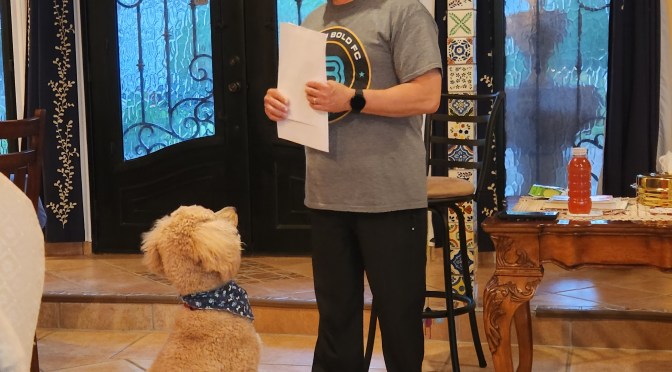
A disciple seeks to be like the master, whom they imitate and then become something worthy of imitation. The process requires studying what is said and shown. My dog Aragon does this. When I leave the room, he waits and watches in earnest for my return. He stares intently when I’m with him, waiting for the next praise or instruction. So, he was easy to train. Listen. Watch and wait. Imitate. We should be like Aragon in our relationship with God. How? Always listen and watch, waiting on the movement of the Holy Spirit, biblical instructions, or admonishments from other Christ followers. Let’s examine the “listen, wait, imitate” rhythm from a biblical perspective.

The master’s voice. Read 1 Kings 19:4-18, and you’ll find a depressed Elijah on the run from Ahab. In verses 10 and 14, he cried to the Lord, “Am I the only one?” He didn’t respond through a great wind and earthquake. He didn’t answer through a fire. Instead, He replied gently, softly. In a small, still voice, the Lord God almighty whispered: “No! Seven thousand others are like you!” (1 Kings 19:11-18).

Aragon knows me. He knows my voice and responds accordingly. I speak, he listens. I go, he goes. He follows because he knows and trusts me. Similarly, Jesus knows those who belong to Him: “My sheep hear My voice, and I know them, and they follow Me; and I give eternal life to them . . .” (John 10:27-28). Besides listening, the obedient to God sometimes must wait patiently for a deed, a word.

Just wait! Aragon will wait patiently for hours for me. When he sees me, he’ll leap into action. The wait is worth it! The same holds for God’s children. The Psalmist wrote this: “I wait for the Lord, my soul waits, and in his word I hope” (Psalm 130:5, ESV). We often wait for a word of instruction, admonishment, or comfort from the Lord through His Spirit, scriptures, or other followers of Jesus.

Imitate and replicate! Training Aragon was easy. He listened, watched, and repeated what he saw. He even tries to make the sounds I make when we play. As imagers of God, we, too, are meant to imitate what we see and hear related to Him and repeat the words and behavior. The apostle Paul confirms it: “Be imitators of me, just as I also am of Christ. Now I praise you because you remember me in everything and hold firmly to the traditions, just as I delivered them to you.” (1Corinthians 11:1-2).

Listen for the Master’s voice even if you must wait. Then, just like Aragon with me, imitate what you learn and become something worthy of imitation by others. What’s next?  Let’s reverse today’s upside-down church model with a church of house churches. While waiting, remember that God wants your loyalty, not your religion.

Blessings and peace,

Dr. Ron Braley, MDiv, DMin.

That’s Heavy, Man!

“Ron! Why do you write about such serious stuff? Just remind us that Jesus loves us no matter what and then tell a cute story or write something funny!” Indeed, my topics are often serious or deep. Why? I sometimes address a specific need or balance our lopsided Christianity that usually tells only half the story. Yes, Jesus loves us no matter what we’ve done or where we are. But we’re not meant to stay there! According to King Solomon, there’s nothing new under the sun. And the need to respond to current issues or provide guidance dates to the earliest days of the New Covenant.

New Testament (Covenant) letter writers usually addressed a particular audience to inform or solve a problem. They would often provide balance in a Christianity warped by heresies or immoralities of the day. Take Paul, for instance. He wrote to the Church in Rome to steer a predominantly Jewish congregation from focusing on religious format or works. Sure, God had predestined the nation of Israel to carry out His plan of salvation (Romans 8:18-30 – similarly, see Ephesians 1:4-6, 11). Its people—especially those who entered the Christian faith—probably felt special and believed that adherence to the Jewish religious Law was still necessary for the New Covenant. However, a focus on works negated the unmerited gift of life offered through Jesus.

The Corinthian Church was another recipient of Paul’s written guidance and correction. These believers, mostly Greek, often engaged in things like sexual immoralities (e.g., 1Corinthians 5:1-13 and 6:12-20). Many filed lawsuits against each other. Still, others practiced gluttony and self-centeredness and rebelled against customs like how women should respond in church or keep their hair. Why did he write against violating local traditions? Because the violations caused problems in the culture and could make God’s Kingdom unattractive to the locals. Paul’s letters addressed those issues (and more) to correct bad behavior and provide a clearer view of a righteous walk of faith. What about today?

We still misbehave toward one another, abuse our bodies, and neglect spiritual formation believing all the while, selfishly, that God has a unique plan for each of us and that He works all things for our personal good. The practices are unrighteous, and the beliefs are gross misunderstandings of Jeremiah 29:11 and Romans 8:28 taken out of context. Yes, God Has a plan and has invited us to join Him in it, but it’s His plan for all, not personal spiritual elevation.

So, I write to you to offer balance and guidance and partner with you to practice your faith according to God’s good pleasure. I promise to lighten it up where I can! What’s next? Let’s learn how not to be aggressive—even passively aggressive—in “Vengeance is God’s, not ours—even in church!”

Blessings and peace,

Dr. Ron Braley

The Way it Is (Discipleship, Part III)

Over the last several weeks, I’ve written that a disciple of Jesus Christ is to be a copycat who makes more copycats and offered three essential tips for effective discipleship:

Tip #1: Be a Sold-out Copycat (of good stuff)!

Tip #2: Follow Jesus’ Model to Make More Copycats!

Tip #3: GO!

Together, we’ve also explored how the earliest Church discipled using Jesus’ approach. Now, let’s talk about how you can be and make disciples today.

First, it’s essential that we continuously develop ourselves spiritually through Bible study, prayer, accountability, and discipleship. After all, we can’t live, model, or share what we don’t know!

Second, we must be incarnational. What I mean is that we must be integral in our communities, whether at work, play, or anything else. That way, we can develop trust-building relationships that will allow dialogue about what we believe and why.

Third, we must be contextual. “Say what??” Exactly! We must be and communicate in the same ways as others so that they’ll understand what we’re showing and telling. Think about it: Jesus spoke in farming terms and figures of speech when He taught the good news of God’s Kingdom to farmers. And he used fishing sayings when talking to fishermen. He used examples to make His points more apparent and applicable.

Without being incarnational, there’s little chance of building the kind of relationships that will allow ongoing, deep and personal discipleship. Without being contextual – meeting and communicating with people where they are instead of expecting them to come, our modeling and evangelism will likely fall on blind eyes and deaf ears. “But Ron – how can I be incarnational and contextual?” Great question!

One way to build relationships incarnationally is to be involved in the lives of others by following a BELLS principle: Bless, Eat, Listen, Learn, and Sent. Make friends, not numbers. Bless multiple people each day. Eat with others (it’s a great way to show care and deepen relationships!). Listen to the Spirit of God as He directs your discipleship steps. Learn about God and His ways, so that you’ll have something to model and tell those people with whom you’re building relationships. And make sure you GO (sent)!!

To be contextual in your modeling and telling, understand the dress, traditions, figures of speech, customs, and desires of those you hope to witness to and disciple. Show interest. Use terminology familiar to them, not Christianese. Finally, consider an ongoing Life Transformation Group of 2-3 people of the same sex for weekly prayer, accountability, and Bible study.

The Way it Was (Discipleship, Part II)

In the last blog, I wrote that a disciple of Jesus Christ is to be a copycat who makes more copycats and offered three essential tips for effective discipleship:

Tip #1: Be a Sold-out Copycat (of good stuff)!

Tip #2: Follow Jesus’ Model to Make More Copycats!

Tip #3: GO!

Now, let’s explore how the earliest Church discipled using Jesus’ approach.

Early Christians didn’t have programs, bills, a different language (Christianese), or an expectation that people should come to them or their church. Instead, they lived life well in the community with everyone else, according to the words of God and ways of Christ. The yet-to-be-churched saw the gospel at work and observed consistent good works and Godly behaviors. What they saw built trust and made them curious. So, the earliest Church grew because God-fearing Christ-followers met people where there were. Here’s part of a letter written to the tutor of Emperor Marcus Aurelius in the 2nd century, which reflects this approach, especially the modeling aspect of discipleship:

Christians are not different from the rest of men in nationality, speech, or customs; they do not live in states of their own, nor do they use a special language, nor adopt a peculiar way of life. … they follow local custom in the matter of dress, food, and way of life; yet the character of the culture they reveal is marvellous … They share in all duties like citizens and suffer all hardships like strangers. … They marry like the rest of men and beget children, but they do not abandon the babies that are born. They share a common board, but not a common bed. In the flesh as they are, they do not live according to the flesh. They dwell on earth, but they are citizens of heaven. They obey the laws that men make, but their lives are better than the laws. … They are maligned, and yet are vindicated. They are reviled, and yet they bless. They suffer insult, yet they pay respect. They do good, yet are punished with the wicked.

In the third of three discipleship blogs, I’ll offer a few tips for being light and the Kingdom of God by meeting people where they are today and ministering in ways they understand. As you can imagine, we must get out from behind church walls, or the building becomes the most expensive ‘lampshade’ on the planet! And there’s no point in bringing others the gospel of God’s Kingdom if they don’t trust or understand us! Don’t worry, though – I’m here to help!

Don’t forget to join me on October 3rd for Disciple-Con 20/20 Vision! For more information, or to purchase tickets, visit http://www.findingdiscipleship.org/disciplecon2020

Questions or comments? Email publisher@taylorpress.net.

Blessings and peace,

Ron Braley