Tag Archives: early church

Growth Under Pressure: Rise & Fall of the Western Church

The Rise. Dr. Martin Luther King Jr. stated, “Change does not roll in on the wheels of inevitability, but comes through continuous struggle.” For the early Church, the struggle was between an ungodly world and Christ’s Kingdom. The tension brought Rome’s wrath, whose leaders murdered Christians and severely limited their ability to engage in commerce. Yet, Christianity grew at about 40% per year!

How? Christians understood that adversity is a natural part of the journey and that perfection and hope emerge (Romans 5:3-5; James 1:2-4). They took the mandate to image God through imitation and replication seriously. For the compassionate, newly transformed, there was no other way. Being a costly faith and valuable religion also contributed to growth. Dietrich Bonhoeffer explains this well in The Cost of Discipleship: “Costly grace is the treasure hidden in the field; for the sake of it, a man will go and sell all that he has. … Such grace is costly because it calls us to follow… It is costly because it costs a man his life, and it is grace because it gives a man the only true life. It is costly because it condemns sin, and grace because it justifies the sinner. Above all, it is costly because it cost God the life of his Son.”

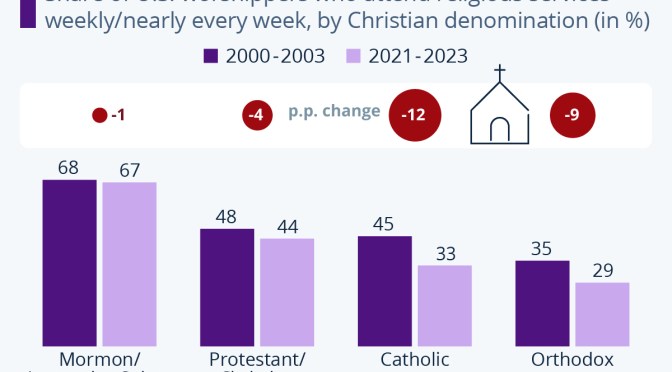
The Fall. Conversely, Western Christianity declines by about 20% each year. Only 5% of churces make disciples who make disciples, and a mere 15% of most memberships live obediently. Spiritual lethargy through passivity has removed tension and stunted growth. Casting Crowns’ song Start Right Here states things well: “We want our coffee in the lobby. We watch our worship on a screen. We got a Rockstar preacher who won’t wake us from our dreams. We want our blessings in our pocket. We keep our missions overseas. But for the hurting in our cities, would we even cross the street?”

Spiritual lethargy and focusing on ‘nickels and noses’ produce a cheap grace that embraces comfort but opposes growth (in numbers or maturity!). Deitrich Bonhoeffer’s take: “Cheap grace means grace sold on the market like cheapjacks’ wares. The sacraments, the forgiveness of sin, … can be had for nothing. … Cheap grace is the preaching of forgiveness without requiring repentance, baptism without church discipline . . . Cheap grace is grace without discipleship …”

The Cure. Growth would require a shift that naturally creates tension between our ungodly world and Christ’s Kingdom introduced through Christ-followers. No more immoralities. No more business-minded attractional buildings, programs, or religions—just discipleship-born imitation, replication, and growth out of adversity.

Summary. The early Church grew astoundingly because of discipleship’s imitation, replication, and growth from persecution. Today’s Western Church will die if it doesn’t do the same. The Thanksgiving holiday is coming, so let’s explore it next time. Until then, fight the good fight, struggle victoriously, and embrace change.

God’s blessings and peace,

Dr. Ron Braley, MDiv, DMin.

Covenantal Anesthesia

Today, we prevent unwanted pregnancies not by abstinence but contraception. No discipline; no problem. Do whatever feels good. Promises made in the dark remain unkept in an age where words and actions are disconnected and often in complete opposition.

Today, we avert the consequences of other ungodly acts such as homosexuality through medicine and contraceptive methods. Lying and litigation are acceptable means by which to achieve objectives. These aren’t God’s ways or representative of His love, which equates to justice and mercy. His speech results in action; He has always done what He says He will do. This was the posture of the early Church: speech-action that mirrored their faith and produced good works accordingly. Their speech and actions were indistinguishable.

Second-century Christian and Church leader Justin notes this of his contemporary Christians: “… community doesn’t consider people true Christians if they simply quote Christ’s teachings but don’t live them.” (Justin, 1 Apol. 16.8 by Alan Kreider, The Patient Ferment of the Early Church, 15). He also lists the saying of Jesus under four categories: sexual ethics, actionable/charitable love, patience, and truth-telling. (ibid.) Many early Church leaders reported that the Christians lived among the non-Christians in community eating, drinking, and working beside them. However, their charity, honesty, and purity as well as patience under trials and hardships set them apart and made an impact that attracted those around the Christians to desire to learn of God’s kingdom and join the faith. Not so today in a world of watered-down preaching full of funny stories and anecdotes framed by entertaining music, coffee, and donuts; no so in a world where churches become the most expensive light-killing lampshades on the planet by hiding and entertaining consumers.

Today, the Western Church looks mostly like the world: same behaviors and worldviews; similar lack of patience, unrepentance, unforgiveness, divorce statistics, selfish driving habits, litigation, financial irresponsibility, and so-on. Why? In my experience as a minister, researcher, and writer, a driving factor is the lack of choice where a covenant with God is concerned.

Removing the consequences of immorality, lying, etc. through contraception, litigation, and ungodly laws can lure us into believing that the lack of consequences imply acceptance. Similarly, and in my experience, Western Christians are lured into believing that God exists to serve them and that prosperity is the goal because covenant and consequences have often been removed in the Church. Churchgoers are anesthetized by receiving a half-baked gospel where, if anything, a silent and personal ‘sinner’s prayer can save them without reciprocation. They are told there’s nothing they have to do – Jesus did it all! No self-discipline, no charity, no sacrifice, no two-way marriage-like covenantal response. No consequence for the pleasure-seeking individual uninterested in communal care who practices behavior antithetical to God’s ways. No accountability. No ongoing spiritual formation or discipleship (Barna, The State of the Church, 2016, for instance: https://www.barna.com/research/state-church-2016/). What to do?

There can be a fix – a positive change that once again draws others to our faith. Turn off the anethsiea of a covenantless gospel; stop entertaining and teach. Hold Christians accountable for ungodly behavior and gently train through discipleship. Move out of the church buildings and live out faith among others in our communities whether at work, play, or dwelling so that they may see our good works, patience, and purity and wonder just as the ancients did.

Blessings,

rb

http://www.ronbraley.com

http://www.findingdiscipleship.org