The Master’s Voice

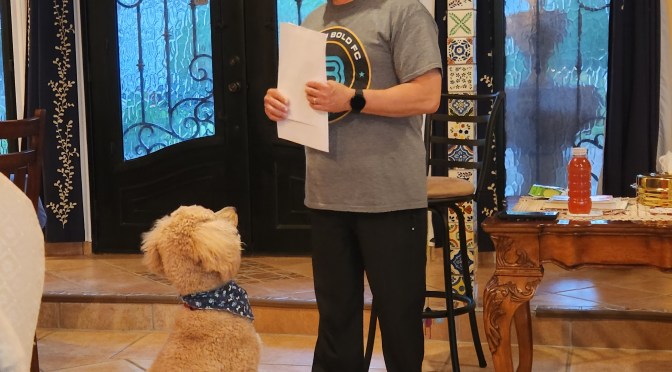
A disciple seeks to be like the master, whom they imitate and then become something worthy of imitation. The process requires studying what is said and shown. My dog Aragon does this. When I leave the room, he waits and watches in earnest for my return. He stares intently when I’m with him, waiting for the next praise or instruction. So, he was easy to train. Listen. Watch and wait. Imitate. We should be like Aragon in our relationship with God. How? Always listen and watch, waiting on the movement of the Holy Spirit, biblical instructions, or admonishments from other Christ followers. Let’s examine the “listen, wait, imitate” rhythm from a biblical perspective.

The master’s voice. Read 1 Kings 19:4-18, and you’ll find a depressed Elijah on the run from Ahab. In verses 10 and 14, he cried to the Lord, “Am I the only one?” He didn’t respond through a great wind and earthquake. He didn’t answer through a fire. Instead, He replied gently, softly. In a small, still voice, the Lord God almighty whispered: “No! Seven thousand others are like you!” (1 Kings 19:11-18).

Aragon knows me. He knows my voice and responds accordingly. I speak, he listens. I go, he goes. He follows because he knows and trusts me. Similarly, Jesus knows those who belong to Him: “My sheep hear My voice, and I know them, and they follow Me; and I give eternal life to them . . .” (John 10:27-28). Besides listening, the obedient to God sometimes must wait patiently for a deed, a word.

Just wait! Aragon will wait patiently for hours for me. When he sees me, he’ll leap into action. The wait is worth it! The same holds for God’s children. The Psalmist wrote this: “I wait for the Lord, my soul waits, and in his word I hope” (Psalm 130:5, ESV). We often wait for a word of instruction, admonishment, or comfort from the Lord through His Spirit, scriptures, or other followers of Jesus.

Imitate and replicate! Training Aragon was easy. He listened, watched, and repeated what he saw. He even tries to make the sounds I make when we play. As imagers of God, we, too, are meant to imitate what we see and hear related to Him and repeat the words and behavior. The apostle Paul confirms it: “Be imitators of me, just as I also am of Christ. Now I praise you because you remember me in everything and hold firmly to the traditions, just as I delivered them to you.” (1Corinthians 11:1-2).

Listen for the Master’s voice even if you must wait. Then, just like Aragon with me, imitate what you learn and become something worthy of imitation by others. What’s next?  Let’s reverse today’s upside-down church model with a church of house churches. While waiting, remember that God wants your loyalty, not your religion.

Blessings and peace,

Dr. Ron Braley, MDiv, DMin.

Lent, Orthodox Style Part III – Pascha

Here, I was going to introduce you to my dog, Aragon. Instead, I’ll turn the Lent Orthodox duo into a trilogy and give you a bonus Part III! You’ll meet Aragon next time. In Parts I and II of Lent, Orthodox Style, I introduced you to Eastern/Greek Orthodoxy and its Lent practices meant to aid Christian formation. The idea is to develop a rhythm of praying, giving, studying, and fasting because these practices are of Christian importance. Lent also prepares the practitioner for Pascha (a celebration of Jesus’ resurrection), today’s subject.

Pascha significance. Christ died to bring us back to God (1 Peter 3:18), satisfying a debt incurred by humanity’s original rebellion: “Therefore, just as through one man sin entered into the world, and death through sin, and so death spread to all men because all sinned” (Romans 5:12) and “But God demonstrates His own love toward us, in that while we were yet sinners, Christ died for us.” (Romans 5:8)

In return, our Heavenly Father raised Him from the dead, paving the way for so many others to be resurrected at the end of this world: “But now Christ has been raised from the dead, the first fruits of those who are asleep. For since by a man came death, by a man also came the resurrection of the dead. For as in Adam all die, so also in Christ all will be made alive. But each in his own order: Christ the first fruits, after that those who are Christ’s at His coming” (1 Corinthians 15:20-23).

So, the Pascha celebration commemorates what Christ did for us and His resurrection, which gives us hope. From dark to light, fasting to feasting, the Pascha celebration brings joy that hints at what God’s children will experience in the coming resurrection after much suffering. How does the celebration unfold? Let’s see!

Pascha celebration. In the previous two articles, we learned about the 40 days of Lent before Pascha. The final week, called “Holy Week,” includes recounting the Gospel story on Thursday and the Lamentation of Christ’s death and burial on Friday and Saturday. It concludes on Sunday with a procession celebrating Christ’s resurrection, after which red eggs symbolizing renewed life through Christ’s blood are handed out, and then a feast. The feast ends the 40-day fast and invites participants to enjoy the foods they sacrificed during that time. After all, “there can be no feasting without fasting!”

In summary, Orthodox Lent aids Christian formation and paves the way to celebrate Pascha, Christ’s resurrection. Visit https://orthodoxwiki.org/Pascha to learn more. What’s next? I’ll finally introduce you to my dog, Aragon, and tell you why we should be more like him, listening for the Master’s voice. Until then, remember that Christ died to satisfy your debt to the creator and rose from the dead to give you hope. Act like it!

Blessings and peace,

Dr. Ron Braley, MDiv, DMin.

Lent, Orthodox Style: Part II

In Part I of this two-parter, I introduced you to Eastern/Greek Orthodoxy and its Lent practices. The 40-day period full of prayers, fasting, charity, and confession ends with Pascha (the resurrection celebration) on May 5th. Why practice Lent? To aid in transformation and prepare for Pascha. It requires serious contemplation and sacrifice. Joanne and I are going through Lent with our oldest daughter this year for spiritual and relational health. How’s it going? You’ll find out as we look at each area, starting with food fasting.

Fasting food. The Lent calendar calls for a strict vegan diet that allows fish twice. We tried—honest! But Joanne is a meat-and-potatoes person and doesn’t like fish. Like her, I need protein! This fast was a shock, and we ditched it after a week. We failed abysmally here but did much better with fasting alcohol.

Fasting wine. We’re allowed to have wine on the weekends. Joanne makes excellent wine, which we often enjoy on our back porch. This fast was sacrificial but physically and spiritually healthy. We were more successful here than with the food fast and will continue the rhythm after Lent.

Scripture reading. We have shared devotional time praying and Bible reading for a very long time. However, the rhythm became choppy after moving to Taylor five years ago. Engaging in daily Bible readings and contemplation has energized the cadence.

Praying. We pray regularly and often, so this was easy. But, as with Bible reading, it was nice to resume a daily rhythm of praying together. How do we pray? According to Jesus’ model, we adore the Father and confess our sins for forgiveness. Our prayers are full of thanksgiving for all He has done, is doing, and will do. Lastly, we spend much time praying for others’ health, healing, and well-being as precisely as possible.

Charity. This, too, was easy for us because we’re charity-minded throughout the year. Why? Well, the practice of actionably loving people proves our love for God and is a standard by which we’ll be judged at the end of this world (e.g., John 13:35; James 2:14-26; Matthew 25:31-46). Sometimes, we give time. Often, we offer material goods or money. The point is to meet people where they are, understand their needs, and respond as we can.

All in all, our Lent season was productive and relational—with God and our daughter. The idea was (and is) to develop a better rhythm of praying, giving, studying, and fasting because these practices are of Christian importance, even beyond Lent. Try them out to experience God intimately and in a new way while improving physical, mental, emotional, and spiritual health.  What’s next?  I’ll introduce you to my dog, Aragon, and explain how we should be more like him in our relationship with God. Meanwhile, religion is acceptable, but obediently being pure, charitable, and transformed is better!

Blessings and peace,

Dr. Ron Braley, MDiv, DMin.