Category Archives: Uncategorized

Unify to Magnify – Part Three!

In part one, I wrote that God wants His children unified as one diverse but single Body. In part two, I explained why this is primarily absent today: Human religion. Can we return to an authentic Christianity that shared Communion elements, prioritized devotion over format, and unified despite minor differences? Maybe. Let’s begin our reunification journey by separating essential from non-essential beliefs and practices.

Big-T versus little-t truths. Some things are absolute ‘Big-T’ truths. For instance, a Son of God was sacrificed as a son of man to reconcile us to God. He arose three days later, giving us hope. But, how we practice commemorating Jesus’ death and our new covenant with God is a subjective ‘little-t’ thing. The same holds for how we’re baptized or praise God. Don’t get your underwear in a twist over these things, but understand and appreciate the differences. This requires education.

Education. We shun what we don’t understand. Education can resolve this. What Big-T truths should we stick to? Why do some churches practice little-t things like baptism, Communion, or praise differently? We should know. Some Christians use icons or pictures to focus prayers and worship. You might assume they’re worshipping idols if you don’t know the truth. Additionally, people and churches can contribute to reunification.

People. Here are things individuals can do to reduce disunity and be better ambassadors to God’s Kingdom:

  • Become educated: Understand where religious traditions came from and prioritize Christ’s Law of Love above them. Engage others in dialogue about beliefs and practices.
  • Appreciate little-t differences, and don’t shun people for them.
  • Participate in community love efforts.
  • Help with community disaster recovery efforts.

Churches. Disunity is fixed here! Prioritize reunification and Christian community by doing these things:

  • Be transparent about your traditions and prioritize biblical, not human, practices and Christ’s Law of Love.
  • Hold community training in Big-T stuff such as biblical languages, bible study principles, history, and the Scriptures.
  • Facilitate community praise events.
  • Facilitate community evangelistic efforts (focusing on Big-T fundamentals!).
  • Encourage dialogue with Christians outside your church; perhaps have speakers share their practices to break down barriers.
  • Collaborate on community love and recovery efforts.

Unity examples. Here are examples of unification and love over religion:

  • A local Thursday night home-based fellowship comprises Catholic, Baptist, Church of Christ, and non-denominational members who enjoy prayer, Communion, testimonies, and interactive learning. We also charitably love each other and, collectively, the community.
  • Multi-denominational pregnancy centers that show Christ’s love while working to mitigate abortion.
  • Multiple churches serving the community through Shepherd’s Heart.
  • The earliest Church, diverse but loving and irreligious.

Summary. Churches must unite in Big-T truths while enjoying diverse little-t practices through education and love. What’s next? Learn how original Christianity as a costly faith flourished because of godly modeling and endurance under incredible pressure—not praise bands, light shows, motivational speakers, or other consumeristic attractions. Meanwhile, be an active and collaborative member of Christ’s Body.

God’s blessings and peace,

Dr. Ron Braley, MDiv, DMin.

Unify to Magnify – Part Two!

In part one, I wrote that God wants His children unified as one diverse but single Body, sharing spiritual gifts, talents, and treasures. Metaphoric eyes, ears, feet, and hands, all different but working together to accomplish God’s desires. However, the Church has been drawn, quartered, and segregated. The ‘arms’ congregate and despise the ‘legs;’ the ‘eyes’ deprive the ‘hands’ of vision.  And we relegate many to hell because of differing religious practices and beliefs. This is a far cry from the original love and simplicity that characterized the Church, however. What happened?

Hands down, the root cause is people. We differ in beliefs and experiential pursuits, and like-minded folks assemble to create and share common traditions and practices. This is the heart of culture—faith, in our case. Let’s focus on cultural differences in how we praise God and engage religious theories and experiences.

Cultural Differences: Praise. Many people honor God in song or dance. Some prefer a gospel genre, while others swear that musical instrumentation is of the devil. Others enjoy hymns, while another church uses contemporary popular songs during services. Regardless, differences in how we praise God are primarily matters of personal taste and don’t generally pose a divisive threat to Western Christianity. Religious differences are another matter.

Cultural Differences: Religion. This presents the Body as ugly to the yet-to-be-churched, who marvel at our disunity. There are many Western Christian splinters, some prompted by one person’s beliefs in the fourth to fifth centuries CE. A Stoic by nature, he spawned new and contentious religious theories like original sin spread through sex and predeterminism (you have no hand in your final spiritual destination). Other church fathers rejected the latter theory, which was revitalized and formalized in the Protestant Reformation. Also, contention in baptism and communion remains.

  • Baptism. Water immersion is a public sign of intentional, saving devotion to God. One early Christian guide suggests cold, running water. Otherwise, warm or standing water is fine. None of the above? Spit! Now? We divide over infant baptism, whether water saves, and baptism’s effectiveness should any body part miss the water.
  • Communion. Early Christians remembered Christ’s sacrifice and a new covenant with God by sharing wine and bread, often as part of a ‘love feast.’ Now? We divide over how and where to take it, who can serve it, and how it works. You’ll be excommunicated in some circles if you share Communion elements with believers outside your church. My, how we’ve abandoned authentic and intimate sharing among believers for religion!

Summary. Christians congregate and isolate with like-minded people, often praising God through diverse musical traditions. However, the most divisive force is the different beliefs implemented by humans, not God. Religious contention has greatly splintered Christ’s Body, but that’s not God’s desire! In part three, we’ll explore ways individuals and churches can unify despite differences in practices and non-essential beliefs.

Blessings and peace,

Dr. Ron Braley, MDiv, DMin.

Unify to Magnify – Part One!

God loves a unified creation. He equips us for that purpose. When we move as one Body, we uplift God and proclaim His greatness. The spiritual hands, feet, eyes, and ears are to work as one to point to the Creator. But that’s not the reality today: theological segregation, human traditions, and pride have fractured the Church.

One denomination revels in study and programs but remands the Holy Spirit to the first century and chastises charismatics. Another focuses on supernatural signs and speaks and acts unbiblically. Others staunchly plant the stake of “we’re the only way to heaven” into the soil of biblical ignorance. Human-born mysticism and legalism have corrupted the once-simple practices of communion and baptism, causing even further division. However, this is not what God desires, nor has this always been the case. Here, we’ll explore Godly unity in a three-parter that defines it, shows our departure, and attempts to make unity a priority again. First things first: an overview.

Unity is a bond, a oneness, that joins individuals into a single entity, as in the Body of Christ. In that context, we are unified by Father, Son, and Spirit, and our unity magnifies (honors) God. Here are some biblical examples:

  • We are unified by one Father, Son, and Spirit for peace and God’s ministry of reconciling creation (Ephesians chapter four): “There is one body and one Spirit … one Lord, one faith, one baptism, one God and Father of all who is over all and through all and in all. . . . for the equipping of the saints for the work of service, to the building up of the body of Christ; until we all attain to the unity of the faith.”
  • The world should see our unity (John 17:23): “I in them and You in Me, that they may be perfected in unity, so that the world may know that You sent Me, and loved them, even as You have loved Me.” But it sees brokenness instead of unity.
  • The parts of the Church only work when unified (1 Corinthians chapter twelve): “For even as the body is one and yet has many members, and all the members of the body, though they are many, are one body, so also is Christ. … If the whole body were an eye, where would the hearing be? If the whole were hearing, where would the sense of smell be? … Now you are Christ’s body, and individually members of it.”

Summary. The Church only functions effectively when everyone works together as one Body, sharing spiritual gifts and resources as God permits. This is not the case today. Next? Let’s look deeper into how the lack of unification crippled Christ’s Body and made God’s Kingdom an ugly thing to many people. Meanwhile, consider how you, as a spiritual eye or ear, can help the Body see and hear.

Blessings and peace,

Dr. Ron Braley, MDiv, DMin.

Know Your Enemy – Part Two

In Part One, we learned that authentic God-fearing Christ-followers war against an unseen realm headed by The Adversary (Satan). Spiritual forces under his control rule nations, moving individuals to oppose God and corrupt creation. Here, we’ll explore how to resist the Evil One (Satan), protecting ourselves spiritually and enduring until the end of this world. First, avoid trouble!

Stay out of harm’s way! “… do not give the devil an opportunity.”(Ephesians 4:27)Avoid immoral sights, sounds, and activities or die by those things. Jesus makes this clear in Matthew 18:9: “If your eye causes you to stumble, pluck it out and throw it from you. It is better for you to enter life with one eye, than to have two eyes and be cast into the fiery hell.” (Matthew 18:9)

We can, like Job, make a righteous deal with our eyes ( Job 31:1) and vow not to look at anything vile and vulgar, as we see in Psalm 101:3. Here’s Paul’s advice from Galatians 5:17: “This I say then, Walk in the Spirit, and you shall not fulfill the lust of the flesh.” What else? Be holistically healthy to avoid spiritual distraction and entrapment.

Holistic health. We can resist our spiritual enemy and be an excellent ambassador to God’s Kingdom by being holistically healthy in these areas (as much as we’re able):

  • Spiritually through study, prayer, charity, and discipleship.
  • Mentally and emotionally by exercising the brain and managing feelings.
  • Relationally by treating others as we wish to be treated and seeking reconciliation.
  • Financially to not be distracted.
  • Physically to be movable by God.

Wear spiritual armor. In Ephesians 6:11-13, Paul teaches about the protection God’s children receive: “Put on the full armor of God, so that you will be able to stand firm against the schemes of the devil.”

  • Belt of truth. Jesus Christ’s truth secures our faith and is our foundation.
  • Breastplate of Righteousness. Just as the breastplate protects the physical heart, the righteousness of Christ protects our mind/spiritual heart.
  • Shoes of the Gospel of Peace. When we wear them, we share the good news of God’s Kingdom brought near to people through Christ’s sacrifice and resurrection.
  • Shield of Faith. Faith protects us from fear, doubt, or anxiety.
  • Helmet of Salvation. With it, we can take every thought captive and avoid sinful pursuits, knowing we will be rescued from God’s wrath.
  • Sword of the Spirit. – This weapon is “able to judge the thoughts and intentions of the heart,” according to Hebrews 4:12.  With it, we can discern God’s truth from the lies of the Evil One.

Summary. Avoid wickedness, stay holistically healthy, and wear the armor God gives you to resist your and His enemy! Next time: We’ll learn the need to unify the community of Christ (the Body) to magnify the Lord God! Remember that He wants you to BE the Church, not DO church!

Blessings and peace,

Dr. Ron Braley, MDiv, DMin.

Know Your Enemy: Part One

If you belong to God, you war against principalities from another dimension. The apostle Paul wrote about this in Ephesians 6:12: “For our struggle is not against flesh and blood, but against the rulers, against the powers, against the world forces of this darkness, against the spiritual forces of wickedness in the heavenly places.” Evil spiritual forces move people to oppose God. How did this happen? What is the genealogy of their evil and leader?

Background. God and other disembodied spirits called Elohim were part of a divine council before our time (Job 38:4-7; Genesis 1:26). The one we’d eventually call Satan rebelled, taking others with him (e.g., Ezekiel 28:12-16). Then, angelic watchers, sent to oversee humanity after their exile from Eden, also rebelled (Genesis 3:22-23; 6:1-2 & 4). After the Great Flood, meant to eliminate their offspring, God disinherited all the nations except Israel.

Those Elohim in charge of the disinherited nations have caused people (especially rulers) to rebel against God ever since. Think of them as other-worldly puppets. Their puppet master and ruler of this world is called in Hebrew Ha Satan—The Adversary. He’s your main enemy—don’t underestimate him, as he and his minions search diligently for the spiritually weak and isolated (1 Peter 5:8)! Let’s consider these things in more detail.

The Course of Evil: Until the Watchers. Initially, God and others comprised an innumerable council of spiritual Elohim. There was no apparent rebellion until one Elohim became an adversary. He fell from grace and tricked humans into revolting, too. Their disobedience caused their expulsion from Eden (Genesis 3:22-24). Other Elohim sent to watch over them afterward also disobeyed. Then, the Great Flood came, after which God distanced Himself from most of creation.

The Course of Evil: Disinheritance, Influence, and the End. Read Deuteronomy 32:8-9 and Psalm 82, and you’ll learn that God temporarily gave control of nearly the entire world to other Elohim. He kept what would become Israel, though. Evil persists because those spirits are now in authority (e.g., Psalm 82). For instance, in Daniel 10:13, we read of the spiritual principalities manipulating Persian rulers in Daniel’s time. And we read that Satan will empower the Beast—Antichrist in Revelation 13:3-4. Finally, 1 John 5:19 reminds us that the world lies in Satan’s authority for now.

The good news is that The Enemy won’t prevail, as we see in Revelation 20:10: “And the devil who deceived them was thrown into the lake of fire and brimstone, where the beast and the false prophet are also; and they will be tormented day and night forever and ever.”

Summary. Evil exists because of free will gone wrong when Elohim rebelled and the one we call Satan became God’s adversary. Next? I’ll equip you to resist your spiritual enemy! Meanwhile, pray that God will protect you from that evil one as you resist him.

Blessings and peace,

Dr. Ron Braley, MDiv, DMin.

Perfect Completion!

What is perfection? Can we be perfect? Our modern English dictionary defines perfection as flawlessness, blemish-free. However, the original language and context teach us that godly perfection is completeness.

Remember the Jerry McGuire movie? In it, Tom Cruise utters the infamous phrase, “You complete me!” This is similar to the perfection God desires and is what the ancient language teaches us. And 1 Chronicles 29:19 relates completeness (perfection) to God’s commandments: “and give to my son Solomon a “perfect” heart to keep Your commandments . . .” Here, the end goal resulting in completion is achieved by honoring God through obeying His commandments. To my point, check out 1 John 2:3-5: “The one who says, “I have come to know Him,” and does not keep His commandments, is a liar, and the truth is not in him; but whoever keeps His word, in him the love of God has truly been perfected. By this we know that we are in Him.”

The New Testament word for perfection means to be complete, full, whole. In 1 Corinthians 13:10, perfection completes the incomplete: “but when the perfect comes, the incomplete will be done away.” The unfinished things of today, even in our worship or knowledge, will be completed when God moves creation to the perfection (completion with Him) it once enjoyed.

An example of the unifying property of perfection can be seen in Colossians 3:14: “Beyond all these things put on love, which is the perfect bond of unity.” The point is that perfection is meant to be completion in a relationship with God through Christ, not flawlessness. Trying to be flawless is futile, especially today when so much immorality rules the day (and night). Here are a few biblical references by Jesus, Paul, and Jesus’ half-brother James that support the point that God seeks partners who ‘complete Him’ and whom He completes in a relationship:

  • Jesus (Matthew 5:48) says, “Therefore you are to be perfect, as your heavenly Father is perfect.”
  • Paul (Colossians 4:12): “Epaphras . . . sends you his greetings, always laboring earnestly for you in his prayers, that you may stand perfect and fully assured in all the will of God.”
  • James (1:4): “And let endurance have its perfect result, so that you may be perfect and complete, lacking in nothing.” Run the race; achieve the end goal.

Summary. Perfection is achieved through completion. We are to be perfect (complete) as God is by entering into a marriage-like relationship with Him. You can do this! On the other hand, if you’re hoping to be blemish-free, good luck—it’s impossible and not what your heavenly Father desires. What’s next? I’ll introduce you to our and God’s enemy and equip you to stand against him. In the meantime, be complete with God by honoring your part of the covenant with Him and staying there.

Blessings and peace,

Dr. Ron Braley, MDiv, DMin.

Will the Real Love Please Stand Up?

“Love is love!” The battle cry implied that any gratifying feeling could qualify as love (ungodly sex, in this case). How can the same word reference both good and bad emotions or behaviors?

Our English language limits how we express feelings and actions, including love. We use that single word to reference emotions, lust, and charity. However, the Bible uses different words for each to ensure we understand what’s really happening when we encounter ‘love:’

  • Lust (usually sensual). Greek epithumia represents a firm intention to have something. Jesus said that someone who lusts after another’s spouse sins (Matthew 5:27-28).  Conversely, the Bible states that we should lust after the things of God.
  • Fondness (emotional love). Related Greek words begin with ‘phil’ and represent a fondness for something. For instance, ‘philadelphia’ is a fondness for brothers and sisters in Christ (Hebrews 13:1). Fondness for money is ‘philaguria’ (Hebrews 13:5). Lust and fondness are emotion-driven and, therefore, come and go. You may like me now but hate me tomorrow—especially if my articles contradict your beliefs. Neither emotion-based lust nor fondness is the unconditional love God has shown or that we must have for each other.
  • Unconditional, real Love (selfless, sacrificial). This love doesn’t come and go with an emotional or sexual wind. It’s doing the right thing for the right reason despite feelings. Greek noun agape is this love that God has for all creation, and the verb agapao is love in action. God is love (agape); God loves as we should (agapao). Let’s dig a bit deeper into this love.

God hasn’t always been happy with humanity but still loved (and loves) us so much that He gave His Son, the one we call Jesus, as an ultimate covenantal sacrifice to bring us back to Him. “For God so loved the world, that He gave His only begotten Son, that whoever believes in Him shall not perish, but have eternal life.” (John 3:16) God then raised Him from the dead to assure His children that they too will be raised at the end of this world. Similarly, we do real, unconditional love because God first loved us (1 John 4:19).

We must honor God with all we are and have and be charitable with time, treasures, and talents: “… ‘YOU SHALL LOVE THE LORD YOUR GOD WITH ALL YOUR HEART, AND WITH ALL YOUR SOUL, AND WITH ALL YOUR MIND.’ This is the great and foremost commandment. The second is like it, ‘YOU SHALL LOVE YOUR NEIGHBOR AS YOURSELF.’” (Matthew 22:37-39). Check out Matthew 25:31-46, and you’ll find that true, actionable love includes charity (feeding, housing, clothing, etc.).

Summary. Love can be a strong intent to have (often sexual lust), an emotion, or an unconditional loving action. What’s next? Let’s explore biblical perfection. In the meantime, love as God loves instead of chasing lusts and emotions.

Blessings and peace,

Dr. Ron Braley, MDiv, DMin.

Drain the Brain [Swamp]!

During his 2016 campaign, President Trump pledged to “drain the swamp!” Whether the swamp is swampier now or not, I pondered, “Do others also need to be drained?” The answer? Yep—the brain/mind. Our focus is on defining, draining, and keeping it clean.

Name that brain! This organ controls all aspects of the body, from speech to movement. One of its functions is the ‘mind,’ from which everything flows. It receives input, develops thoughts, and facilitates action. Because it is central to everything, biblical writers call it the ‘heart.’ It can enable entering God’s Kingdom (Matthew 5:8). It determines what’s important to an individual (Matthew 6:21). And it processes temptations, sometimes permitting rebellion against God: “But the things that proceed out of the mouth come from the heart, and those defile the man. For out of the heart come evil thoughts, murders, adulteries, fornications, thefts, false witness, slanders.” (Matthew 15:18-19) Is having a swampy brain/mind/heart dangerous? Absolutely!

The dangers of a swampy brain. Feeding the heart swamp is easy because we usually do what seems and feels good. Here’s the process, according to Jesus’ brother James: “But each one is tempted when he is carried away and enticed by his own lust. Then when lust has conceived, it gives birth to sin; and when sin is accomplished, it brings forth death.” (James 1:14-15) Feeding the swamp can produce a depraved and rebellious mind that will at least lead to spiritual death.

The apostle Paul confirmed this in Romans 1:29-31. There, he wrote that God abandoned those who rejected Him in favor of immoralities and rebellion stemming from a depraved mind. The outcome? Exclusion from God’s Kingdom (Galatians 5:19-21). How can we clean the heart and keep it swamp-free? Read on!

Draining, cleaning, and protecting the brain. The best course of action is to keep the swamp from forming in the first place by:

  • Guarding our ears and eyes (Matthew 6:22-23).
  • Walking by the Spirit God gives everyone devoted to Him (Galatians 5:16).
  • Immersing (clothing) ourselves with the things of our God and Christ instead of chasing what feels good but is immoral (Romans 13:12-14).

But what if we’ve already allowed a swampy heart to form? Repent by changing behavior because of a new heart in Christ, which leads to these things:

  • Putting aside evil things like slander and filthy speech (Colossians 3:8).
  • Transformation by renewing the heart through Bible study, discipleship, etc. (Romans 12:1-2).
  • Good habits formed through practicing physically and spiritually healthy things.

Summary. In the things of God, the mind and heart are usually synonymous. Chasing what seems or feels good can form a swampy heart that is useless to God. To drain it, don’t succumb to unhealthy temptations, avoid ungodly stuff, walk by God’s Spirit, and be transformed by renewing your mind/heart. Next time, we’ll ask, “Will the Real Love Please Stand Up?” Meanwhile,  follow Christ, not people!

Blessings and peace,

Dr. Ron Braley, MDiv, DMin.

A Church of House Churches

Early Christians met in house churches to learn, encourage, and worship interactively. There were no inside-the-church preachers, priests, buildings, tithes, or religious dogma. Potential converts came to the Faith because of observed Christian behavior and compelling evangelism outside church walls. Members upheld covenantal vows and communal expectations.

No one person ruled anyone. Elders provided oversight but weren’t elevated. Preachers and evangelists taught outside church walls; pastors shepherded and taught inside and were equal to everyone else and unpaid. Everyone shared testimonies, burdens, songs, biblical texts, and resources. Not today.

Today’s pursuit of “nickels and noses” derails disciple-making and transformation. Western Christianity declines about 20% per year, and churches close at an alarming rate. The remainder focuses on attracting consumers, and 90% or more of church income goes toward expenses. Only 5% of Western churches claim to make disciples who make disciples. A whopping 960 people out of 1,000 introduced to God’s Kingdom are unfruitful and unworthy of imitation because expectations, modeling, discipleship, and accountability are missing. Let’s contrast the earliest Christian way of life with today’s Christian religion to see the differences.

No sanctioned buildings, tax exemptions, or Old Testament tithes existed until fourth-century Constantine. Christians were to ‘go and make.’ Today, we thrust new buildings into strange communities and expect people to ‘come, listen, and give.’ Potential converts counted the cost of discipleship and then devoted entirely to God and the Church. Today’s Christians usually expect instant salvation from belief without response. Without discipleship and transformation, they look like the world. Preachers preached outside; now, they preach inside to a passive audience. Everyone was required to participate; today, people come and go without expectations or consequences. It’s no wonder our Christianity is impotent and dying. Can we reverse the trend? Yes!

The existing brick-and-mortar church must become a sending agency that equips Christians to ‘go and make’ outside the church walls. That must be its focus and where most resources go. We could reverse the embarrassing ROI (Return On Investment) if we retool to become ‘churches of house churches’ like first-century house-church Christianity overseen by Elders and Bishops. An effective church today could produce and oversee pastors who shepherd house churches in their communities. Antioch church in Waco, TX., does something similar. And so does Jason Shepperd in his project “A House of House Churches” (https://www.amazon.com/Church-House-Churches-Articulated-Ecclesiology/dp/B0B1K5WBLX). He’s the senior pastor, and most visitors don’t know him. Why? He’s not the focus. Jason and the pastors he trains invisibly lead a potent church of house churches where discipleship, training, accountability, benevolence, ‘one anothers,’ and transformation happen.

Today’s business-focused Christian religion and churches don’t resemble the influential, intimate, communal first-century Church. It’s supposed to make disciples who make disciples (Matthew 28:18-20), which it doesn’t do. Let’s reverse the trend to revitalize Western Christianity!

Please consider reading my book From Butts in the Pews to Be-Attitudes: Turning Consumers into Disciples (available on Amazon, Barnes and Noble, and Xulon Press) for more information and support for the statistics in this article. Next time? Drain the brain [swamp], and please God! Remember that religion is for you, and obedience is for God.

Blessings and peace,

Dr. Ron Braley, MDiv, DMin.

The Master’s Voice

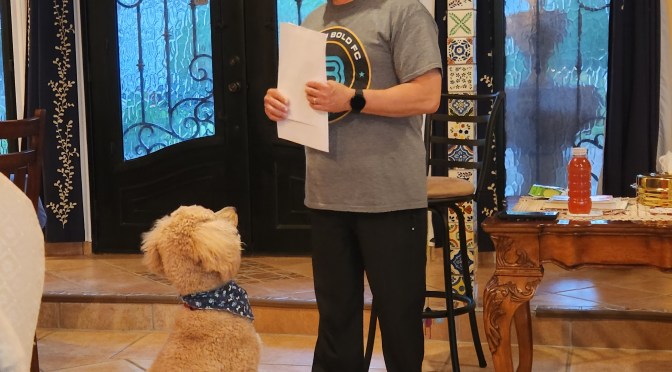
A disciple seeks to be like the master, whom they imitate and then become something worthy of imitation. The process requires studying what is said and shown. My dog Aragon does this. When I leave the room, he waits and watches in earnest for my return. He stares intently when I’m with him, waiting for the next praise or instruction. So, he was easy to train. Listen. Watch and wait. Imitate. We should be like Aragon in our relationship with God. How? Always listen and watch, waiting on the movement of the Holy Spirit, biblical instructions, or admonishments from other Christ followers. Let’s examine the “listen, wait, imitate” rhythm from a biblical perspective.

The master’s voice. Read 1 Kings 19:4-18, and you’ll find a depressed Elijah on the run from Ahab. In verses 10 and 14, he cried to the Lord, “Am I the only one?” He didn’t respond through a great wind and earthquake. He didn’t answer through a fire. Instead, He replied gently, softly. In a small, still voice, the Lord God almighty whispered: “No! Seven thousand others are like you!” (1 Kings 19:11-18).

Aragon knows me. He knows my voice and responds accordingly. I speak, he listens. I go, he goes. He follows because he knows and trusts me. Similarly, Jesus knows those who belong to Him: “My sheep hear My voice, and I know them, and they follow Me; and I give eternal life to them . . .” (John 10:27-28). Besides listening, the obedient to God sometimes must wait patiently for a deed, a word.

Just wait! Aragon will wait patiently for hours for me. When he sees me, he’ll leap into action. The wait is worth it! The same holds for God’s children. The Psalmist wrote this: “I wait for the Lord, my soul waits, and in his word I hope” (Psalm 130:5, ESV). We often wait for a word of instruction, admonishment, or comfort from the Lord through His Spirit, scriptures, or other followers of Jesus.

Imitate and replicate! Training Aragon was easy. He listened, watched, and repeated what he saw. He even tries to make the sounds I make when we play. As imagers of God, we, too, are meant to imitate what we see and hear related to Him and repeat the words and behavior. The apostle Paul confirms it: “Be imitators of me, just as I also am of Christ. Now I praise you because you remember me in everything and hold firmly to the traditions, just as I delivered them to you.” (1Corinthians 11:1-2).

Listen for the Master’s voice even if you must wait. Then, just like Aragon with me, imitate what you learn and become something worthy of imitation by others. What’s next?  Let’s reverse today’s upside-down church model with a church of house churches. While waiting, remember that God wants your loyalty, not your religion.

Blessings and peace,

Dr. Ron Braley, MDiv, DMin.