
Tag Archives: god

Find Joy in Anything!

Troubles come and go. Well, it seems that they mostly come these days. And then there’s work … and chores. Plenty of them! During all that, peace of mind and cheerfulness can be ever elusive. But it doesn’t have to be that way! Things that can make us unhappy don’t have to drag us down. Believe it or not, we can be cheerful amidst them. Even mundane tasks like doing dishes, mowing the lawn, or housework can be done cheerfully and for God’s glory through pure joy. What is ‘joy,’ and how is that possible?

Joy is a cheerfulness that comes from within. It manifests as calm delight or great gladness. Unlike happiness, which depends on external forces, joy’s cheerfulness is generated deep within our souls. Its power enables us to rejoice amidst trouble, as we see in James 1:2 (“Consider it all joy, my brethren, when you encounter various trials”). The apostle echoes a similar sentiment in 2 Corinthians 7:4. Rejoicing during hardships might seem impossible, but God’s Spirit enables this ability.

He gives His Spirit to everyone who devotes to Him by ‘making Jesus Lord’ (Romans 10:8-10). That Spirit comforts us. Heals us. Illuminates so we see truth and life. He also produces joy when we walk with Him, as seen in Galatians 5:22 (“But the fruit of the Spirit is love, joy, peace, patience, kindness, goodness, faithfulness, gentleness, self-control …”). When we allow the Spirit to change and guide us, anything good is possible—even being of good cheer in the middle of trouble or tedious chores. Catherine of Siena, a 14th-century theologian, taught much about this.

She stressed that we could (and should) find joy in everyday tasks, thinking of them as acts of worshipful service. To her, daily duties should be a form of devotion; “even the most mundane tasks are opportunities to express love for God.” Joy can be found even in the smallest or most mundane task, “considering nothing too little when done for God.” How can we do this practically?

First, remember that God gave you life; every breath and act belongs to Him. Therefore, we can imagine that everything we do is for Him in some way. Second, the transforming power of God’s Spirit changes how we look at chores or hardship—our minds are renewed when we are in harmony with Him. Finally, turn boring stuff into challenges; congratulate yourself for accomplishing them or persevering through trials and trouble.

Summary. You can be joyful—of good cheer—during trouble or while doing boring tasks through the mind-transforming Spirit of God and approaching those situations differently. So, where will we go next? Let’s explore “Jesus in the Underworld” as I correct faulty thinking and traditions about what Jesus did when He was in the earth for three days before His resurrection. Until then, walk by God’s Spirit and find joy in anything, even the mundane!

God’s blessings and peace, Dr. Ron Braley, MDiv, DMin.

What’s Your Story?

Mention the need to evangelize their faith, and Christians tend to freak out. They imagine having to go door to door handing out pamphlets and telling people about a Jesus they don’t often know how to verbalize. Evangelism isn’t meant to be this way. Instead, we’re to organically present the Kingdom of God through Holy Spirit-fueled actions and stories. Here are a couple of examples:

 [Jesus] said to her, “‘Go, call your husband and come here.” The woman answered and said, “I have no husband.” Jesus said to her, “You have correctly said, ‘I have no husband’; for you have had five husbands, and the one whom you now have is not your husband; this you have said truly.” The woman said to [Jesus], “Sir, I perceive that You are a prophet.” … “So the woman … went into the city and said to the men, Come, see a man who told me all the things that I have done …” (John 4:16-19; 4:28-29)

And a leper came to Jesus, … saying, “If You are willing, You can make me clean.” Moved with compassion, Jesus stretched out His hand and touched him, and said to him, “I am willing; be cleansed.” Immediately the leprosy left him and he was cleansed. … [and he] went out and began to proclaim it freely and to spread the news around, to such an extent that Jesus could no longer publicly enter a city, but stayed out in unpopulated areas; and they were coming to Him from everywhere. (Mark 1:40-45)

Your experiences are your evangelism; no one can refute what God has done for you and through you. So, use what you know to introduce the Kingdom to those who need to meet Him. As you walk by the Spirit God has given you, verbalize your faith meaningfully. In other words, tell about your experiences and the Kingdom in speech and actions the unchurched will understand; meet them where they are. Don’t use ‘Christianese’ or words even most Christians don’t understand, like ‘propitiation’ or ‘sanctification.’ Your defense for your faith—your ‘elevator pitch,’ doesn’t even have to mention a God or Christ at first, which the hearer likely won’t know or understand.

Here’s a brief example: “I was a drunk. I’d lost everything. But in my darkest moment, I learned about the creator of everything, including you and me, who loves us so much and wants us to have a relationship with Him and be healed. He has changed my life, and, as you see, I’m a new person. You can be, too! Let me tell you how …”

Summary. God has worked with you and through you. Just act accordingly and talk about those things. Use what you know to introduce God to those who need Him. Next time, let’s learn how to find joy in anything. Meanwhile, share your Kingdom experiences—first by action, then by word if necessary.

God’s blessings and peace,

Dr. Ron Braley, MDiv, DMin.

When Love Grows Cold …

In my last article, I taught that real, unconditional, godly love is “doing the right thing no matter how we ‘feel.’” It doesn’t come and go with an emotional or sexual wind; it’s constant and actionable. That’s God’s love for us, as proved by Jesus’ sacrifice and resurrection from the dead to pay our debt to the Creator and give us hope. Similarly, we do real, unconditional love because God first loved us (1 John 4:19). How can we summarize and do real love?

True love seeks the highest good in others. It is always actionable and even translated occasionally as ‘charity.’ For instance, the apostle Paul mentions these actions (or lack of certain actions) in a not-all-inclusive true love list (1 Corinthians 13:4-6): “Love is patient, love is kind and is not jealous; love does not brag and is not arrogant, does not act unbecomingly; it does not seek its own, is not provoked, does not take into account a wrong suffered, does not rejoice in unrighteousness, but rejoices with the truth.”

Furthermore, Jesus gave the following examples when teaching about last-days judgment in Matthew 25:31-40: “Then the King will say to those on His right, ‘Come, you who are blessed of My Father, inherit the kingdom prepared for you from the foundation of the world. For I was hungry, and you gave Me something to eat; I was thirsty, and you gave Me something to drink; I was a stranger, and you invited Me in … Truly I say to you, to the extent that you did it to one of these brothers of Mine, even the least of them, you did it to Me.’” In other words, do love and live.

Still, Jesus said true love will ‘grow cold’ in the last days: “At that time many will fall away … Because lawlessness is increased, most people’s love will grow cold. But the one who endures to the end, he will be saved.” (Matthew 24:10-13) What does that mean? What would, or does, cold love look like?

If true love = action, cold love is the opposite: diminishing charity, patience, self-control, truth, etc. Look around, and this is the predominant posture in America, which has earned the title of “the most self-centered nation in the world.” What will be the end for the loveless? “Then He will answer them, ‘Truly I say to you, to the extent that you did not do it to one of the least of these, you did not do it to Me.’ These will go away into eternal punishment …” (Matthew 25:45-46)

Summary. True love seeks the highest good in others through actions like charity and self-control. Cold love deceives, deprives, and hurts others. What’s next? Let’s explore evangelism in “What’s Your Story?” In the meantime, don’t be lukewarm in your zeal for God and don’t let your love run cold! The results could be devastating!

God’s blessings and peace,

Dr. Ron Braley, MDiv, DMin.

Godly Superstars on the Fringe

God created people and does amazing things with and through them—not necessarily the pristine, wealthy, or popular, but often the poor, despised, and unexpected. Matthew or Zacheus, presumably greedy Jewish folk who collected taxes for the Romans, may come to mind. This article isn’t about them. Instead, I want to introduce you to God’s superstars on the fringe who weren’t Hebrew or Israelite but pagans, some harlots and warmongers. Yet, God used them to draw creation back to Himself. Let’s take a look at a few, starting with Job.

Job. This righteous man, perhaps an Edomite, lived at around 2,000 BCE. He honored God with all he had and did. And God found favor in him as a result: “The LORD said to Satan, ‘Have you considered My servant Job? For there is no one like him on the earth, a blameless and upright man, fearing God and turning away from evil.’” (Job 1:8). God presents him as an incredible model of perseverance and reverence.

Melchizedek. This pagan king of Salem reigned in around 2,000 BCE in the days of Abraham. Despite not being in the lineage of Abraham to Jesus (and not from the Jewish priestly line!), he was considered a “priest of God Most High” (Genesis 14:18). You can read all about him and Jesus’ comparison to him in Hebrews chapters 5-7 (FYI: Melchizedek was a real king/priest, NOT Jesus pre-incarnate!).

Tamar. This stubborn Aramean Gentile lived in the House of Judah in about 1,600 BCE. When she was betrayed by the King, she pretended to be a prostitute so he’d sleep with her and produce an heir. Pushing for her rights in this way proved her loyalty to Judah and earned her a place in Jesus’ lineage.

Rahab. This Canaanite prostitute lived in Jericho at around 1,400 BCE. Regardless of her occupation, her faithfulness earned her a place in biblical history when she hid and protected Israelite spies. Her works by faith also earned her a place in Jesus’ lineage: she was King David’s great-great-grandmother.

Ruth. This Moabite woman lived around 1,300 BCE and was King David’s great-grandmother. She was an incredibly loyal and kind woman who stayed by her widowed mother-in-law, helping her return to Israel, where Ruth became part of Jesus’ lineage.

Cornelious. Our final godly ‘superstar on the fringe’ is Cornelius (Roman Centurion from the Italian Cohort), who lived around 30 CE. His claim to fame? This pagan soldier prayed to the one true God and then obediently summoned Peter, who preached the good news of God’s Kingdom to him and his family. Cornelious is likely the first converted Gentile.

Summary. God will have His way—sometimes through the least of us, those on the fringe of society or culture. Next time, we’ll examine what it looks like “When Love Runs Cold.” Meanwhile, remember that God can use you even if you might be ‘on the fringe.’

God’s blessings and peace,

Dr. Ron Braley, MDiv, DMin.

Apocalyptic Poster Children

I’m an ‘end times’ dude. Not an imperious date-setting soul, but someone interested in teaching people easy-to-understand truths about the end of this age and all it comprises. I published “Finding the End of the World” to do just that in 2011. Here, I’d like to clear up confusion about Revelation’s letters to seven churches to address real people with real problems.

Clearing the fog. Some teach that biblical history is divided into eras (dispensations) representing God’s interaction with people. Furthermore, historical dispensationalists insist that the seven churches of Revelation (chapters two and three) represent particular church ages from the apostles to Christ’s return. Don’t buy into it. The letters contain admonishments and praises to existing churches—nothing more, nothing less, although we can learn from them. Let’s begin our journey by introducing John’s Revelation and the letters.

Introduction to the Revelation. In about 95 CE, Emporer Domitian exiled John (and his scribe Prochorus) to Patmos. They penned the Revelation within two years until Emporer Nerva freed them. What was unveiled? Last-day events from increasing false Christs, war, famine, and earthquakes to great judgment and the new age. Chapter one introduces the Revelation, chapters two and three contain instructions to seven of John’s Asia Minor churches, chapters 4 and 5 prepare to unveil the future, and chapters 6:1 through 22:5 detail a future hinted at by Jesus 70 years beforehand (e.g., Matthew 24-25). Now, the letters.

The Letters.

  • Ephesus. This ‘great’ city had an assembly that refused to follow heretics but whose love for God, Christ, and each other had grown cold.
  • Smyrna. This ‘loveliest’ city was home to prideful Christian-persecuting Jews (‘Synagogue of Satan’). Saints would have to persevere through a short tribulation to inherit God’s Kingdom.
  • Pergamum. Called “Satan’s throne,” it was the pagan worship center of Asia. Heresies and immorality abounded, as did self-indulgence. Jesus said, “Change!”
  • Thyatira. True Christians refusing paganism and immoralities couldn’t buy and sell in the marketplace, although prophetess Jezebel misled some to compromise. Others standing fast would avoid God’s future wrath.
  • Sardis. A legendarily wealthy and degenerate city with a dead church (except for a few). Overcome or be erased from the Book of Life!
  • Philadelphia. City of brotherly love, city of earthquakes … and another Synagogue of Satan against the Church. Believers would face tribulation but be empowered by Jesus to persevere.
  • Laodicea. “Lukewarm Laodicea” existed between hot and cold springs, producing undesirable lukewarm water. It was wealthy, self-centered, indifferent, and lukewarm in faith. Jesus to Laodicean Christians: “Overcome and rule with Me!”

Summary. God gave Jesus warnings and commendations to send to overseers of seven Asia Minor churches. They were contained in seven letters (Revelation chapters three and four). The immoral would suffer God’s wrath, while overcomers would inherit God’s Kingdom. Read and heed! What’s next? Let’s explore godly superstars on the fringe. In the meantime, be like the assemblies of Smyrna or Philadelphia or suffer the consequences.

God’s blessings and peace,

Dr. Ron Braley, MDiv, DMin.

A Receding Sea of Gray

“I’ve seen your future!” I thought as I looked across a congregation and its ‘sea of gray’ I taught about a year ago. Without revitalization, it would rapidly diminish to a point of no return, and the doors close for good. This was my experience at Northview Christian Church, once a thriving Christian community. It’s also the path of most Western mainline denominational churches. If you’re not Roman  Catholic or focused on attraction, you’re probably on your way out. What gives?

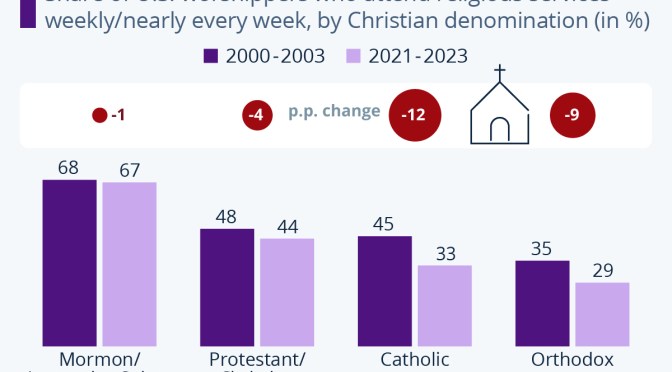
A diminishing sea of gray. Western Christianity declines at about 20% per year. Yet, most mainline denominational churches are full of the elderly, who are the backbone. They’re likely faithful and hard-working. But they’re dying. Although Western Christianity declines at about 20% a year now, the rate will likely decline sharply over the next decade as the population of the wise and faithful shrinks rapidly. Even if butts in the pews remain, the effect on Christendom will be crippling without these vital gray-headed souls.

Consequences. Our wise theological models and teachers are evaporating. Opportunities for church discipline for growth and correction (not punishment!) are disappearing. Who will lead the spiritually immature when they’re gone? Who will demonstrate how to effectively apply God’s words and ways? Here are several scriptures that soberly remind us their importance (NASB):

  • Leviticus 19:32. “You shall rise up before the grayheaded and honor the aged …”
  • Job 12:12-13. “Wisdom is with aged men … To Him belong counsel and understanding.”
  • 1 Peter 5:5. “You younger men, likewise, be subject to your elders …”

The cure. Listen to mature followers and put them to work as the Spirit has enabled! Learn from and imitate them (at least the Godly stuff)! That will create spiritually mature followers who can replenish the sea of gray and keep the churches healthy! But there’s more!

Understand that while the good news of God’s Kingdom brought near to humans doesn’t change, contexts do. Be incarnational and contextual, meeting communities and cultures where they are without comprising the message. Remember that the ‘little-t’ stuff like how we perform music, baptism, or Communion methods aren’t worth falling on a theological sword over! Remove religious barriers to reduce clergy-laity separation. Become relevant to today’s folks who can become tomorrow’s sea of gray even if dress or music needs to evolve. And remember to give your young and old alike opportunities to serve according to spiritual giftings.

Summary. Our fruitful and wise congregants are dying. So are our churches. Don’t let their legacy disappear and Western Christianity along with it: replenish the sea of gray by once again becoming relevant to local communities and training replacements. Next time, let’s explore something weird, useful, and last-days-ish: Apocalyptic Poster Children. Meanwhile, leave your bubble and step into someone else’s (with permission!) to make the Church more relevant and replenish a receding sea of godly gray.

God’s blessings and peace,

Dr. Ron Braley, MDiv, DMin.

Revisiting Thanksgiving

Family. Turkey. Stuffing. Gravy. Pies. Tums! There are so many things to be thankful for, and the Thanksgiving holiday is upon us! Expressing thanksgiving is good for our relationships and mental health. And it’s what God desires: “… in everything give thanks; for this is God’s will for you in Christ Jesus.” (1 Thessalonians 5:18). Although people have tended to be thankful, the formal holiday stems from the gratitude early Spanish and European settlers showed to the indigenous American Indians for feeding them and acclimating them to a new land and new ways.

It’s hard to say precisely when the first Thanksgiving occurred. One account pinpoints the autumn of 1621 when “at least 90 Wampanoag joined 52 English people at what is now Plymouth, Massachusetts, to mark a successful harvest.” Another group in Berkeley Hundred (now Virginia) celebrated their arrival to the new world as early as 1619. Supposedly, the meal consisted of scant oysters and ham. But they were thankful even without abundant turkey, ham, pie, cranberry sauce, etc. We find another, even earlier, Thanksgiving celebration in 1565 with the Spanish settlers and the Seloy tribe. But who established the official Thanksgiving holiday, and when?

The first Federal Congress passed a Thanksgiving Holiday resolution on September 28, 1789. Consequently, President George Washington proclaimed Thursday, November 26, 1789, a day for public thanksgiving. But President Abraham Lincoln made the holiday a regular, recurring event (the last Thursday in November) in 1863. Of course, commerce prevailed, and President Franklin D. Roosevelt moved Thanksgiving to the second-to-last Thursday of November in 1939 to lengthen the Christmas shopping season.

Regardless, we must always give thanks for everything that is benevolent and brings innocent joy, including each other, God’s provision and mercy, our jobs, and every breath we take. As a community, we must express thanksgiving for those who protect us. Decision-makers who govern deserve our thanks, too. And in our gratitude, we must show love and be thankful when we receive it. This is worship, and it brings healing and expresses our love for God while healing our relationship with Him.

Worship comprises ‘worth’ and ‘ship.’ It means to give worth to what we value. We express worthiness to God by acknowledging His protection, provision, salvation, comfort, grace, and mercy. How should we do this? By showing (not just telling!) gratitude. In other words, ‘being’ thankful through our actions. Purity. Prayer. Loving others as God loves. Sacrifice. Note how worship is full of action, not passivity.

Summary: Have a blessed Thanksgiving Holiday! Be thankful and enjoy the festivities. But don’t stop there: be grateful every day through your actions. In your gratitude for what you have received from God, give the same to others. Next time, I’ll share more about our diminishing Western Christianity and its evaporating sea of gray. Until then, give more than you receive.

Blessings and peace,

Dr. Ron Braley, MDiv, DMin.                                                                 
Growth Under Pressure: Rise & Fall of the Western Church

The Rise. Dr. Martin Luther King Jr. stated, “Change does not roll in on the wheels of inevitability, but comes through continuous struggle.” For the early Church, the struggle was between an ungodly world and Christ’s Kingdom. The tension brought Rome’s wrath, whose leaders murdered Christians and severely limited their ability to engage in commerce. Yet, Christianity grew at about 40% per year!

How? Christians understood that adversity is a natural part of the journey and that perfection and hope emerge (Romans 5:3-5; James 1:2-4). They took the mandate to image God through imitation and replication seriously. For the compassionate, newly transformed, there was no other way. Being a costly faith and valuable religion also contributed to growth. Dietrich Bonhoeffer explains this well in The Cost of Discipleship: “Costly grace is the treasure hidden in the field; for the sake of it, a man will go and sell all that he has. … Such grace is costly because it calls us to follow… It is costly because it costs a man his life, and it is grace because it gives a man the only true life. It is costly because it condemns sin, and grace because it justifies the sinner. Above all, it is costly because it cost God the life of his Son.”

The Fall. Conversely, Western Christianity declines by about 20% each year. Only 5% of churces make disciples who make disciples, and a mere 15% of most memberships live obediently. Spiritual lethargy through passivity has removed tension and stunted growth. Casting Crowns’ song Start Right Here states things well: “We want our coffee in the lobby. We watch our worship on a screen. We got a Rockstar preacher who won’t wake us from our dreams. We want our blessings in our pocket. We keep our missions overseas. But for the hurting in our cities, would we even cross the street?”

Spiritual lethargy and focusing on ‘nickels and noses’ produce a cheap grace that embraces comfort but opposes growth (in numbers or maturity!). Deitrich Bonhoeffer’s take: “Cheap grace means grace sold on the market like cheapjacks’ wares. The sacraments, the forgiveness of sin, … can be had for nothing. … Cheap grace is the preaching of forgiveness without requiring repentance, baptism without church discipline . . . Cheap grace is grace without discipleship …”

The Cure. Growth would require a shift that naturally creates tension between our ungodly world and Christ’s Kingdom introduced through Christ-followers. No more immoralities. No more business-minded attractional buildings, programs, or religions—just discipleship-born imitation, replication, and growth out of adversity.

Summary. The early Church grew astoundingly because of discipleship’s imitation, replication, and growth from persecution. Today’s Western Church will die if it doesn’t do the same. The Thanksgiving holiday is coming, so let’s explore it next time. Until then, fight the good fight, struggle victoriously, and embrace change.

God’s blessings and peace,

Dr. Ron Braley, MDiv, DMin.

Unify to Magnify – Part Three!

In part one, I wrote that God wants His children unified as one diverse but single Body. In part two, I explained why this is primarily absent today: Human religion. Can we return to an authentic Christianity that shared Communion elements, prioritized devotion over format, and unified despite minor differences? Maybe. Let’s begin our reunification journey by separating essential from non-essential beliefs and practices.

Big-T versus little-t truths. Some things are absolute ‘Big-T’ truths. For instance, a Son of God was sacrificed as a son of man to reconcile us to God. He arose three days later, giving us hope. But, how we practice commemorating Jesus’ death and our new covenant with God is a subjective ‘little-t’ thing. The same holds for how we’re baptized or praise God. Don’t get your underwear in a twist over these things, but understand and appreciate the differences. This requires education.

Education. We shun what we don’t understand. Education can resolve this. What Big-T truths should we stick to? Why do some churches practice little-t things like baptism, Communion, or praise differently? We should know. Some Christians use icons or pictures to focus prayers and worship. You might assume they’re worshipping idols if you don’t know the truth. Additionally, people and churches can contribute to reunification.

People. Here are things individuals can do to reduce disunity and be better ambassadors to God’s Kingdom:

  • Become educated: Understand where religious traditions came from and prioritize Christ’s Law of Love above them. Engage others in dialogue about beliefs and practices.
  • Appreciate little-t differences, and don’t shun people for them.
  • Participate in community love efforts.
  • Help with community disaster recovery efforts.

Churches. Disunity is fixed here! Prioritize reunification and Christian community by doing these things:

  • Be transparent about your traditions and prioritize biblical, not human, practices and Christ’s Law of Love.
  • Hold community training in Big-T stuff such as biblical languages, bible study principles, history, and the Scriptures.
  • Facilitate community praise events.
  • Facilitate community evangelistic efforts (focusing on Big-T fundamentals!).
  • Encourage dialogue with Christians outside your church; perhaps have speakers share their practices to break down barriers.
  • Collaborate on community love and recovery efforts.

Unity examples. Here are examples of unification and love over religion:

  • A local Thursday night home-based fellowship comprises Catholic, Baptist, Church of Christ, and non-denominational members who enjoy prayer, Communion, testimonies, and interactive learning. We also charitably love each other and, collectively, the community.
  • Multi-denominational pregnancy centers that show Christ’s love while working to mitigate abortion.
  • Multiple churches serving the community through Shepherd’s Heart.
  • The earliest Church, diverse but loving and irreligious.

Summary. Churches must unite in Big-T truths while enjoying diverse little-t practices through education and love. What’s next? Learn how original Christianity as a costly faith flourished because of godly modeling and endurance under incredible pressure—not praise bands, light shows, motivational speakers, or other consumeristic attractions. Meanwhile, be an active and collaborative member of Christ’s Body.

God’s blessings and peace,

Dr. Ron Braley, MDiv, DMin.

Unify to Magnify – Part Two!

In part one, I wrote that God wants His children unified as one diverse but single Body, sharing spiritual gifts, talents, and treasures. Metaphoric eyes, ears, feet, and hands, all different but working together to accomplish God’s desires. However, the Church has been drawn, quartered, and segregated. The ‘arms’ congregate and despise the ‘legs;’ the ‘eyes’ deprive the ‘hands’ of vision.  And we relegate many to hell because of differing religious practices and beliefs. This is a far cry from the original love and simplicity that characterized the Church, however. What happened?

Hands down, the root cause is people. We differ in beliefs and experiential pursuits, and like-minded folks assemble to create and share common traditions and practices. This is the heart of culture—faith, in our case. Let’s focus on cultural differences in how we praise God and engage religious theories and experiences.

Cultural Differences: Praise. Many people honor God in song or dance. Some prefer a gospel genre, while others swear that musical instrumentation is of the devil. Others enjoy hymns, while another church uses contemporary popular songs during services. Regardless, differences in how we praise God are primarily matters of personal taste and don’t generally pose a divisive threat to Western Christianity. Religious differences are another matter.

Cultural Differences: Religion. This presents the Body as ugly to the yet-to-be-churched, who marvel at our disunity. There are many Western Christian splinters, some prompted by one person’s beliefs in the fourth to fifth centuries CE. A Stoic by nature, he spawned new and contentious religious theories like original sin spread through sex and predeterminism (you have no hand in your final spiritual destination). Other church fathers rejected the latter theory, which was revitalized and formalized in the Protestant Reformation. Also, contention in baptism and communion remains.

  • Baptism. Water immersion is a public sign of intentional, saving devotion to God. One early Christian guide suggests cold, running water. Otherwise, warm or standing water is fine. None of the above? Spit! Now? We divide over infant baptism, whether water saves, and baptism’s effectiveness should any body part miss the water.
  • Communion. Early Christians remembered Christ’s sacrifice and a new covenant with God by sharing wine and bread, often as part of a ‘love feast.’ Now? We divide over how and where to take it, who can serve it, and how it works. You’ll be excommunicated in some circles if you share Communion elements with believers outside your church. My, how we’ve abandoned authentic and intimate sharing among believers for religion!

Summary. Christians congregate and isolate with like-minded people, often praising God through diverse musical traditions. However, the most divisive force is the different beliefs implemented by humans, not God. Religious contention has greatly splintered Christ’s Body, but that’s not God’s desire! In part three, we’ll explore ways individuals and churches can unify despite differences in practices and non-essential beliefs.

Blessings and peace,

Dr. Ron Braley, MDiv, DMin.