Tag Archives: religion

Dunkin’ Do-Nots

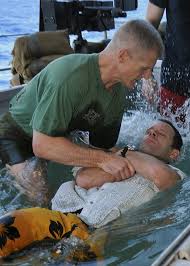
I found the Sacrament (or Ordinance) of Baptism fascinating, and it reminds me of so many questions and internal friction spawned by this simple and yet critical Christian function! Dip or dunk? Necessary for salvation? Public or private? Prescriptive or Descriptive?

Baptism was prescribed from the beginning and had a presence in ancient Israel and pagan rituals, but what purpose does it serve for contemporary Christianity? Humanmade doctrine varies, and you’ll find it an act that imparts grace on the newly-born and old alike for the sacramental-minded. And there, a sprinkle is likely to be just as effective as a complete dunking as long as an individual ordained in the particular sect or denomination performs the rite. On the other hand, you’d be more likely to find baptism an ordinance of immersion and more of a symbolic act of burial and resurrection than an impartation of Godly grace if you’re of a Protestant persuasion. Which is correct, and does the function impact the salvation of those being doused or dunked?

What the Bible makes clear: Baptism in our New Testament context is meant to represent the forgiveness of sin and symbolize rebirth in Christ. It provided accountability, at least in the beginning, through the public profession of faith – often in the face of possible martyrdom. But that the ritual is necessary for salvation is unlikely; that idea may be part of a misunderstanding of salvation and a focus on praxis as opposed to the heart.

First of all, and contrary to our contemporary desire, the Bible teaches us that salvation – a rescuing by definition – will be a stay from God’s future wrath (e.g. 1Peter 1:3-5). Second, Jesus had a lot to say about our heart (intent) and the idea of choosing and following. And, Paul seems to corroborate the concept of persevering in our covenant with God. Finally, the Bible and this week’s lectures confirm that our confession of choice is synonymous with a ‘dying to self,’ and dying is indeed necessary before burial and resurrection baptism symbolizes. So, while it may not be directly related to salvation itself, baptism is meant to be a visible sign (not unlike circumcision in God’s covenant with Israel) that someone has ‘counted the cost’ and chosen to covenant with God. In other words, the ‘washing’ implies an educated commitment.

A common practice in the early church (still done in some Christian circles today) was to spend perhaps many months training a new ‘believer’ before baptism to ensure they understood what they were about to do. Contrast the practice with our Western tendency to get someone to say a ‘sinner’s prayer’ and seek baptism with little or no knowledge of the God with whom they’re supposed to covenant!

So, dunk, dip, or sprinkle as long as the recipient ends up as more than just wet!

Blessings,

Rb

Keep an eye out for “Finding Answers to Stuff Churches Don’t Discuss!” scheduled for a mid-20167publication. There, you’ll find roughly 60 topics related to daily life (such as sex, religion, finances, tattooing, and everything in between!) along with practical application of God’s guidance for navigating those difficult waters!

And, for a very comprehensive and detailed study of the very important topic of God’s judgment to come and being rescued from it, feel free to read my 2011 guide titled, “Finding the End of the World” available at Amazon, Barnes and Noble, and from www.ronbraley.com in paper and e-book formats. In the guide, you’ll find roughly 500 pages of building blocks to help you do your own complete and unbiased study based on Scripture and history!

Evangelism: When enough is enough . . .

I’ve often witnessed someone focusing on trying to maintain what ends up being a tumultuous and unhealthy relationship because they believe they’ll eventually ‘lead the other person to Christ’. In business, this could be considered a bad ROI – Return on Investment – of the resources spent trying to ‘save’ someone.
We’re not responsible for saving people, only for passing on the good news of salvation from God’s wrath to come. The receiver must choose what to do with the information and any prompting by the Spirit of God. Granted, evangelizing that good news will benefit from relationships; however, you may reach a point when ‘enough is enough’ – especially if the relationship is emotionally or spiritually harmful to you. And, your time may be better spent in moving forward in telling others the good news and discipling those who become willing participants in a covenant with God through the Christ.

Then He said to His disciples, “The harvest is plentiful, but the workers are few. Therefore beseech the Lord of the harvest to send out workers into His harvest.” —Matthew 9:37-38.

“Whoever does not receive you, nor heed your words, as you go out of that house or that city, shake the dust off your feet.” —Matthew 10:14.

“Do not give what is holy to dogs, and do not throw your pearls before swine, or they will trample them under their feet, and turn and tear you to pieces.” —Matthew 7:6.

Keep an eye out for “Finding Answers to Stuff Churches Don’t Discuss!” scheduled for a mid-2015 publication. There, you’ll find roughly 60 topics related to daily life (such as sex, religion, finances, tattooing, and everything in between!) along with practical application of God’s guidance for navigating those difficult waters!
And, for a very comprehensive and detailed study of the very important topic of God’s judgment to come and being rescued from it, feel free to read my 2011 guide titled, “Finding the End of the World” available at Amazon, Barnes and Noble, and from http://www.ronbraley.com in paper and e-book formats. In the guide, you’ll find roughly 500 pages of building blocks to help you do your own complete and unbiased study based on Scripture and history!

The Church: Then and Now

People have asked me several times to explain how today’s churches compare to the first-century Church. Good things can come from the Christian culture and church business model we experience today (some missions, some training, some benevolence, and governance).  However, they’re limited in scope and pale in comparison to the overshadowing abuse of Scripture, lack of discipleship training, and overarching concern about supporting the business of church.

Jesus intended for us to do three things per His commandments: treat God the Father appropriately, treat our fellow humans charitably, and spread the good news of salvation. This is what the early Church did despite great persecution and poverty, and they succeeded by sharing resources and using spiritual gifts. Everyone was on the same functional level and they filled roles as the Spirit of God enabled them. Today, churches are segregated business units with paid professionals, organizational charts, and exorbitant capital and operational expenses. The focus has, therefore, shifted from evangelism and charity to managing the business, and attracting and appeasing consumers of religious and emotional experiences.

A picture is certainly worth a thousand words, so you’ll find below a table that summarizes Church roles and responsibilities. It includes a comparison of the ancient and modern Churches and related Scripture references.


Function or Role

1st-Century Church

Today’s Church

Related Scripture

       
Evangelism One of three critical functions; To be done by all Not a priority or typically nurtured; Related to a lack of discipleship and training efforts Psalms 96

Matthew 28:19-20

Mark 16:15

Luke 24:47

Acts 1:8

Romans 1:16 and 10:12-15

2Corinthians 5:18-20

Benevolence: Brothers & Sisters in Christ Critical for survival; benevolence is one of three critical functions of the Church; we’ll be judged by Jesus for our involvement;  To be done by all Not a focus for resources or activities (only about 1% of funds collected) Matthew 25:41-43

Acts 2:45, 4:32-35, and 6:1-5

Romans 12:5-13

1Corinthians 16:1-5

2Corinthians 8:10-20 and 9:1-5

Ephesians 4:28

James 2:13-17

1John 3:14-18

Benevolence: Traveling Evangelists Critical for survival; benevolence is one of three critical functions of the Church Some missionary support; most care of missionaries/traveling evangelists comes from individual followers of Jesus outside normal ‘tithes’ Acts 20:34-35

Romans 16:1-2

1Corinthians 9:1-14

2Corinthians 11:7-9

Philippians 4:14-19

Titus 3:13-14

3John 1:7-8

Discipleship One of three important functions of the Church (the other two: benevolence and evangelism); done by those more mature in their faith Not generally a priority as evidenced by Scriptural illiteracy and lack of programs (95% or more of those who say they believe in Jesus don’t read the Bible or regularly engage in study) Matthew 28:19-20

Romans 6:17 and 10:17

Colossians 1:28 and 3:16

2Timothy 3:16

Titus 1:9 and 2:3

Hebrews 5:12-14

Governance Oversight through mature Christians and Bishops (overseers) Multiple levels of responsibilities; incumbents are usually paid Acts 14:23;

1Corinthians 12:27-29

1Timothy 3:1-13 and 5:17

Fund Raising Done for benevolence without mandate or limit Done through threats of robbing God (OT Scriptural misuse) or promises of prosperity; Funds are used primarily for salaries, real-estate, or related business expenses See ‘Benevolence’ scriptures above
Worship Outward; participatory More inward; audience and performance-based Ephesians 5:19

Colossians 3:16


Which ‘Church’ do you belong to?