Tag Archives: Christianity

A Receding Sea of Gray

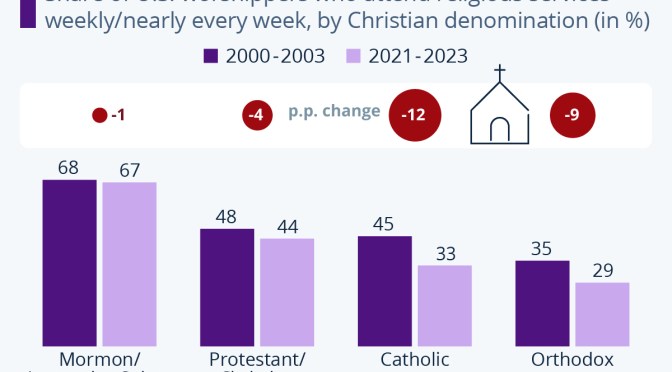
“I’ve seen your future!” I thought as I looked across a congregation and its ‘sea of gray’ I taught about a year ago. Without revitalization, it would rapidly diminish to a point of no return, and the doors close for good. This was my experience at Northview Christian Church, once a thriving Christian community. It’s also the path of most Western mainline denominational churches. If you’re not Roman  Catholic or focused on attraction, you’re probably on your way out. What gives?

A diminishing sea of gray. Western Christianity declines at about 20% per year. Yet, most mainline denominational churches are full of the elderly, who are the backbone. They’re likely faithful and hard-working. But they’re dying. Although Western Christianity declines at about 20% a year now, the rate will likely decline sharply over the next decade as the population of the wise and faithful shrinks rapidly. Even if butts in the pews remain, the effect on Christendom will be crippling without these vital gray-headed souls.

Consequences. Our wise theological models and teachers are evaporating. Opportunities for church discipline for growth and correction (not punishment!) are disappearing. Who will lead the spiritually immature when they’re gone? Who will demonstrate how to effectively apply God’s words and ways? Here are several scriptures that soberly remind us their importance (NASB):

  • Leviticus 19:32. “You shall rise up before the grayheaded and honor the aged …”
  • Job 12:12-13. “Wisdom is with aged men … To Him belong counsel and understanding.”
  • 1 Peter 5:5. “You younger men, likewise, be subject to your elders …”

The cure. Listen to mature followers and put them to work as the Spirit has enabled! Learn from and imitate them (at least the Godly stuff)! That will create spiritually mature followers who can replenish the sea of gray and keep the churches healthy! But there’s more!

Understand that while the good news of God’s Kingdom brought near to humans doesn’t change, contexts do. Be incarnational and contextual, meeting communities and cultures where they are without comprising the message. Remember that the ‘little-t’ stuff like how we perform music, baptism, or Communion methods aren’t worth falling on a theological sword over! Remove religious barriers to reduce clergy-laity separation. Become relevant to today’s folks who can become tomorrow’s sea of gray even if dress or music needs to evolve. And remember to give your young and old alike opportunities to serve according to spiritual giftings.

Summary. Our fruitful and wise congregants are dying. So are our churches. Don’t let their legacy disappear and Western Christianity along with it: replenish the sea of gray by once again becoming relevant to local communities and training replacements. Next time, let’s explore something weird, useful, and last-days-ish: Apocalyptic Poster Children. Meanwhile, leave your bubble and step into someone else’s (with permission!) to make the Church more relevant and replenish a receding sea of godly gray.

God’s blessings and peace,

Dr. Ron Braley, MDiv, DMin.
Growth Under Pressure: Rise & Fall of the Western Church

The Rise. Dr. Martin Luther King Jr. stated, “Change does not roll in on the wheels of inevitability, but comes through continuous struggle.” For the early Church, the struggle was between an ungodly world and Christ’s Kingdom. The tension brought Rome’s wrath, whose leaders murdered Christians and severely limited their ability to engage in commerce. Yet, Christianity grew at about 40% per year!

How? Christians understood that adversity is a natural part of the journey and that perfection and hope emerge (Romans 5:3-5; James 1:2-4). They took the mandate to image God through imitation and replication seriously. For the compassionate, newly transformed, there was no other way. Being a costly faith and valuable religion also contributed to growth. Dietrich Bonhoeffer explains this well in The Cost of Discipleship: “Costly grace is the treasure hidden in the field; for the sake of it, a man will go and sell all that he has. … Such grace is costly because it calls us to follow… It is costly because it costs a man his life, and it is grace because it gives a man the only true life. It is costly because it condemns sin, and grace because it justifies the sinner. Above all, it is costly because it cost God the life of his Son.”

The Fall. Conversely, Western Christianity declines by about 20% each year. Only 5% of churces make disciples who make disciples, and a mere 15% of most memberships live obediently. Spiritual lethargy through passivity has removed tension and stunted growth. Casting Crowns’ song Start Right Here states things well: “We want our coffee in the lobby. We watch our worship on a screen. We got a Rockstar preacher who won’t wake us from our dreams. We want our blessings in our pocket. We keep our missions overseas. But for the hurting in our cities, would we even cross the street?”

Spiritual lethargy and focusing on ‘nickels and noses’ produce a cheap grace that embraces comfort but opposes growth (in numbers or maturity!). Deitrich Bonhoeffer’s take: “Cheap grace means grace sold on the market like cheapjacks’ wares. The sacraments, the forgiveness of sin, … can be had for nothing. … Cheap grace is the preaching of forgiveness without requiring repentance, baptism without church discipline . . . Cheap grace is grace without discipleship …”

The Cure. Growth would require a shift that naturally creates tension between our ungodly world and Christ’s Kingdom introduced through Christ-followers. No more immoralities. No more business-minded attractional buildings, programs, or religions—just discipleship-born imitation, replication, and growth out of adversity.

Summary. The early Church grew astoundingly because of discipleship’s imitation, replication, and growth from persecution. Today’s Western Church will die if it doesn’t do the same. The Thanksgiving holiday is coming, so let’s explore it next time. Until then, fight the good fight, struggle victoriously, and embrace change.

God’s blessings and peace,

Dr. Ron Braley, MDiv, DMin.

Unify to Magnify – Part Three!

In part one, I wrote that God wants His children unified as one diverse but single Body. In part two, I explained why this is primarily absent today: Human religion. Can we return to an authentic Christianity that shared Communion elements, prioritized devotion over format, and unified despite minor differences? Maybe. Let’s begin our reunification journey by separating essential from non-essential beliefs and practices.

Big-T versus little-t truths. Some things are absolute ‘Big-T’ truths. For instance, a Son of God was sacrificed as a son of man to reconcile us to God. He arose three days later, giving us hope. But, how we practice commemorating Jesus’ death and our new covenant with God is a subjective ‘little-t’ thing. The same holds for how we’re baptized or praise God. Don’t get your underwear in a twist over these things, but understand and appreciate the differences. This requires education.

Education. We shun what we don’t understand. Education can resolve this. What Big-T truths should we stick to? Why do some churches practice little-t things like baptism, Communion, or praise differently? We should know. Some Christians use icons or pictures to focus prayers and worship. You might assume they’re worshipping idols if you don’t know the truth. Additionally, people and churches can contribute to reunification.

People. Here are things individuals can do to reduce disunity and be better ambassadors to God’s Kingdom:

  • Become educated: Understand where religious traditions came from and prioritize Christ’s Law of Love above them. Engage others in dialogue about beliefs and practices.
  • Appreciate little-t differences, and don’t shun people for them.
  • Participate in community love efforts.
  • Help with community disaster recovery efforts.

Churches. Disunity is fixed here! Prioritize reunification and Christian community by doing these things:

  • Be transparent about your traditions and prioritize biblical, not human, practices and Christ’s Law of Love.
  • Hold community training in Big-T stuff such as biblical languages, bible study principles, history, and the Scriptures.
  • Facilitate community praise events.
  • Facilitate community evangelistic efforts (focusing on Big-T fundamentals!).
  • Encourage dialogue with Christians outside your church; perhaps have speakers share their practices to break down barriers.
  • Collaborate on community love and recovery efforts.

Unity examples. Here are examples of unification and love over religion:

  • A local Thursday night home-based fellowship comprises Catholic, Baptist, Church of Christ, and non-denominational members who enjoy prayer, Communion, testimonies, and interactive learning. We also charitably love each other and, collectively, the community.
  • Multi-denominational pregnancy centers that show Christ’s love while working to mitigate abortion.
  • Multiple churches serving the community through Shepherd’s Heart.
  • The earliest Church, diverse but loving and irreligious.

Summary. Churches must unite in Big-T truths while enjoying diverse little-t practices through education and love. What’s next? Learn how original Christianity as a costly faith flourished because of godly modeling and endurance under incredible pressure—not praise bands, light shows, motivational speakers, or other consumeristic attractions. Meanwhile, be an active and collaborative member of Christ’s Body.

God’s blessings and peace,

Dr. Ron Braley, MDiv, DMin.

Unify to Magnify – Part Two!

In part one, I wrote that God wants His children unified as one diverse but single Body, sharing spiritual gifts, talents, and treasures. Metaphoric eyes, ears, feet, and hands, all different but working together to accomplish God’s desires. However, the Church has been drawn, quartered, and segregated. The ‘arms’ congregate and despise the ‘legs;’ the ‘eyes’ deprive the ‘hands’ of vision.  And we relegate many to hell because of differing religious practices and beliefs. This is a far cry from the original love and simplicity that characterized the Church, however. What happened?

Hands down, the root cause is people. We differ in beliefs and experiential pursuits, and like-minded folks assemble to create and share common traditions and practices. This is the heart of culture—faith, in our case. Let’s focus on cultural differences in how we praise God and engage religious theories and experiences.

Cultural Differences: Praise. Many people honor God in song or dance. Some prefer a gospel genre, while others swear that musical instrumentation is of the devil. Others enjoy hymns, while another church uses contemporary popular songs during services. Regardless, differences in how we praise God are primarily matters of personal taste and don’t generally pose a divisive threat to Western Christianity. Religious differences are another matter.

Cultural Differences: Religion. This presents the Body as ugly to the yet-to-be-churched, who marvel at our disunity. There are many Western Christian splinters, some prompted by one person’s beliefs in the fourth to fifth centuries CE. A Stoic by nature, he spawned new and contentious religious theories like original sin spread through sex and predeterminism (you have no hand in your final spiritual destination). Other church fathers rejected the latter theory, which was revitalized and formalized in the Protestant Reformation. Also, contention in baptism and communion remains.

  • Baptism. Water immersion is a public sign of intentional, saving devotion to God. One early Christian guide suggests cold, running water. Otherwise, warm or standing water is fine. None of the above? Spit! Now? We divide over infant baptism, whether water saves, and baptism’s effectiveness should any body part miss the water.
  • Communion. Early Christians remembered Christ’s sacrifice and a new covenant with God by sharing wine and bread, often as part of a ‘love feast.’ Now? We divide over how and where to take it, who can serve it, and how it works. You’ll be excommunicated in some circles if you share Communion elements with believers outside your church. My, how we’ve abandoned authentic and intimate sharing among believers for religion!

Summary. Christians congregate and isolate with like-minded people, often praising God through diverse musical traditions. However, the most divisive force is the different beliefs implemented by humans, not God. Religious contention has greatly splintered Christ’s Body, but that’s not God’s desire! In part three, we’ll explore ways individuals and churches can unify despite differences in practices and non-essential beliefs.

Blessings and peace,

Dr. Ron Braley, MDiv, DMin.

A McDonaldized Christianity

My doctoral dissertation addressed the sobering and declining state of Western Christianity. It explored how to motivate churchgoers to ‘get off their butts’ and become the disciples and disciple-makers they are to be. The journey led me to some interesting places, ideologically speaking. I discovered and wrote this about the consumeristic nature of much of the Church in the West: “The packaging of goods and spiritualities meant to appeal to consumers of religious experiences has been compared to McDonald’s processes. The product is a Happy Meal spirituality.” Churches can become “just one more dispenser of Happy Meals.” Now, this may not necessarily apply to your church, but I encourage you to read on and reflect.

According to author John Drane, the McDonaldized experience and church produce nominal believers. The format is appealing but empty, entertaining and spiritually tasty, but non-nutritious. John MacArthur says this about a possible contributor to the religious consumerism of faux Christians: “Provide non-Christians with an agreeable, inoffensive environment. Give them freedom, tolerance, and anonymity. Always be positive and benevolent. If you must have a sermon, keep it brief and amusing. Don’t be preachy or authoritative. Above all, keep everyone entertained.” Spiritual laziness is undoubtedly one side effect of this tendency.

A pre-packaged, one-size-fits-all McDonaldized approach to Christianity enables passivity. A person or team entertains a passive audience. Perhaps another person preaches at the same spectators. And the anonymity of which John MacArthur wrote, something of a Happy Meal toy, allows people to ‘slip out the back’ or avoid being held accountable for the lack of discipleship and spiritual growth. There’s another serious flaw in the McDonaldization process where it occurs in our Christianity: the loss of spiritual diversity and maturity.

Communities are born of shared values and traditions, and they are meant to meet the needs of their members. Christian communities were (and are) no exception—especially in the early days after Jesus’ ascension. Each person was required to help meet the physical needs of the Christian group (in other words, work!). They were also expected to contribute to spiritual formation, unity, and maturity based on God-given spiritual gifts and disciple-making abilities (Ephesians 4:11-16). But this kind of collective behavior must be tailored to the group’s specific needs; a pre-packaged McDonaldized Christianity that focuses on format over content and context just won’t do! It leaves little room for spiritual formation, active participation (versus passive observation), or movement by God’s Spirit.

Perhaps it’s time for a different kind of Christian diet—one that tastes good but is also spiritually nutritious. Maybe then we’ll get our butts out of the pews and behave like people who know about God AND who God knows (1Corinthians 8:3; Galatians 4:8-9). What’s next? Let’s uncover some of Jesus’ most excellent and applicable sayings in “Jesus Said What??” in next week’s article.

Blessings and peace,

Dr. Ron Braley

Western Christianity Versus the Borg

Jesus encouraged us to unshoulder our burdens and share them with Him (cf. Matthew 11:28); the Apostle Paul tells us to share our burdens with each other (cf. Galatians 6:2). And we are to use our resources to care for our Christian brothers and sisters. Nevertheless, we maintain a ‘great divide’ between congregation and clergy and each other relationally—indeed, a gap too wide to facilitate the transfer of our burdens to others or Christ. So they collect and weigh us down until we become the picture of spiritual unhealthiness and a questionable witness.

Meanwhile, individualism prohibits deep interpersonal relationships necessary for discipleship, accountability, or the discovery of needs. How do we narrow the gap and once again participate instead of dictating or isolating—through true community, not as a collective of individuals.

Scott Boren, the author of The Relational Way, points out that many sociologists have dubbed the United States as the most individualized society in human history. And statistics and trends show that the church congregations resemble the world. Therefore, churches tend to be made up of individuals who just happen to congregate simultaneously for the same religious experiences. Let’s have a bit of fun and look at something that looks more like we should: The Borg.

If you’re a Star Trek fan, you’ll likely know of the Borg – that single entity comprising many individuals functioning as that single consciousness; they exist to participate relationally for the betterment of the ‘one.’ Here are some helpful snippets from the Star Trek database (http://www.startrek.com/database_article/borg):

The Borg have a singular goal … This collective consciousness is experienced by the Borg as “thousands” of voices — they are collectively aware, but not aware of themselves as separate individuals. … Among the many advantages their collective consciousness affords them, the Borg hive-mind allows for instantaneous adaptations … with the power of their collective thoughts alone. … The hive-mind drones do not register as individual life-signs when scanned, only as a mass reading …

OK, so the Borg is fictional, and the Church isn’t. However, we could learn a profound lesson from the Borg concept: Participate to serve, not just experience; Grow to help, not for self-gain. Commune, not isolate, for godly love and discipleship.

In summary, God has equipped each of us to partner with others in His ministry of reconciliation. Rather than assemble as self-centered individuals with a shared desire to experience religion, let’s become more relational and community-minded to build trust for service and discipleship. Then, we can genuinely resemble the Borg … well, without all the tubes and stuff!

Next week, we’ll explore sin and the light that brings it out of the dark in my article Would Someone Please Turn on the Lights??

Blessings and peace,

Dr. Ron Braley

Christianity Before the baggage

We’re creatures of habit and tradition and may believe that Christianity today in America is like the original Church started by Jesus and perpetuated by the apostles. Actually, our Christianity and the Church Jesus began are miles apart. The Church was, at first, one organization made up of different personalities, gifts, and talents. The diversity ensured spiritual growth and success in ministry. Today, there are thousands of Christian denominations, cults, organizations, and fractures, and each attracts people who think, believe, and act alike (for the most part). The single, diverse Church rich in shared spiritual gifts, skills, and talents is gone. There are other differences too.

In the first couple of centuries, Christianity was a costly religion (and, therefore, valuable to its members) because of persecution and difficulty in buying or selling in the marketplace. Every member of the community was required to contribute to its welfare and worship. Everyone sang and prayed aloud. Everyone was expected to put their spiritual gifts to work (e.g., teaching, preaching, overseeing . . .). Church discipline for spiritual growth (not punishment!) was necessary and expected.

Today? We live in a world of free or cheap grace without much discipleship or accountability (write to me via the editor if you’d like to see the statistics!). Few are required to participate, and, therefore, about 85% of Christians are freeloaders who don’t contribute or engage in spiritual formation or discipleship. Oh – and discipline within the Christian community? Forget about it! Anyone who doesn’t like the message or accountability can just go to another church down the road. What about things like baptism and Communion?

Initially, Communion (the Lord’s Supper) was a simple, intimate, worshipful dinner between believers. No pomp or circumstance. Today, it’s practiced in many ways, from a simple, quick ceremony as part of a Sunday service to a deeply mystical encounter. Baptism is another practice that differs significantly today from its early Christian counterpart.

For the first several generations from Jesus, baptism was a simple ceremony that confirmed the convert’s devotion to God and entry into the universal Church. Interestingly, according to early accounts, the water could be cold or warm, running or still, or even spit (as a last resort). The point wasn’t the water but devotion. After a few generations from Jesus, heresies and false teachings abounded, as did weak faith that people left under persecution. To ensure that converts truly understood the covenant they were about to enter, the Church began intense training and observation—sometimes for as much as three years—before baptism. That’s not the case today—baptism requires nothing more than a verbal affirmation of faith, no demonstration.

You may be wondering about one more big difference: giving. I’ll need to write a separate article for that one! What about next week? We’ll compare and contrast individualism in American churches to Star Trek’s Borg.

Exploring God’s Will

We often want to know God’s will—especially for us. His will is what He wants to do, primarily to keep us from destruction through our transformation and eventual salvation from His wrath. It is His plan for humankind. In the process, He desires us to be obedient, rejoice, pray, and spread the good news to others. Although we tend to think God’s will is some glorious plan for our individual lives, we should instead focus on helping God see His plan for creation through to completion. That’s all well and good. But what exactly does ‘will’ mean?

The word in the ancient language implies choice, desire, pleasure, or an inclination. So, God’s will can be something He desires (as in Matthew 18:12-14) or His plan for humanity (i.e., Matthew 26:42 or John 6:37-40).

Here are some of God’s desires:

  • That all people are saved from His coming wrath (2Peter 3:9)
  • Obedience, not legalism (Matthew 9:13)
  • Our good works, done because of our faith (1Peter 2:13-16)
  • That we rejoice and pray continuously (1Thessalonians 5:16-19)
  • That we proclaim the good news of His Kingdom & make disciples (Matthew 28:19-20)

What are some benefits of partnering with God to accomplish His desires?

  • Redemption and forgiveness; the reward of everlasting life (John 6:40; Ephesians 1:5-13; Hebrews 10:35-36)
  • We get His Spirit and intercession on our behalf (Romans 8:26-28)

How do we participate in God’s plan and accomplish His desires? First, we must obey His commandments to honor the Father and Son and be charitable to people (1John 5:3; Matthew 22:36-40). We must also abstain from sexual immorality (1Thessalonians 4:2-4). We are to imitate God (Ephesians 5:1-20), allow the Holy Spirit to lead us (Romans 8:14, Galatians 5:25). Making God’s priorities our priorities (Matthew 6:33) is critical, and we must obey our civil leaders and submit to them (Hebrews 13:17).

Whew! That seems like a lot of stuff! But, we can learn what we’re to do in accomplishing God’s will or discovering the answers to our prayers by doing these things:

•           Study the Bible, which teaches principles that help in decision-making (2Timothy 3:16-17).

•           Ask for wisdom (James 1:5-6).

•           Seek wisdom (from family, friends, spiritually mature, etc.) (Proverbs 13:10).

•           Pray!!!

But, we can hinder the accomplishment of God’s will or desires – even for us – through:

•           Bad motives (James 4:3).

•           Bad relationships (1Peter 3:7).

•           Unrighteousness due to disobedience and the lack of the Spirit (John 9:31).

Summary: God has a plan for humanity: salvation through Christ. He also desires fellowship and obedience from us in a pursuit of holiness. We can join in and help accomplish God’s plans or desires, or we can rebel and keep Him from using us or even answering our requests. Of course, this rebellion will result in death. Next week, we’ll take a look at demons with job titles & the ‘spirit’ of biblical abuse.

Blessings and peace,

Ron Braley

The Value of Worship

Last week, we explored the history behind our fractured Christianity. This week, we’ll take a brief look at the ‘Big-T’ non-negotiable practices of shared faith and contrast them against ‘little-t’ subjective truths of how we engage in religion, how we worship. But first, let’s define the term.

It is a 16th-century compound word that combines ‘worth’ and ‘ship.’ Basically, the word is action-oriented and represents how we assign worth to what we value. In the Bible, worship was actionable: bowing down, singing, praying, giving, sexual purity, kindness, etc. Jesus’ related point was that we tend to put our resources (worth) into what we value (Matthew 6:21). Let’s go back to the first century to contrast Christian mandates with today’s religious practices.

Two thousand years ago, Christians were charged with honoring their heavenly Father with all they were and had and to treat each other with the love of Christ (Matthew 22:34-40). They were to make disciples and baptize new converts into the faith (e.g., Matthew 28:18-21); those faithful newbies received the Spirit of God in return for regeneration (e.g., Acts 5:32 & Titus 3:5). Simple devotion, baptism, charity, and disciple-making while walking by the Spirit of God in the Christian community were essential Christian activities. Being a community, Christ-followers enjoyed table fellowship that brought the remembrance of what Jesus did for humankind and why, initially on Saturday evenings during corporate worship (prayer, teaching, singing, etc. (see Colossians 3:16 for a foundation)). No mystery or magic; no strict religious focus or a one-to-many format – well, not yet anyway.

By the fourth century, candles, chants, and rituals turned baptism into a solemn religious experience, although the primary intent remained: devote to God and renounce sin. Similarly, simple table fellowship and a communal remembrance of Jesus’ sacrifice and the covenant it enabled became a formalized and mystical experience that not everyone could administer or enjoy. Corporate prayer where members in a Christian assembly participated has ceased to be a shared, communal experience. Collaborative teaching and the sharing of spiritual gifts have given way to preaching and a strict format that leaves little if any room for in-depth and applicable biblical teaching or movements by the Spirit of God.

“But, Ron – does how we sing, teach, pray, baptize, or take Communion in a worship service matter?” The answer depends on whether biblical teaching in disciple-making, heartfelt prayer, faith-fueled baptism, intimate sharing in covenantal remembrance or corporate singing and exercising spiritual gifts occur in true worship while involved in religious activities. We may practice our faith differently depending on religious culture. But, we must never forsake Communion’s intimate sharing, the devotion of baptism, communal prayer and singing, or the maturity found in discipleship.

Oh – I mentioned the phrase “Christian love.” Please join me next week to look at the different ways we do, and should, love!

Blessings and peace,

Ron Braley

One body, 30,000 toes??

“Ron: Why do we have so many different kinds of churches??” Wow! Where on earth do I begin in answering this question? One source estimates that 30,000 or more different Christian organizations exist globally, and another states that more than 200 different church flavors make their home in the United States. The short answer is that it was never meant to be this way and wasn’t until about 400 years ago. Since then, a tendency toward individualism and a theological ‘wild, wild, west’ have led to many personal interpretations of the Bible and segregated churches. Add to that unchecked personal beliefs that God has given special revelation to some, and we end up with more Body of Christ fractures than the oil fields of western North Dakota! Perhaps a little church history would help us understand how we got here in such a short time – in about one-fifth of Christianity’s history.

The earliest and simplest Christianity modeled Christ in community and trained and then baptized anyone devoting their lives to the Father through the Son. Of course, there were occasional heresies and rebellions, but that was the basic approach. Over time, the Church split over differences in faith practices. For about 1,600 years, only two primary partitions of Christianity existed: Orthodoxy in the east and Roman Catholicism from about Rome westward.

Sixteenth-century Roman Catholicism, like many institutions, suffered corruption and some supposed unbiblical practices. Protestor Martin Luther (and others) pushed back against such things as indulgences and the idea that good deeds or money could earn a ticket to heaven. Although it doesn’t appear that Luther intended the eventual splintering of Christianity that we’ve witnessed over the last 400-ish years, this is what ensued. What began as an intended reformation of the Roman Catholic church brought on many unintended theological divisions and different worship practices.

Today, many Christian fragments exist, even within denominations. And they fall along a continuum of extremes. For some congregations, humans have no free will to choose a partnership with God. At the other end of the spectrum, God has no influence and exists only to make people feel good and respond when they need Him. Perhaps we should stop deciding for God how He will use His authority! He is indeed the Lord of all, and He seeks relationships with those who choose to receive the Living Water of Christ and walk by the Holy Spirit.

To summarize, there are 30,000 Christian ‘toes’ because each has a mind of its own and often wiggles to its own beat. Now, it isn’t all bad: some Christ-minded cultures that devote to God and love others have provided diverse and meaningful ways to put true faith into practice. Next week, we’ll explore worship and contrast Big-T truths of the Christian faith against the little-t truths of those worshipful practices.

Blessings and peace,

Ron Braley