Tag Archives: Christianity

Covenantal Anesthesia

Today, we prevent unwanted pregnancies not by abstinence but contraception. No discipline; no problem. Do whatever feels good. Promises made in the dark remain unkept in an age where words and actions are disconnected and often in complete opposition.

Today, we avert the consequences of other ungodly acts such as homosexuality through medicine and contraceptive methods. Lying and litigation are acceptable means by which to achieve objectives. These aren’t God’s ways or representative of His love, which equates to justice and mercy. His speech results in action; He has always done what He says He will do. This was the posture of the early Church: speech-action that mirrored their faith and produced good works accordingly. Their speech and actions were indistinguishable.

Second-century Christian and Church leader Justin notes this of his contemporary Christians: “… community doesn’t consider people true Christians if they simply quote Christ’s teachings but don’t live them.” (Justin, 1 Apol. 16.8 by Alan Kreider, The Patient Ferment of the Early Church, 15). He also lists the saying of Jesus under four categories: sexual ethics, actionable/charitable love, patience, and truth-telling. (ibid.) Many early Church leaders reported that the Christians lived among the non-Christians in community eating, drinking, and working beside them. However, their charity, honesty, and purity as well as patience under trials and hardships set them apart and made an impact that attracted those around the Christians to desire to learn of God’s kingdom and join the faith. Not so today in a world of watered-down preaching full of funny stories and anecdotes framed by entertaining music, coffee, and donuts; no so in a world where churches become the most expensive light-killing lampshades on the planet by hiding and entertaining consumers.

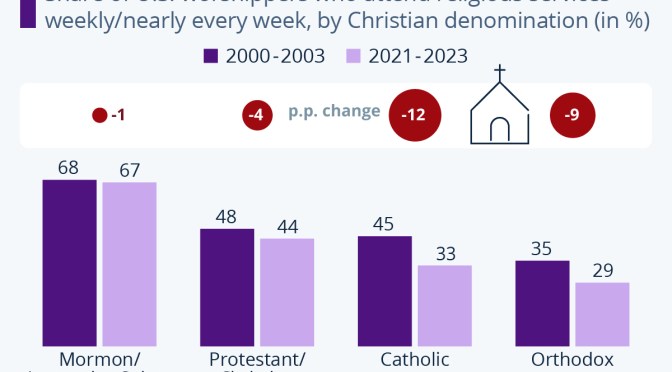
Today, the Western Church looks mostly like the world: same behaviors and worldviews; similar lack of patience, unrepentance, unforgiveness, divorce statistics, selfish driving habits, litigation, financial irresponsibility, and so-on. Why? In my experience as a minister, researcher, and writer, a driving factor is the lack of choice where a covenant with God is concerned.

Removing the consequences of immorality, lying, etc. through contraception, litigation, and ungodly laws can lure us into believing that the lack of consequences imply acceptance. Similarly, and in my experience, Western Christians are lured into believing that God exists to serve them and that prosperity is the goal because covenant and consequences have often been removed in the Church. Churchgoers are anesthetized by receiving a half-baked gospel where, if anything, a silent and personal ‘sinner’s prayer can save them without reciprocation. They are told there’s nothing they have to do – Jesus did it all! No self-discipline, no charity, no sacrifice, no two-way marriage-like covenantal response. No consequence for the pleasure-seeking individual uninterested in communal care who practices behavior antithetical to God’s ways. No accountability. No ongoing spiritual formation or discipleship (Barna, The State of the Church, 2016, for instance: https://www.barna.com/research/state-church-2016/). What to do?

There can be a fix – a positive change that once again draws others to our faith. Turn off the anethsiea of a covenantless gospel; stop entertaining and teach. Hold Christians accountable for ungodly behavior and gently train through discipleship. Move out of the church buildings and live out faith among others in our communities whether at work, play, or dwelling so that they may see our good works, patience, and purity and wonder just as the ancients did.

Blessings,

rb

http://www.ronbraley.com

http://www.findingdiscipleship.org

Western Christianity Versus the Borg

Jesus encouraged us to unshoulder our burdens and share them with Him (cf. Matthew 11:28); the Apostle Paul tells us to share our burdens with each other (cf. Galatians 6:2). Moreover, we are to use our resources to care for our Christian brothers and sisters. Still, we maintain a ‘great divide’ between laity and clergy and each other relationally – indeed a gap too wide to facilitate the transfer of our burdens to others or Christ. So they collect and weigh us down until we become the picture of spiritual unhealthiness and a questionable witness. Meanwhile, individualism prohibits deep interpersonal relationships necessary for accountability or the discovery of needs. How do we narrow the gap and once again participate instead of dictating or isolating? Through real community, not as a collective of individuals.

Our current one-to-many church model whereby a minister talks to a congregation and then sends them away has created a division between clergy and laity and defies the biblical structure meant for the assembly of Christ followers. There, everyone is equal, and they operate in parallel to use resources and spiritual gifts to equip the Saints for God’s ministry of reconciliation. Our contemporary Christianity, however, saddles clergy as paid religious professionals with laity responsibility for spiritual development and business tasks. As a result, growth is stunted, spiritual lethargy abounds, and opportunities for sharing God-given gifts and talents are nearly non-existent. Moreover, the congregation itself exists not as one body but a collection of individuals sharing the inbound religious experience.

Scott Boren, the author of The Relational Way, points out that the United States has been dubbed by many sociologists as the most individualized society in human history (12). Because our churches comprise complex, diverse humanity that doesn’t, for the most part, become transformed into the likeness of Christ, we too model individualism. We share little including struggles and needs or the Gospel for that matter. Why? Individualism and relationalism are antithetical; the former (us) creates a firewall that restricts relationships and, therefore, the trust necessary for sharing. Let’s have a bit of fun and look at something that looks more like we should: The Borg.

If you are a long-time Star Trek fan, you will likely know of the Borg – that single entity comprising many individuals functioning as that single consciousness; they exist to participate relationally for the betterment of the ‘one.’ Here are some helpful snippets from the Star Trek database (http://www.startrek.com/database_article/borg):

The Borg have a singular goal … This collective consciousness is experienced by the Borg as “thousands” of voices — they are collectively aware, but not aware of themselves as separate individuals. … Among the many advantages their collective consciousness affords them, the Borg hive-mind allows for instantaneous adaptations … with the power of their collective thoughts alone. … The hive-mind drones do not register as individual life-signs when scanned, only as a mass reading …

OK, so the Borg is fictional, and the Church is not. However, we could learn a serious lesson from the Borg concept: Participate to serve, not experience; Grow to help, not for self-gain.

In summary, God has equipped each of us to partner with others in His ministry of Reconciliation. Rather than congregate as self-centered individuals with a common desire to experience religion, let’s become more relational to build trust to enable training and service. Then, we can truly resemble the Borg … well, without all the tubes and stuff!

Blessings,

rb

Communion – Food for Thought

The sacrament/ordinance of Communion invites different thoughts and even an air of mystery depending on your religious background. Regardless, we typically understand it to be either a Spirit-enabled grace or remembrance related to Jesus’ sacrifice; whether grace or memory will, again, depend on religious affiliation. However, the sacrifice is but one of two major points of consideration. Remembering only the sacrifice, we seemingly gloss over the other – the covenant Jesus’ sacrifice enabled. That marriage-like covenant will be the focus of my blog.

God and our Christ have always communicated with us in terms and contexts humans understand and to which we can relate. For instance, Jesus used fishing terminology when teaching fishermen and farming concepts when instructing farmers. Likewise, God used or established human practices to guide performance and dress rehearsals for things to hope for in the future.

An excellent example of God’s use of an existing practice to guide contemporary behavior was the covenant He formed with Abraham with its cutting, shedding of blood, and the promise of servitude. It constituted the basis for the renewed covenant through Moses and the dress rehearsals of the Passover feast (e.g. 1Corinthians 5:7) and a marriage-like relationship with Israel. Both rehearsals would eventually be fulfilled by Jesus’ sacrifice and resulting marriage-like covenant. But what do covenant, sacrifice, and marriage have to do with Communion?

Jesus and Paul made clear that the Church is the Bride of Christ (see the fulfillment steps below) just as Israel was the Bride of God (e.g. Exodus 19:5-6; Isaiah 54:5-8). And why not? Marriage is a covenant, and there’s no other human relationship meant to be as close. Therefore, the Jewish marriage served as a good ‘dress rehearsal’ for the relationship of God with the world through the Christ.

Understanding the process Jesus and His disciples were familiar with will help in the interpretation of Jesus, Paul, and John’s comments related to the bride, a cup of the covenant, separation and preparation of a home, the return of Christ, and the wedding supper. Here are major steps of the Jewish betrothal/marriage process we fulfill with Jesus until His return:

Ancient Jewish Betrothal & Our Fulfillment

  1. Father of the groom selects a potential bride: 2Corinthians 11:2
  2. Covenant sealed by bride and groom drinking from the cup of covenant: Matthew 26:27-29
  3. Separation (John Chapter 14; Matthew 9:14-15) & building of a home: John 14:2-3
  4. Father determined the day/hour of the marriage gathering: Mark 13:26-32

Ancient Jewish Wedding & Our Fulfillment

  1. Wedding announcement by shouts and trumpet: Matthew 24:30-31; 1Thessalonians 4:16-17
  2. Wedding feast and the drinking of the last cup: Matthew 26:29; Revelation 19:7-9
  3. The wife goes to her new home: Revelation 21:1-2 & 9-10


In closing, my challenge is that we as His Bride not only remember Jesus’ sacrifice during the sharing of wine and bread but also the marriage-like covenant His shed blood and broken body made possible.


Blessings,

Rb


Keep an eye out for “Finding Answers to Stuff Churches Don’t Discuss!” scheduled for a mid-20167 publication. There, you’ll find roughly 60 topics related to daily life (such as sex, religion, finances, tattooing, and everything in between!) along with practical application of God’s guidance for navigating those difficult waters!

And, for a very comprehensive and detailed study of the very important topic of God’s judgment to come and being rescued from it, feel free to read my 2011 guide titled, “Finding the End of the World” available at Amazon, Barnes and Noble, and from www.ronbraley.com in paper and e-book formats. In the guide, you’ll find roughly 500 pages of building blocks to help you do your own complete and unbiased study based on Scripture and history!

Dunkin’ Do-Nots

I found the Sacrament (or Ordinance) of Baptism fascinating, and it reminds me of so many questions and internal friction spawned by this simple and yet critical Christian function! Dip or dunk? Necessary for salvation? Public or private? Prescriptive or Descriptive?

Baptism was prescribed from the beginning and had a presence in ancient Israel and pagan rituals, but what purpose does it serve for contemporary Christianity? Humanmade doctrine varies, and you’ll find it an act that imparts grace on the newly-born and old alike for the sacramental-minded. And there, a sprinkle is likely to be just as effective as a complete dunking as long as an individual ordained in the particular sect or denomination performs the rite. On the other hand, you’d be more likely to find baptism an ordinance of immersion and more of a symbolic act of burial and resurrection than an impartation of Godly grace if you’re of a Protestant persuasion. Which is correct, and does the function impact the salvation of those being doused or dunked?

What the Bible makes clear: Baptism in our New Testament context is meant to represent the forgiveness of sin and symbolize rebirth in Christ. It provided accountability, at least in the beginning, through the public profession of faith – often in the face of possible martyrdom. But that the ritual is necessary for salvation is unlikely; that idea may be part of a misunderstanding of salvation and a focus on praxis as opposed to the heart.

First of all, and contrary to our contemporary desire, the Bible teaches us that salvation – a rescuing by definition – will be a stay from God’s future wrath (e.g. 1Peter 1:3-5). Second, Jesus had a lot to say about our heart (intent) and the idea of choosing and following. And, Paul seems to corroborate the concept of persevering in our covenant with God. Finally, the Bible and this week’s lectures confirm that our confession of choice is synonymous with a ‘dying to self,’ and dying is indeed necessary before burial and resurrection baptism symbolizes. So, while it may not be directly related to salvation itself, baptism is meant to be a visible sign (not unlike circumcision in God’s covenant with Israel) that someone has ‘counted the cost’ and chosen to covenant with God. In other words, the ‘washing’ implies an educated commitment.

A common practice in the early church (still done in some Christian circles today) was to spend perhaps many months training a new ‘believer’ before baptism to ensure they understood what they were about to do. Contrast the practice with our Western tendency to get someone to say a ‘sinner’s prayer’ and seek baptism with little or no knowledge of the God with whom they’re supposed to covenant!

So, dunk, dip, or sprinkle as long as the recipient ends up as more than just wet!

Blessings,

Rb

Keep an eye out for “Finding Answers to Stuff Churches Don’t Discuss!” scheduled for a mid-20167publication. There, you’ll find roughly 60 topics related to daily life (such as sex, religion, finances, tattooing, and everything in between!) along with practical application of God’s guidance for navigating those difficult waters!

And, for a very comprehensive and detailed study of the very important topic of God’s judgment to come and being rescued from it, feel free to read my 2011 guide titled, “Finding the End of the World” available at Amazon, Barnes and Noble, and from www.ronbraley.com in paper and e-book formats. In the guide, you’ll find roughly 500 pages of building blocks to help you do your own complete and unbiased study based on Scripture and history!

Adopt a Bible!

Disappointingly, our plea for Bibles for Africa recently yielded no results despite the knowledge that most Africans have no Bible (including most Christian teachers and leaders!).

How can the people learn about God or become disciples effectively with no guide?

How can we who are wealthy by comparison and have an abundance of Bibles and Christian literature be obedient to Jesus’ commandment to ‘tell’ and ‘make disciples’ without doing our part to rectify this incredible disparity?

So, I thought I’d take a different approach by asking everyone to ‘adopt a Bible’. A donation of only $10 will buy one Swahili Bible. Obviously, Africa needs more than one Bible but if everyone buys at least one, we win in our obedience and Africa wins by being able to learn and teach their Faith.

Will you adopt a Bible for Africa by donating here? http://findingrevelation.com/FindingDiscipleship/Africa%20Bibles.htm

Blessings!

Ron Braley, findingdiscipleship.org & ronbraley.com


New Beginnings

We think about a New Year in human terms and for new human beginnings. But, there is an ultimate and true start that brings new beginnings for Jesus’ followers – and will bring an end to all else (Revelation 22:11-13).

Let the one who does wrong, still do wrong; and the one who is filthy, still be filthy; and let the one who is righteous, still practice righteousness; and the one who is holy, still keep himself holy. Behold, I am coming quickly, and My reward is with Me, to render to every man according to what he has done. I am the Alpha and the Omega, the first and the last, the beginning and the end. —Revelation 22:11-13.
Examples of human New Year celebrations:
• American/European: January 1st
• Chinese (Also known as the Spring Festival): 23rd day of the 12th lunar month of the Chinese calendar
• Jewish: Religious – Pesach (Passover): The 1st Jewish month; Agricultural – Rosh Hashanah: 7th month on the Jewish calendar

Human New Year resolutions: We usually make them to bring hope of a new human beginning (perhaps that the next year will be better than the last). We also make them as ‘do overs’ – we want to change what we don’t like.

But, let’s look at a new human and spiritual beginning in Jesus. Why would we care? To move toward God and life, and away from judgment and spiritual wrath. Here’s how:
• Believe and Repent (our focus) (Mark 1:15)
• Be baptized as an outward, physical manifestation of new faith (Mark 16:16)
• Grow in faith, live right, and tell others the good news (i.e. Matthew 19-20)

Interestingly, both human and spiritual new beginnings require repentance.
• Defined: A change in heart that results in a change in behavior
• Enables forgiveness, and salvation (Luke 24:47 and Acts 11:15-18)
• It’s what God desires of everyone (2Peter 3:9-10) and often disciplines us for (Revelation 3:19)
• A beginning that leads to good habits and better health (relationship, emotional, physical, and spiritual)
• We don’t practice sin once we repent (Galatians 5:20-23, John 8:3-12, and 1John 3:2-10
• Not repenting will lead to judgment and wrath (Romans 2:5-10)

Repent, experience a new beginning, and don’t look back! The results will be spiritually, physically, emotionally, and mentally rewarding.

Keep an eye out for “Finding Answers to Stuff Churches Don’t Discuss!” scheduled for a mid-2015 publication. There, you’ll find roughly 60 topics related to daily life (such as sex, religion, finances, tattooing, and everything in between!) along with practical application of God’s guidance for navigating those difficult waters!

And, for a very comprehensive and detailed study of the very important topic of God’s judgment to come and being rescued from it, feel free to read my 2011 guide titled, “Finding the End of the World” available at Amazon, Barnes and Noble, and from http://www.ronbraley.com in paper and e-book formats. In the guide, you’ll find roughly 500 pages of building blocks to help you do your own complete and unbiased study based on Scripture and history!

Evangelism: When enough is enough . . .

I’ve often witnessed someone focusing on trying to maintain what ends up being a tumultuous and unhealthy relationship because they believe they’ll eventually ‘lead the other person to Christ’. In business, this could be considered a bad ROI – Return on Investment – of the resources spent trying to ‘save’ someone.
We’re not responsible for saving people, only for passing on the good news of salvation from God’s wrath to come. The receiver must choose what to do with the information and any prompting by the Spirit of God. Granted, evangelizing that good news will benefit from relationships; however, you may reach a point when ‘enough is enough’ – especially if the relationship is emotionally or spiritually harmful to you. And, your time may be better spent in moving forward in telling others the good news and discipling those who become willing participants in a covenant with God through the Christ.

Then He said to His disciples, “The harvest is plentiful, but the workers are few. Therefore beseech the Lord of the harvest to send out workers into His harvest.” —Matthew 9:37-38.

“Whoever does not receive you, nor heed your words, as you go out of that house or that city, shake the dust off your feet.” —Matthew 10:14.

“Do not give what is holy to dogs, and do not throw your pearls before swine, or they will trample them under their feet, and turn and tear you to pieces.” —Matthew 7:6.

Keep an eye out for “Finding Answers to Stuff Churches Don’t Discuss!” scheduled for a mid-2015 publication. There, you’ll find roughly 60 topics related to daily life (such as sex, religion, finances, tattooing, and everything in between!) along with practical application of God’s guidance for navigating those difficult waters!
And, for a very comprehensive and detailed study of the very important topic of God’s judgment to come and being rescued from it, feel free to read my 2011 guide titled, “Finding the End of the World” available at Amazon, Barnes and Noble, and from http://www.ronbraley.com in paper and e-book formats. In the guide, you’ll find roughly 500 pages of building blocks to help you do your own complete and unbiased study based on Scripture and history!

Exploring God’s Will

God’s will is what He wants to do, which is primarily to keep us from destruction through salvation. This is His plan for mankind. In the process, He desires for us to be obedient, rejoice, pray, and spread the good news to others. Although we tend to think God’s will is actually some kind of grandiose plan for our lives, we should instead focus on helping God see His plan for mankind through to completion.

“Will” is defined in two ways in the Greek translated into the New Testament:

  • Strong’s G2307, thelēma, a determination; choice; inclination: – desire, pleasure, will. (John 6:40)
  • Strong’s G2309, thelō ethelō   to determine; choose or prefer; to wish, be inclined to; to delight in: – desire, intend, list, love, mean, please (Matthew 9:13 – desire;  Matthew 15:28 – wish; Matthew 26:39 – will; Mark 12:38 – like; Galatians 5:17 – please)

So, God’s will can be something He desires (as in Matthew 18: 12-14) or His plan for mankind (i.e. Matthew  26:42 or John 6:37-40).

Some of God’s desires:

  • That none are lost (Matthew 18: 12-14)
  • Obedience, not legalism (Matthew 9:13)
  • Our good deeds so we’ll silence the foolish (1Peter 2:13-16)
  • We rejoice and pray continuously (1Thessalonians 5:16-19)
  • We preach the Gospel/make disciples (Matthew 28:19-20)

About His plans:

  • They’re just that – HIS plans. Helping should be our focus.
  • Can be progressive – not always immediately accomplished!

Benefits of partnering with God to accomplish His plan:

  • Redemption and forgiveness; the reward of everlasting life (John 6:40) & (Ephesians 1: 5-13) & (Hebrews 10: 35-36)
  • God works for the good of those who love him; for it is God who is at work in you (Philippians 2:12-13)
  • The Spirit and His intercession (Romans 8:26-28)

How do we participate in His plan and accomplish His desires?

  • Be obedient
    • Do His commandments (1John 5:3 and Matthew 22:36-40).
    • Obedience is more important than works or sacrifice (Matthew 9:13).
    • Abstain from sexual immorality (1Thessalonians 4:2-4).
    • Be an ‘imitator of God’ (Ephesians 5:1-20).
  • Allow ourselves to be led by the Spirit (Romans 8:14).
  • Live by the Spirit (Galatians 5:25).
  • Seek His kingdom first; this requires submission (Matthew 6:33).
  • Obey our leaders and submit (Hebrews 13:17).

How can we learn of the things we’re to do in accomplishing His will or in learning of answers to our requests?

  • The Bible teaches principles that help in decision-making (2Timothy 3:16-17).
  • Ask for wisdom (James 1:5-6).
  • Seek wisdom (this can be from family, friends, spiritually-mature, etc.) (Proverbs 13:10).
  • Pray!!!
  • Use a ‘fleece’ as Gideon did (Judges 6:36-40).

We can hinder the accomplishment of God’s will or desires – even for us – through:

  • Bad motives (James 4:3).
  • Bad relationships (1Peter 3:7).
  • Unrighteousness due to disobedience and the lack of the Spirit (John 9:31).
  • Not allowing God’s timing (i.e. as Abraham did).

Summary: God has a plan for mankind: salvation through the Christ. He also desires fellowship and obedience from us in a pursuit of holiness. We can join in and help accomplish God’s plans or desires, or we can rebel and keep Him from using us or even answering our own requests. Of course, this rebellion will result in death.

Keep an eye out for “Finding Answers to Stuff Churches Don’t Discuss!” scheduled for a mid-2015 publication. There, you’ll find roughly 60 topics related to daily life (such as sex, religion, finances, tattooing, and everything in between!) along with practical application of God’s guidance for navigating those difficult waters!

And, for a very comprehensive and detailed study of the very important topic of God’s judgment to come and being rescued from it, feel free to read my 2011 guide titled, “Finding the End of the World” available at Amazon, Barnes and Noble, and from www.ronbraley.com in paper and e-book formats. In the guide, you’ll find roughly 500 pages of building blocks to help you do your own complete and unbiased study based on Scripture and history!

The “A-B-C’s” of Christianity

Absolute Belief Creates action . . .

What True Christianity is NOT:

  • A self-centered culture focused on pleasing the senses through music, dress, and ear-tickling self-help messages.
  • Founded on blind faith.
  • A belief system without action.
  • Appealing to most humans in its truest form because of its narrow and difficult way shaped by discipline, self-control, and benevolence.
  • A gateway to the giant Jinni, slot machine, one-way gift-giver, or however most people look at God these days.
  • Entitlement for sinful ‘do-overs’.
  • Promises of an illness-free materially-prosperous life where we will never suffer consequences of our actions or the actions of others while we wait to go to Heaven.

What True Christianity IS:

  • Action out of faith.
  • Born of faith that comes from confidence.
  • Ever-increasing confidence gained from prayer, fellowship, discipleship, and study.
  • A system of ‘paying it forward’ whereby those who are mentored and discipled do the same while also proclaiming what God and our Christ Jesus have done for us.
  • Representative of those who have entered into a two-way marriage-like relationship with God through Jesus.
  • Potential hardship and death on earth; Reward and life later.

~ Getting There from Here ~

Belief is the first step to obtaining salvation, which is available to everyone – not just a chosen few (Mark 16:15-16 and John 3:16-18). If we believe with all our heart, then a change of heart that results in a change of behavior – repentance – must follow.

  • Repentance is absolutely necessary for being rescued from coming judgment (Acts 17:30-31)!
  • Sinful behavior keeps us from God; repentance allows us to draw near to Him (Acts 3:19).
  • True belief and repentance lead to good fruit that comes out of obedience (Acts 26:20).

We’re also told in the Gospel to be baptized by water.

  • A person is born initially of water (through the womb) but must be spiritually born as well to enter God’s kingdom (John 3:5-6).
  • Baptism has become the symbolic of the washing away of sin that Christ offered through His death and resurrection (Romans 6:3-4).

Because true faith comes from the heart, a person must believe completely that Jesus died for them and then confess this belief. Faith – belief – is obtained and strengthened from experiencing the testimonies and fulfilled prophecies contained in the Word of God. They serve to ‘convince’ men of the truth and build faith (Romans 10:17 and 1 Peter 2:1-2).

To obtain and keep salvation (which, by the way, is a ‘rescuing’ from God’s wrath to come):

  • Believe in the gospel – the good news of salvation through Jesus. True belief will bring a new heart.
  • Repent by using that new heart to change sinful behavior.
  • Be baptized as an outward sign of your new faith.
  • Increase faith through continual exposure to teachings contained in the Bible.
  • Don’t practice sinful behavior – those things that are counter to God’s ways!!

While the gift of salvation is given by faith and not because of anything we can do to earn it, faith must lead to obedience and therefore production of ‘fruit’. In fact, James tells us that faith – or belief – without obedience (works) is useless (James 2:14-20). So, learn, grow, care for others, and follow God’s ways . . . and live!


Keep an eye out for “Finding Answers to Stuff Churches Don’t Discuss!” scheduled for a mid-2015 publication. There, you’ll find roughly 60 topics related to daily life (such as sex, religion, finances, tattooing, and everything in between!) along with practical application of God’s guidance for navigating those difficult waters!

And, for a very comprehensive and detailed study of the very important topic of God’s judgment to come and being rescued from it, feel free to read my 2011 guide titled, “Finding the End of the World” available at Amazon, Barnes and Noble, and from www.ronbraley.com in paper and e-book formats. In the guide, you’ll find roughly 500 pages of building blocks to help you do your own complete and unbiased study based on Scripture and history!

Ghouls, Spirituality, and Jesus . . . Compatible?

Christians are often conflicted over whether to celebrate Halloween.

For some, Halloween is a harmless time of fun when everyone can dress up and party. Their children love this time of year because of the costumes and quest for candy.

On the other hand, a growing number of Jesus’ followers are uncomfortable with the festival. They choose not to participate in it to avoid the appearance of a double standard once they learn of its origin. So, where did this contentious holiday come from?

Halloween is an ancient festival born of paganism and Christianity (Samhain for the pagans and Hallowmas for the Catholic Church – both 3 days long beginning on October 31st). The holiday was brought to the United States by European immigrants in the 19th century.

What does this have to do with God and our Christ? Embracing or condoning any kind of spiritualism, witchcraft, divination, or communication with the dead will bring certain judgment from God at the last days and open the door to demonic oppression or possession in the meantime. This could include the religious practice of praying to or for the dead, séances, or the pursuit of magical or astrological arts (i.e. consulting mediums, use of tarot cards, reliance upon horoscopes, etc.).

Should a follower of the Christ, celebrate the holiday? This is a personal decision that should be made carefully after consideration of its origin, current practices, and damage to a potential witness for Jesus.


Keep an eye out for “Finding Answers to Stuff Churches Don’t Discuss!” scheduled for a mid-2015 publication. There, you’ll find roughly 60 topics related to daily life (such as sex, religion, finances, tattooing, and everything in between!) along with practical application of God’s guidance for navigating those difficult waters!

And, for a very comprehensive and detailed study of the very important topic of God’s judgment to come and being rescued from it, feel free to read my 2011 guide titled, “Finding the End of the World” available at Amazon, Barnes and Noble, and from www.ronbraley.com in paper and e-book formats. In the guide, you’ll find roughly 500 pages of building blocks to help you do your own complete and unbiased study based on Scripture and history!