
Tag Archives: discipleship

Get Dirty But Shake Off the Dust!

I’m a discipleship guy. Why? Because, without it, there’s little to no Christian transformation and the beautiful things it brings. So, I’m all about change and spiritual growth—mine and yours. But what is basic discipleship, and how can we be fruitful as we do it? And, what do we do when it’s not working out?

First, discipleship is about imitation: presenting something worth imitating and mimicking what is seen and heard. Jesus taught, modeled what He taught, tested, corrected, and sent as He discipled. He gave His disciples something good to imitate. Then, they did what Jesus did. Here’s an example from nearly 2,000 years ago, written by the apostle Paul to the Church in Thessalonica: “You also became imitators of us and of the Lord, having received the word in much tribulation with the joy of the Holy Spirit, so that you became an example to all the believers in Macedonia and in Achaia.” (Thessalonians 1:6)

Second, discipleship can be messy! It occurs when we walk with someone at their rhythm of life; their and our discipleship and spiritual growth must never stop. The disciple-discipler relationship develops the trust needed to share struggles, woes, and joys. Importantly, authentic discipleship ensures that you observe a disciple’s behavior and are prepared to answer questions or offer correction. This is where it can get messy. But discipleship doesn’t happen without it.

Third, discipleship isn’t for everyone, and most of these relationships will fail. Why? Most likely due to a lack of devotion to God or the discipleship process, which can be tough. So, what should you do if this happens as you disciple? Setting clear expectations about mandatory devotion to God and the discipleship relationship is essential. Then, hold the disciple accountable. But if they aren’t growing, showing up, studying, etc., it might be time to ‘cut bait.’ Ditch the spiritual dead weight and move on! “But Ron, the disciple is my friend! Are you saying I must end the friendship?” Absolutely not! Keep that relationship, but focus your discipleship efforts elsewhere. Jesus addressed this in Mark 6:7-13: “And He summoned the twelve and began to send them out in pairs, and gave them authority over the unclean spirits . . . And He said to them, “Wherever you enter a house, stay there until you leave town. Any place that does not receive you or listen to you, as you go out from there, shake the dust off the soles of your feet for a testimony against them.” They went out and preached that men should repent. …”

To recap, discipleship is about your speech and example, as well as others imitating what they hear and see. So, be someone worth imitating! And don’t get stuck in a dead-end discipleship relationship. There’s plenty for you to do, so move forward! Next week? You’ll finally meet two inspiring third-century martyrs worth imitating: Perpetua and Felicitas.

Blessings and peace,

Dr. Ron Braley

Relatively Speaking

I’ve heard visiting relatives are like dead fish: both stink by the third day! Whether that’s true depends on the relatives, I suppose. But one thing’s for sure: relationships are meant to be mutually beneficial and very little happens without them. Besides familial, friendship, and commercial advantages, relationships become the backbone for things like discipleship, charity, correction, and conflict resolution.

Discipleship. This only works when trusting, intimate relationships provide a conduit for learning and spiritual growth. Jesus utilized existing relationships and built upon them with friends such as James, John, Peter, Andrew, and Philip. He also grew new, trusting discipleship-focused relationships through existing connections: Nathanael, by way of Philip, is a great example. What else? Imitation!

Discipleship demands relationship-enabled imitation. Jesus “did what He saw the Father do, spoke what He heard the Father speak.” Paul imitated Jesus, and the Thessalonians imitated Paul. Then others imitated those folks. Do the math: disciples around Thessalonica, therefore, imitated the Father. Besides discipleship, relationships enable love and spiritual growth.

Charity and spiritual formation. God told Israel, and Jesus reiterated in Matthew 22:35-40, that we must honor Him with everything and love people. King Solomon explained in Ecclesiastes 4:9-12 that “two are better than one” for prosperity, comfort, and safety. Effective relationships permit spiritual encouragement and equipping as we exhibit patience (1 Thessalonians 5:11; Colossians 3:12-13). Similarly, close relationships allow us to do this: “with all humility and gentleness, with patience, showing tolerance for one another in love, being diligent to preserve the unity of the Spirit in the bond of peace.” (Ephesians 4:2-3) When that doesn’t work, we must resolve relational conflicts and reconcile.

Spiritual correction and conflict resolution. The apostle Peter wrote that “love covers a multitude of sins” as we seek to restore relationships (1 Peter 4:8; Galatians 6:1-2). They can be reconciled and healed through tender-heartedness and forgiveness (Ephesians 4:32). We also use relationships to beat each other back into shape (spiritually speaking) as you’ll find in Proverbs 27:17. There’s a more sobering, and life-saving aspect to this, though.

Christians often say, “Who am I to judge?” but don’t buy into it! Jesus explained in Matthew 18:15-20 that our responsibility is lovingly calling out anti-Godly behavior. His half-brother James doesn’t mix words when he wrote that we must try to turn our Christian brothers and sisters from the ‘way of death’ (James 5:19-20). Need more? Check out 1 Corinthians chapter five and 2 Thessalonians 3:11-15 for examples of needing to judge (I like ‘assess’ better!) God-fearing, Christ-followers to stay on the Way of Life (sexual immorality and slackers, in these Corinthian and Thessalonian cases). But, spiritual correction requires deep, authentic and trusting relationships to work.

Summary. Deep, trusting relationships are necessary for things like discipleship, charity, correction, and conflict resolution. One way to put them to work is by presenting the good news of God’s Kingdom to the yet-to-be-churched; an airtight alibi is essential. Let’s hang out there next!

God’s blessings and peace,

Dr. Ron Braley, MDiv, DMin.

A Leap of Faith!

Jesus encouraged us by saying that faith can move mountains. Fine. But what is faith, and how do we get and keep it? You’ll find that it is the outcome of experience turned into action. Let’s explore this by first defining faith.

Faith defined. Faith, confidence, belief, and assurance are synonymous and provide the foundation and motivation for all else in a Christian’s journey: “Now faith is the assurance of things hoped for, the conviction of things not seen.”(Hebrews 11:1)

Faith’s sources. Faith in all things related to God is born and nurtured, never meant to be blind. Even Jesus fostered great confidence about God’s Kingdom and power through Spirit-fueled miracles and fulfilling ancient promises. Our faith comes through learning about these things: “So faith comes from hearing, and hearing by the word of Christ” (Romans 10:17). A primary source is the Scriptures that “were inspired by God and profitable for teaching, for reproof, for correction, for training in righteousness; so that the man of God may be adequate, equipped for every good work.”

Faith also develops by witnessing God’s work in people’s lives through testimonies and our own experiences as we activate what we’ve learned. Of course, the common experiential source is God’s Spirit, who works through us on God’s behalf, illuminates His words and ways, and nudges us to stay on the Way of Life (e.g., John 16:13). The vehicle for all of this is discipleship.

Creating a foundation through discipleship is of utmost importance in developing (and keeping!) faith. Besides charity, it is supposed to be the church’s focus. Every function within it must support discipleship, or the church becomes just a collection of nickels and noses fueling religious business: a whitewashed tomb. Discipleship demands walking with people in their daily rhythms of life as Jesus did. And, as He also did, it involves training, observing, correcting, and sending. Discipleship is the soil that produces good spiritual fruit (Matthew 13:3-8 & 18-23). It’s the stuff of obedience, imitation, and replication that ensures faith is, and faith does.

Faith is as faith does! We love claiming that we are ‘saved by faith alone’ as if actionless belief in Jesus alone magically keeps us from God’s judgment. As Paul Harvey often quipped, “Now for the rest of the story!” Faith in God through Jesus MUST lead to charity (Godly love): “But prove yourselves doers of the word, and not merely hearers who delude themselves. …” (James 1:22-25) “Even so faith, if it has no works, is dead, being by itself. … But are you willing to recognize, you foolish fellow, that faith without works is useless?” (James 2:17-20)

Summary. Faith is confidence in what God has done and is doing. It is built through experiences born of discipleship and the Spirit, and it must produce. Relationships are the backbone of discipleship, so let’s go there next time. Meanwhile, believe, grow spiritually, and get to work!

God’s blessings and peace,

Dr. Ron Braley, MDiv, DMin.

What’s Your Story?

Mention the need to evangelize their faith, and Christians tend to freak out. They imagine having to go door to door handing out pamphlets and telling people about a Jesus they don’t often know how to verbalize. Evangelism isn’t meant to be this way. Instead, we’re to organically present the Kingdom of God through Holy Spirit-fueled actions and stories. Here are a couple of examples:

 [Jesus] said to her, “‘Go, call your husband and come here.” The woman answered and said, “I have no husband.” Jesus said to her, “You have correctly said, ‘I have no husband’; for you have had five husbands, and the one whom you now have is not your husband; this you have said truly.” The woman said to [Jesus], “Sir, I perceive that You are a prophet.” … “So the woman … went into the city and said to the men, Come, see a man who told me all the things that I have done …” (John 4:16-19; 4:28-29)

And a leper came to Jesus, … saying, “If You are willing, You can make me clean.” Moved with compassion, Jesus stretched out His hand and touched him, and said to him, “I am willing; be cleansed.” Immediately the leprosy left him and he was cleansed. … [and he] went out and began to proclaim it freely and to spread the news around, to such an extent that Jesus could no longer publicly enter a city, but stayed out in unpopulated areas; and they were coming to Him from everywhere. (Mark 1:40-45)

Your experiences are your evangelism; no one can refute what God has done for you and through you. So, use what you know to introduce the Kingdom to those who need to meet Him. As you walk by the Spirit God has given you, verbalize your faith meaningfully. In other words, tell about your experiences and the Kingdom in speech and actions the unchurched will understand; meet them where they are. Don’t use ‘Christianese’ or words even most Christians don’t understand, like ‘propitiation’ or ‘sanctification.’ Your defense for your faith—your ‘elevator pitch,’ doesn’t even have to mention a God or Christ at first, which the hearer likely won’t know or understand.

Here’s a brief example: “I was a drunk. I’d lost everything. But in my darkest moment, I learned about the creator of everything, including you and me, who loves us so much and wants us to have a relationship with Him and be healed. He has changed my life, and, as you see, I’m a new person. You can be, too! Let me tell you how …”

Summary. God has worked with you and through you. Just act accordingly and talk about those things. Use what you know to introduce God to those who need Him. Next time, let’s learn how to find joy in anything. Meanwhile, share your Kingdom experiences—first by action, then by word if necessary.

God’s blessings and peace,

Dr. Ron Braley, MDiv, DMin.

Growth Under Pressure: Rise & Fall of the Western Church

The Rise. Dr. Martin Luther King Jr. stated, “Change does not roll in on the wheels of inevitability, but comes through continuous struggle.” For the early Church, the struggle was between an ungodly world and Christ’s Kingdom. The tension brought Rome’s wrath, whose leaders murdered Christians and severely limited their ability to engage in commerce. Yet, Christianity grew at about 40% per year!

How? Christians understood that adversity is a natural part of the journey and that perfection and hope emerge (Romans 5:3-5; James 1:2-4). They took the mandate to image God through imitation and replication seriously. For the compassionate, newly transformed, there was no other way. Being a costly faith and valuable religion also contributed to growth. Dietrich Bonhoeffer explains this well in The Cost of Discipleship: “Costly grace is the treasure hidden in the field; for the sake of it, a man will go and sell all that he has. … Such grace is costly because it calls us to follow… It is costly because it costs a man his life, and it is grace because it gives a man the only true life. It is costly because it condemns sin, and grace because it justifies the sinner. Above all, it is costly because it cost God the life of his Son.”

The Fall. Conversely, Western Christianity declines by about 20% each year. Only 5% of churces make disciples who make disciples, and a mere 15% of most memberships live obediently. Spiritual lethargy through passivity has removed tension and stunted growth. Casting Crowns’ song Start Right Here states things well: “We want our coffee in the lobby. We watch our worship on a screen. We got a Rockstar preacher who won’t wake us from our dreams. We want our blessings in our pocket. We keep our missions overseas. But for the hurting in our cities, would we even cross the street?”

Spiritual lethargy and focusing on ‘nickels and noses’ produce a cheap grace that embraces comfort but opposes growth (in numbers or maturity!). Deitrich Bonhoeffer’s take: “Cheap grace means grace sold on the market like cheapjacks’ wares. The sacraments, the forgiveness of sin, … can be had for nothing. … Cheap grace is the preaching of forgiveness without requiring repentance, baptism without church discipline . . . Cheap grace is grace without discipleship …”

The Cure. Growth would require a shift that naturally creates tension between our ungodly world and Christ’s Kingdom introduced through Christ-followers. No more immoralities. No more business-minded attractional buildings, programs, or religions—just discipleship-born imitation, replication, and growth out of adversity.

Summary. The early Church grew astoundingly because of discipleship’s imitation, replication, and growth from persecution. Today’s Western Church will die if it doesn’t do the same. The Thanksgiving holiday is coming, so let’s explore it next time. Until then, fight the good fight, struggle victoriously, and embrace change.

God’s blessings and peace,

Dr. Ron Braley, MDiv, DMin.

A Church of House Churches

Early Christians met in house churches to learn, encourage, and worship interactively. There were no inside-the-church preachers, priests, buildings, tithes, or religious dogma. Potential converts came to the Faith because of observed Christian behavior and compelling evangelism outside church walls. Members upheld covenantal vows and communal expectations.

No one person ruled anyone. Elders provided oversight but weren’t elevated. Preachers and evangelists taught outside church walls; pastors shepherded and taught inside and were equal to everyone else and unpaid. Everyone shared testimonies, burdens, songs, biblical texts, and resources. Not today.

Today’s pursuit of “nickels and noses” derails disciple-making and transformation. Western Christianity declines about 20% per year, and churches close at an alarming rate. The remainder focuses on attracting consumers, and 90% or more of church income goes toward expenses. Only 5% of Western churches claim to make disciples who make disciples. A whopping 960 people out of 1,000 introduced to God’s Kingdom are unfruitful and unworthy of imitation because expectations, modeling, discipleship, and accountability are missing. Let’s contrast the earliest Christian way of life with today’s Christian religion to see the differences.

No sanctioned buildings, tax exemptions, or Old Testament tithes existed until fourth-century Constantine. Christians were to ‘go and make.’ Today, we thrust new buildings into strange communities and expect people to ‘come, listen, and give.’ Potential converts counted the cost of discipleship and then devoted entirely to God and the Church. Today’s Christians usually expect instant salvation from belief without response. Without discipleship and transformation, they look like the world. Preachers preached outside; now, they preach inside to a passive audience. Everyone was required to participate; today, people come and go without expectations or consequences. It’s no wonder our Christianity is impotent and dying. Can we reverse the trend? Yes!

The existing brick-and-mortar church must become a sending agency that equips Christians to ‘go and make’ outside the church walls. That must be its focus and where most resources go. We could reverse the embarrassing ROI (Return On Investment) if we retool to become ‘churches of house churches’ like first-century house-church Christianity overseen by Elders and Bishops. An effective church today could produce and oversee pastors who shepherd house churches in their communities. Antioch church in Waco, TX., does something similar. And so does Jason Shepperd in his project “A House of House Churches” (https://www.amazon.com/Church-House-Churches-Articulated-Ecclesiology/dp/B0B1K5WBLX). He’s the senior pastor, and most visitors don’t know him. Why? He’s not the focus. Jason and the pastors he trains invisibly lead a potent church of house churches where discipleship, training, accountability, benevolence, ‘one anothers,’ and transformation happen.

Today’s business-focused Christian religion and churches don’t resemble the influential, intimate, communal first-century Church. It’s supposed to make disciples who make disciples (Matthew 28:18-20), which it doesn’t do. Let’s reverse the trend to revitalize Western Christianity!

Please consider reading my book From Butts in the Pews to Be-Attitudes: Turning Consumers into Disciples (available on Amazon, Barnes and Noble, and Xulon Press) for more information and support for the statistics in this article. Next time? Drain the brain [swamp], and please God! Remember that religion is for you, and obedience is for God.

Blessings and peace,

Dr. Ron Braley, MDiv, DMin.
The Master’s Voice

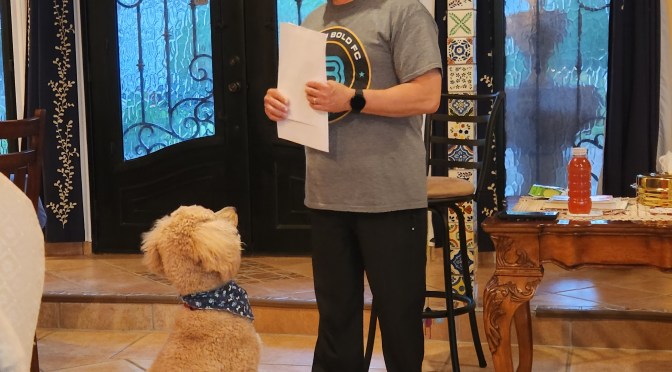
A disciple seeks to be like the master, whom they imitate and then become something worthy of imitation. The process requires studying what is said and shown. My dog Aragon does this. When I leave the room, he waits and watches in earnest for my return. He stares intently when I’m with him, waiting for the next praise or instruction. So, he was easy to train. Listen. Watch and wait. Imitate. We should be like Aragon in our relationship with God. How? Always listen and watch, waiting on the movement of the Holy Spirit, biblical instructions, or admonishments from other Christ followers. Let’s examine the “listen, wait, imitate” rhythm from a biblical perspective.

The master’s voice. Read 1 Kings 19:4-18, and you’ll find a depressed Elijah on the run from Ahab. In verses 10 and 14, he cried to the Lord, “Am I the only one?” He didn’t respond through a great wind and earthquake. He didn’t answer through a fire. Instead, He replied gently, softly. In a small, still voice, the Lord God almighty whispered: “No! Seven thousand others are like you!” (1 Kings 19:11-18).

Aragon knows me. He knows my voice and responds accordingly. I speak, he listens. I go, he goes. He follows because he knows and trusts me. Similarly, Jesus knows those who belong to Him: “My sheep hear My voice, and I know them, and they follow Me; and I give eternal life to them . . .” (John 10:27-28). Besides listening, the obedient to God sometimes must wait patiently for a deed, a word.

Just wait! Aragon will wait patiently for hours for me. When he sees me, he’ll leap into action. The wait is worth it! The same holds for God’s children. The Psalmist wrote this: “I wait for the Lord, my soul waits, and in his word I hope” (Psalm 130:5, ESV). We often wait for a word of instruction, admonishment, or comfort from the Lord through His Spirit, scriptures, or other followers of Jesus.

Imitate and replicate! Training Aragon was easy. He listened, watched, and repeated what he saw. He even tries to make the sounds I make when we play. As imagers of God, we, too, are meant to imitate what we see and hear related to Him and repeat the words and behavior. The apostle Paul confirms it: “Be imitators of me, just as I also am of Christ. Now I praise you because you remember me in everything and hold firmly to the traditions, just as I delivered them to you.” (1Corinthians 11:1-2).

Listen for the Master’s voice even if you must wait. Then, just like Aragon with me, imitate what you learn and become something worthy of imitation by others. What’s next?  Let’s reverse today’s upside-down church model with a church of house churches. While waiting, remember that God wants your loyalty, not your religion.

Blessings and peace,

Dr. Ron Braley, MDiv, DMin.
Dirt & Fruit

I once heard the saying, “No root, no fruit!” It’s true, especially where God is concerned. Dirt that lacks nutrients, whether natural earth or spiritual soil, stunts root growth. Here, we’ll look at the spiritual stuff.

Jesus addressed spiritual seeds, sowers, and receivers in Matthew 13:1-9 and 18-23. The “seed” is an introduction to God’s Kingdom made by a sower (e.g., teacher, evangelist, or disciple-maker); the soil is the recipient. Depending on the sower and receiver, the result can be spiritual fruit or fuel for the burn pile (John 15:4-6). In Matthew 13, Jesus offered examples of the different seed recipients and their conditions to illustrate growth opportunities and outcomes. I’ll present each scenario one at a time.

Roadside (13:4 and 19): “When anyone hears the word of the kingdom and does not understand it, the evil one comes and snatches away what has been sown in his heart.” A lack of wisdom hides God’s Kingdom; erroneous church leaders and teachers can be at fault. Flawed or incomplete evangelism, encouraging someone to enter a one-sided selfish relationship with God without understanding the terms and conditions, is also at fault. The cure? Find a mature Christ-follower and imitate what you see and hear!

Rocks (13:5-6 and 20-21): “… this is the man who hears the word and immediately receives it with joy; yet he has no firm root in himself, but is only temporary…” This person understands at least the appealing parts of Christianity and perhaps entered it emotionally. Once the feelings are gone, so is any motivation for growth. As with the roadside receiver, causes include bad teaching, inadequate evangelism, and the absence of discipleship.

Thorns (13:7 and 22): “… this is the man who hears the word, and the worry of the world and the deceitfulness of wealth choke the word, and it becomes unfruitful.” This person probably understands the Kingdom but chooses self-centeredness, where the “lust of the flesh and eyes” rules over all else (1 John 2:15-17).

Good soil (13:8 and 23): “… this is the man who hears the word and understands it; who indeed bears fruit and brings forth, some a hundredfold, some sixty, and some thirty.” This person likely benefitted from truthful teaching and has a fertile heart, ready to take in and put to work what they learn about God and His Kingdom! No burn pile in their future!

To summarize, receive truth and engage in foundational discipleship and formational spiritual disciplines to grow fruit! Live and prosper by imitating authentic Christians who teach and model the Kingdom. What’s next? It’s often difficult to reconcile God’s realm “in the skies” and Satan’s kingdom on the earth and see how all things will be fixed one day as God takes back what’s His. So, let’s go there next time. Meanwhile, always test what you hear or read to ensure it resonates with God’s nature and desires.

Blessings and peace,

Dr. Ron Braley, MDiv, DMin.
Goin’ to the Spiritual Gym!

Want to get thinner? Eat better and less. Want to get fit? Move. Want to get stronger? Work out at the gym. These excellent disciplines can improve physical, mental, and emotional health. Easy? Nope! I wouldn’t be writing this if they were! But discipline, hard as it may be, is crucial to developing good habits—even for spiritual growth. So, today, we’ll go to the ‘spiritual gym,’ beginning with foundational discipleship.

Discipleship. Everything needs a solid foundation, including your house, vocation, relationships, and Christianity. Most things wither or fail without one! Christian foundation is formed through discipleship. But discipleship, with ‘discipline’ at its core, happens intentionally through training and imitation. Learn and imitate what? Prayer. Study. Charity. Purity. Operating by God’s Spirit. Discipling others. How did Jesus disciple people? Tell, demonstrate, test, correct, and send.

Spiritual Formation. But, at some point, ongoing formation geared toward maturity must take over and build upon the foundation: “Therefore leaving the elementary teaching about the Christ, let us press on to maturity . . .” (Hebrews 6:1). Ongoing formation seeks to build spiritual muscles to help the God-fearing Christ-follower endure until the end of this world. We must discipline ourselves to build good, Godly habits like athletes, according to the apostle Paul: “Everyone who competes in the games exercises self-control in all things. . . . Therefore I run in such a way, as not without aim; I box in such a way, as not beating the air; but I discipline my body and make it my slave, so that, after I have preached to others, I myself will not be disqualified.” (1 Corinthians 9:25-27) Of course, no one wants to be disqualified from salvation (God’s rescuing) to come (1 Peter 1:3-5)! So, let’s briefly address the spiritual formation He expects.

In loving ourselves (so we can obediently honor God and love others), we must be relationally, emotionally, physically, financially, and spiritually healthy. Weakness in any of these areas can distract us from bearing God’s image, being an ambassador of His Kingdom, or honoring our part of the two-way covenantal relationship with Him. We begin our journey to wellness in all areas by “presenting our bodies a living and holy sacrifice” and remapping our brains (Romans 12:1-2). How do we do that? By disciplining ourselves to pray regularly and study the Bible often (praying all the while for illumination). And, by being continually charitable with time, talents, and treasures while pursuing purity according to God’s righteousness—His standards.

Summary: Here, we went to the spiritual gym for foundational discipleship and ongoing spiritual formation to be healthy enough to please God. What’s next? It’s way past Independence Day, but let’s see what it means to say, “I pledge allegiance to God!” in the following article. In the meantime, be kind, just, merciful, and pure above being religious.

Blessings and peace,

Dr. Ron Braley, MDiv, DMin.

Diamonds in the Rough

Diamonds are precious. They begin insignificant but become prized after enduring extreme pressure and heat. The stuff? Simple carbon. Ordinarily, pressure and heat come from the earth over time. Diamonds can be created artificially much faster, but the process remains the same: apply pressure and heat to the right stuff. Christian growth works similarly: the right stuff enduring life’s stresses and purification’s heat. Are you a godly diamond in the making?

You may be a God-desired diamond if . . . you know God and respond accordingly. Knowing God and His nature is easy: it’s all over the Bible (just study it and hang out with more-mature Christians)! You’ll find He’s kind and just (fair but firm). His Spirit will be happy to help you understand Him fully (Luke 10:21 and John 14:26). Our response? Purity (1 Corinthians 6:20). Devotion and charity (Matthew 22:30-35). Justice and mercy (Micah 6:8). Discipleship (e.g., Matthew 28:18-20). Obedience: “By this we know that we have come to know Him, if we keep His commandments.” (1 John 2:3). Follow (John 10:27). But you can’t keep or follow what you don’t know or ignore! Stay the course, and God will know you too.

You may be a God-desired diamond if . . . God knows you because you know Him and respond as He desires. “But now that you have come to know God, or rather to be known by God . . .” (Galatians 4:9) and “But if anyone loves God, he is known by God.” (1 Corinthians 8:3). Hint: You can’t love what you don’t know!

You may be a God-desired diamond if . . . you and God know each other, and the relationship empowers you to endure life’s pressures. God didn’t say we’ll never suffer in this world (to the contrary!). Still, He promised to walk with us (e.g., Matthew 5:4). Know that pressure is necessary for growth and hope: “And not only this, but we also exult in our tribulations, knowing that tribulation brings about perseverance; and perseverance, proven character; and proven character, hope” (Romans 5:3-4 (see also James 1:2-4)).

You ARE a God-desired diamond if you know God, God knows you, and you remain His despite incredible pressure. For instance, Jesus said that if we love Him, we’ll remain (stay steadfast in our relationship) and that He and the Father will do the same with us in return (John 14:23 and 15:4-10).

In summary, know God and relate so He’ll know you too. Then, endure and stay and model that to others. The results? “Those who have insight will shine brightly like the brightness of the expanse of heaven, and those who lead the many to righteousness, like the stars forever and ever.” (Daniel 12:3). Shine on you godly diamonds! What’s next? Ever feel like you’re spinning your spiritual wheels? Me too! Let’s look at doing donuts in a spiritual parking lot.

Blessings and peace,

Dr. Ron Braley, MDiv, DMin.