Tag Archives: martyr

Perpetua: Faithful unto Death

Human life is valuable; we cherish ours above all else. Yet, Jesus said that God-fearing Christ-followers would willingly give up everything to enter God’s kingdom, even under severe persecution in the last day: “And they overcame [Satan] because of the blood of the Lamb and because of the word of their testimony, and they did not love their life even when faced with death.” (Revelation 12:11) Here, you’ll meet such a martyr who had much to lose but infinitely more to gain: third-century Vibia Perpetua.

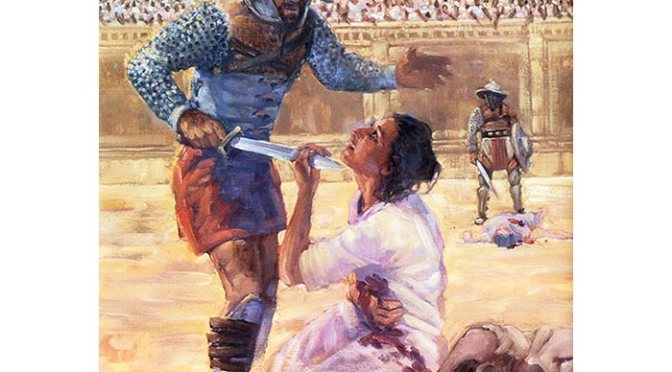
Twenty-two-year-old Perpetua, who had a breastfed infant son, had recently completed her discipleship and been baptized when she was condemned to die in the arena for her allegiance to God and Christ. Understand that her discipleship and martyrdom occurred when cheap grace, with its self-centeredness, and today’s ‘get-saved-quick’ culture, would have been unfamiliar concepts. Discipleship often took up to three years and required close mentoring and observation to ensure that the trainees (catechumens) truly understood the potential cost of their faith before being admitted to the Christian community and, presumably, God’s kingdom.

Perpetua weighed the costs and chose to relinquish all earthly pleasures for heavenly joys beyond imagination, even though she was offered the chance to keep her life and her infant son by denying Christ. What you’ll read now is from her diary, which was completed by an anonymous eyewitness and friend after her death.

  • Sentenced to death for becoming a slave to Christ: “Hilarianus passed sentence on all of us: we were condemned to the beasts, and we returned to prison in high spirits.”
  • Great joy and evangelism: “Some days later, an adjutant named Pudens, who was in charge of the prison, began to show us great honor, realizing that we possessed some great power within us. … By this time the adjutant who was head of the [jail] [became] a Christian.”
  • Death march: “… it was chosen that their sex might be matched with that of the beast. So they were stripped naked, placed in nets and thus brought out into the arena.”
  • Out with the old, in with the new: “… the heifer tossed Perpetua and she fell on her back. Then sitting up she pulled down the tunic that was ripped along the side so that it covered her thighs, thinking more of her modesty than of her pain. … She screamed as she was struck on the bone; then she took the trembling hand of the young gladiator and guided it to her throat.”

Perpetua showed that no one would willingly die for something they didn’t truly believe in. The apostles and early church fathers wouldn’t have lied about the good news of God’s kingdom out of fear of being held accountable by their peers. This should make you think about what’s ahead while you still can. You might wonder, “Ron! Where’s the power button to turn on the kind of faith Perpetua had?” Let’s find out next time!

Blessings and peace,

Dr. Ron Braley
The Ultimate Sacrifice

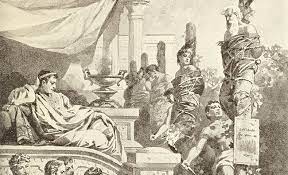
Veterans Day is upon us (November 11)! Initially set apart to honor WWI veterans, ‘Armistice Day’ became dedicated to world peace and all war veterans. Jesus taught there’s no greater love than sacrificing life for others’ sake (John 15:13). Honoring those who’ve given their lives defending others makes sense. So, please do this on the 11th! Here, I’d like to introduce folks from the Christian community who’ve sacrificed life, limb, time, treasure, and talents to serve others and present God’s Kingdom to the unchurched: martyrs, missionaries, evangelists/apostles, and helpers. Martyrs first.

Martyrs. A martyr is someone killed for their beliefs (e.g., religious). Notable Christian martyrs include Stephen, stoned to death in about 30 AD, and eleven of the twelve original apostles killed for their faith. Later, faithful Lawrence was grilled to death in 258 AD. Perpetua was a 22-year-old nursing mother killed by a wild beast in the coliseum for her unshakable faith in the third century AD. Another example is Margaret Clitherow, pressed to death in 1586 for ‘illegally’ harboring priests in her home. Others suffer hardship, even if they don’t always die for their faith.

Missionaries. Jesus said, “GO and make disciples!” (e.g., Matthew 28:18-20). Some people do this close to home. Others travel to foreign lands or new communities. We call the latter missionaries, and they often sacrifice life, limb, and significant comfort and resources to serve God. Examples include 18th-century William Carey, known as the “Father of Modern Missions.” He was the first missionary to India and translated the Bible into Bengali. And there was David Livingstone—a 19th-century Scottish physician who evangelized Africa. Speaking of Africa, Joanne and I just returned from a two-week mission to Kenya and Uganda, Africa, training about 400 church leaders in Christian Leadership and Discipleship principles.

Evangelists and Apostles. These preachers of God’s Kingdom to the yet-to-be-churched are another sacrificial group (where they preach determines whether they’re an evangelist or apostle). An apostle is sent into new communities to start new churches; evangelists usually preach closer to home. These obedient folks often undergo hardships and sacrifice comfort and familiarity to introduce God’s Kingdom to the spiritually needy here and abroad.

Humble Helpers. We also must recognize the folks who work humbly, obediently, and quietly behind the scenes to support and promote God’s Kingdom. They don’t seek recognition but deserve it because they sacrifice time, treasures, and talents! These folks are rare, accounting for less than 20% of a typical congregation! You’ll find them teaching, cooking, cleaning, greeting, fixing, mowing—serving selflessly in these and many more ways!

Summary: On November 11, remember those who’ve died for others. We should also honor the people who willingly sacrifice everything to introduce God’s Kingdom to the lost. Next, in anticipation of the Thanksgiving holiday, I’ll write about being thankful. Meanwhile, remember that God expects you to BE the Church, not DO church.

Blessings and peace,

Dr. Ron Braley, MDiv, DMin.

The Lamb & the Lion

Our Jesus – the Christ – is certainly the lamb of God’ that takes away the sin of the world (John 1:29). Unfortunately, we often miss the real point in our experiential Christian culture, feeling good while we imagine our Jesus as a cute and cuddly lamb . . . I think you’ll find that a better visual would be that of a ‘mamma bear’ who is kind, just, and protective with her own but ruthless against opposition.

The truth is that the dress rehearsal of Passover and its sacrificial lamb, and prophetic utterance by the likes of Isaiah, were fulfilled by our Christ’s obedience to God to become the once-for-all sacrifice for sin. Jesus ‘bought’ us with His sacrifice; we must now choose whether to believe and obey – follow – or to ignore this new covenant with God through the Christ.

He was oppressed and He was afflicted, Yet He did not open His mouth; Like a lamb that is led to slaughter, And like a sheep that is silent before its shearers, So He did not open His mouth. —Isaiah 53:7 & Acts 8:32.

Clean out the old leaven so that you may be a new lump, just as you are in fact unleavened. For Christ our Passover also has been sacrificed. Therefore let us celebrate the feast, not with old leaven, nor with the leaven of malice and wickedness, but with the unleavened bread of sincerity and truth. —1Corinthians 5:7-8.

When He had taken the book, the four living creatures and the twenty-four elders fell down before the Lamb . . . “Worthy are You to take the book and to break its seals; for You were slain, and purchased for God with Your blood men from every tribe and tongue and people and nation. You have made them to be a kingdom and priests to our God; and they will reign upon the earth.” —Revelation 5:8-9.

Also true is that those who wish to follow the lamb must consider the cost as Jesus said, for they may very well go to their own destruction or be afflicted in their bodies (just look at all the apostles, except John, who were martyred for their faith!).

And they overcame him because of the blood of the Lamb and because of the word of their testimony, and they did not love their life even when faced with death. —Revelation 12:11.

What about the ‘Lion’? Well, Jesus our redeemer is also referred to as the ‘Lion from the tribe of Judah’ in God’s revelation given to John by Jesus.

Then I began to weep greatly because no one was found worthy to open the book or to look into it; and one of the elders said to me, “Stop weeping; behold, the Lion that is from the tribe of Judah, the Root of David, has overcome so as to open the book and its seven seals.” —Revelation 5:4-5.

So far, we understand that the picturesquely mild and meek ‘lamb’ is that way in symbol only. The example was used to show how Jesus was voluntarily slaughtered as a lamb to assist God the Father in the accomplishment of His desire to reconcile with His creation.

Our creator is a just God who will keep His promise to reward the faithful and destroy the wicked. Jesus, because of His obedience, earned the right to save and judge as a faithful arm of God’s wrath.

and they said to the mountains and to the rocks, “Fall on us and hide us from the presence of Him who sits on the throne, and from the wrath of the Lamb —Revelation 6:16.

And I saw heaven opened, and behold, a white horse, and He who sat on it is called Faithful and True, and in righteousness He judges and wages war. . . .  From His mouth comes a sharp sword, so that with it He may strike down the nations, and He will rule them with a rod of iron; and He treads the wine press of the fierce wrath of God, the Almighty. And on His robe and on His thigh He has a name written, “KING OF KINGS, AND LORD OF LORDS.” —Revelation 19:11-16.

So, the lamb and the lion are one and the same: savior and judge. Rescuer and executioner. Which will you experience?

Keep an eye out for “Finding Answers to Stuff Churches Don’t Discuss!” scheduled for a mid-2016 publication. There, you’ll find roughly 60 topics related to daily life (such as sex, religion, finances, tattooing, and everything in between!) along with practical application of God’s guidance for navigating those difficult waters!

And, for a very comprehensive and detailed study of the very important topic of God’s judgment to come and being rescued from it, feel free to read my 2011 guide titled, “Finding the End of the World” available at Amazon, Barnes and Noble, and from www.ronbraley.com in paper and e-book formats. In the guide, you’ll find roughly 500 pages of building blocks to help you do your own complete and unbiased study based on Scripture and history!