Tag Archives: judgment

The Tithe: Religion Over Love!

Recently, I discussed the Old Covenant Law, pointing out that Christians aren’t required to follow its religious or civil rules. Most Christian leaders agree, yet they often push congregants to tithe. However, there is no obligation to do so. Yes, God desires giving — but for charity, not for church expenses under the pretense of an Old Covenant tithe.

The tithe, meaning ‘a one-tenth part,’ was part of the ancient pagan suzerain-vassal (king-servant) covenant system that God adopted to establish His salvation-focused relationship with people, starting with Abram. However, as far as we know, God did not command a tithe until He renewed the covenant through Moses. Then He instructed the eleven tribes who received land to tithe to support the priests, their families, and the temple. Eventually, they disobeyed, which led to starvation and disrepair, prompting a sharp rebuke (Malachi 3:6-15). Today, there are no physical temples or priests: we are the spiritual temple and a priesthood of believers (e.g., 1 Corinthians 3:16; 1 Peter 2:5), and therefore, do not need a tithe.

So, there was no New Covenant tithe until Constantine reinstituted it in the fourth century to fund religious leaders and buildings. Previously, money was collected only for charity. For example, Paul collected funds from regional churches to support the beleaguered saints in Jerusalem. Additionally, Tertullian wrote: “Though we have our treasure-chest, it is not made up of purchase-money, as of a religion that has its price. On the monthly day, if he likes, each puts in a small donation; but only if it be his pleasure, and only if he be able: for there is no compulsion; all is voluntary. These gifts are . . . to support and bury poor people …”. Today?

Many church leaders misuse Scripture to guilt or excite congregants into tithing for things God never asked for, ignoring charity and discipleship—things that God and Christ commanded. Beyond misinterpreting Malachi 3:6-15, Luke 6:38 is often distorted to promote a tithing pyramid scheme, where giving more money supposedly leads to receiving more. Read it along with verses 1-36, and you’ll see the context is about judging and the exchange of justice and mercy, not tithing. Still, little return is seen from today’s tithes. Fewer than 5% of American churches make disciples that make disciples. Fewer than 20% of church members engage in spiritual disciplines. Typically, less than 1% of church budgets go to missions, and there’s usually nothing allocated for charity or discipleship—the core things we’re called to do. The solution?

Leaders: don’t misuse the Scriptures! Be open about church business needs and teach your people to prioritize charity—starting at home, then within the Body, and finally to others. I could write much more about solving this issue, but I’ve run out of space! Maybe in a future article…

In summary, there’s no New Covenant tithe, but loving others is essential. Next, we’ll revisit “Christmas, the Retold Story!”

Blessings and peace,

Dr. Ron Braley (MDiv, DMin)

The Long Arm of the Law

Many Christians say they’re “no longer under the Old Covenant Law.” That’s mostly true. However, the statement downplays the Law’s importance and ignores the need to follow its moral teachings. Here, we’ll examine both Old and New Covenant Laws. First, why are laws necessary?

Why do we have laws? Boundaries are everywhere. Traffic laws help keep us safe on the road. Others protect communities from harm. This is true even in the animal kingdom. For example, I saw an elephant herd temporarily expel a young male that was getting ‘frisky’ with already spoken-for females. Laws also helped Israelites honor God and love people.

Old Covenant Law. First, a better translation of ‘Law’ is ‘instruction.’ The Old Covenant version consisted of 613 instructions, starting with the Ten Commandments. Second, there were three types of instructions: civil, religious, and moral. Civil instructions addressed issues like handling corpses, sexual immorality, and other community safety measures. Religious instructions directed people to serve God, and an abundant life in ancient Israel depended on meditating on the Law’s commandments and obeying them (e.g., Deuteronomy 30:8; Joshua 1:8).

Although New Covenant Christians are no longer bound by Old Covenant civil or religious laws (e.g., Romans 7:6; Galatians 5:18), moral guidance—such as most of the Ten Commandments—is still relevant. These principles continue to apply (e.g., you don’t have a green light to murder someone!).

Old Covenant instructions served another purpose: to establish an impossible standard. Breaking the rules became sin that could cause physical or spiritual death, emphasizing the need for a remedy (e.g., Romans 5:20-21; 1 Corinthians 15:55-57). Now, there is a New Covenant Law that fulfills the Old Covenant’s civil and religious instructions and offers the cure for sin.

New Covenant Law. The relationship with God, as outlined in the Old and New Covenants, is a continuum from the Old to the New. The New doesn’t erase the Old (Romans 3:31), and offers the solution for our inability to perfectly follow the Old Law of God: Jesus, through whom grace and truth are made known (John 1:17). Through Him, those led by the Spirit by faith are justified before God. This isn’t achieved by merely following Old Covenant’s civil and religious rules (Romans 7:4-7; Galatians 2:16 and 5:18)! But don’t be fooled: belief and action go hand in hand (Romans 2:13; James 2:14-26)! A belief that produces no results is worthless to God and will lead to wrath at the end of the world (John 15, Matthew 25:31-46, etc.).

Summary. Christians no longer follow the Old Covenant’s civil and religious rules, but they still need to adhere to many of its moral principles. And the New Covenant’s instructions to honor God and love others (relational terms and conditions) must be obeyed … or else. What’s next? Let’s revisit “Christmas, the Retold Story!” to take a closer look at how the plan of reconciling creation with the Creator unfolded.

Blessings and peace,

Dr. Ron Braley (MDiv, DMin)

The Power Button of Faith

Last time, I introduced third-century Perpetua as a prime example of unwavering faith. This time, I’ll answer the question, “Ron! Where’s the power switch to activate great faith like she had?” The button’s name is ‘experience.’ Keep pressing it and enjoy an extraordinary life with God here and in the hereafter, just like Perpetua. Alright—let’s explore the experiential ‘power button of faith.’

Everything in the Christian faith revolves around personal encounters and experiences. This includes what we read in the Bible and what we experience throughout our faith journey. For example, people encountered God through dreams and prophecies, which they documented. Others met Jesus as He spoke and healed, and they recorded those moments. Even the historical events, genealogies, love letters, and lamentations in the Bible are documented accounts of real experiences. Engaging with these—by reading, hearing, and seeing—can help build faith after an introduction to God’s Kingdom and making a well-placed choice (Romans 10:9-10).

Experience is essential for strong faith, and it can take many forms, such as biblical writings and the proclamation of God’s Kingdom being near to people. “But these [signs performed by Jesus] have been written so that you may believe that Jesus is the Christ, the Son of God; and that believing you may have life in His name.” (John 20:31) And, according to the apostle Paul: “How then will they call on Him in whom they have not believed? How will they believe in Him whom they have not heard? And how will they hear without a preacher?” (Romans 10:14) One more: “The fear of the LORD is the beginning of wisdom, And the knowledge of the Holy One is understanding.” (Proverbs 9:10)

Another kind of experience that can ignite and build strong faith is personal evangelism. Not as you might think, though. I’m not talking about speaking to strangers about things they don’t understand or handing out pamphlets, but representing God’s Kingdom as ambassadors through your actions. What you do matters much more than what you say!

“Alright, Ron. I believe in God through Jesus and have dedicated all I am and have to them (Romans 10:9-10); my faith power button exists. Now what? How do I energize and strengthen it? We grow stronger in anything through discipline; building faith is no different. Study the Bible. Don’t just read the words—study and ask for understanding! Pray regularly to adore and thank God, intercede for yourself and others, and confess sinful behavior. Practice your faith through self-control and charity. And when you lack faith (perhaps due to discouragement and doubt or spiritual immaturity), pray for faith-boosting wisdom (James 1:5-6).

In summary, develop a faith power button through experience, then strengthen it by practicing spiritual disciplines like study, prayer, self-control, charity, and fellowship. For something entirely different, we’ll explore the Old Covenant Law (Instruction) and its role in setting standards, revealing darkness, and understanding God’s nature in the following article.

Blessings and peace,

Dr. Ron Braley

Perpetua: Faithful unto Death

Human life is valuable; we cherish ours above all else. Yet, Jesus said that God-fearing Christ-followers would willingly give up everything to enter God’s kingdom, even under severe persecution in the last day: “And they overcame [Satan] because of the blood of the Lamb and because of the word of their testimony, and they did not love their life even when faced with death.” (Revelation 12:11) Here, you’ll meet such a martyr who had much to lose but infinitely more to gain: third-century Vibia Perpetua.

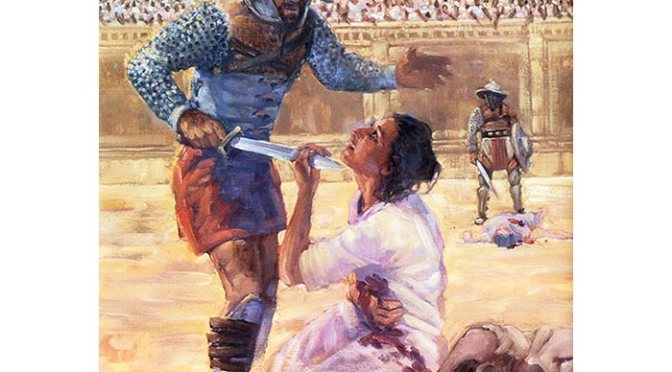
Twenty-two-year-old Perpetua, who had a breastfed infant son, had recently completed her discipleship and been baptized when she was condemned to die in the arena for her allegiance to God and Christ. Understand that her discipleship and martyrdom occurred when cheap grace, with its self-centeredness, and today’s ‘get-saved-quick’ culture, would have been unfamiliar concepts. Discipleship often took up to three years and required close mentoring and observation to ensure that the trainees (catechumens) truly understood the potential cost of their faith before being admitted to the Christian community and, presumably, God’s kingdom.

Perpetua weighed the costs and chose to relinquish all earthly pleasures for heavenly joys beyond imagination, even though she was offered the chance to keep her life and her infant son by denying Christ. What you’ll read now is from her diary, which was completed by an anonymous eyewitness and friend after her death.

  • Sentenced to death for becoming a slave to Christ: “Hilarianus passed sentence on all of us: we were condemned to the beasts, and we returned to prison in high spirits.”
  • Great joy and evangelism: “Some days later, an adjutant named Pudens, who was in charge of the prison, began to show us great honor, realizing that we possessed some great power within us. … By this time the adjutant who was head of the [jail] [became] a Christian.”
  • Death march: “… it was chosen that their sex might be matched with that of the beast. So they were stripped naked, placed in nets and thus brought out into the arena.”
  • Out with the old, in with the new: “… the heifer tossed Perpetua and she fell on her back. Then sitting up she pulled down the tunic that was ripped along the side so that it covered her thighs, thinking more of her modesty than of her pain. … She screamed as she was struck on the bone; then she took the trembling hand of the young gladiator and guided it to her throat.”

Perpetua showed that no one would willingly die for something they didn’t truly believe in. The apostles and early church fathers wouldn’t have lied about the good news of God’s kingdom out of fear of being held accountable by their peers. This should make you think about what’s ahead while you still can. You might wonder, “Ron! Where’s the power button to turn on the kind of faith Perpetua had?” Let’s find out next time!

Blessings and peace,

Dr. Ron Braley

The Problem with Divorce Isn’t Divorce!

Destruction of husband-wife unions and resulting divorce is commonplace. But is divorce the problem or a sin? No. Underlying lies, abuse, and otherwise ungodly behavior are. And adultery isn’t the only culprit.

Traditionally, religious leaders teach that adultery is the only ‘authorized’ reason for divorce. Consequently, people often remain in physically and mentally abusive relationships, even unto death. However, we understand from the Scriptures that valid reasons for divorce can include other violations of promises to love, honor, and cherish.

Acceptable reasons can include grievous offenses that threaten the well-being of a spouse and damage the marriage relationship. This was certainly the case in ancient Israel. Since marriage is often founded on culturally cultivated vows and promises, divorce due to breaking those promises could (and can) also depend on cultural expectations.

Grievous offenses by Israelite women warranting divorce: Adultery is the only one, especially since the marriage bed consecrated the covenant in the first place. Her adultery violated the promise to honor her husband, and is why Jesus, who was speaking to men, said the only valid reason to divorce one’s wife would be sexual immorality.

Accepting Jesus’ response without considering the historical, cultural, or biblical contexts prompts the misbelief that sexual infidelity was, and is, the only valid reason for divorce by either spouse. This has been the unfortunate position held by the Church for many centuries. In fact, the Catholic Church and Protestant offshoots have historically banned divorce except for adultery and, at best, only allowed separation for physical abuse or abandonment. However, Jesus’ non-legalistic response was related to a contemporary ‘any cause’ divorce and Moses’ reluctant permission for men to divorce because of their lack of love and forgiveness. He wasn’t relegating married women to abuse or death unless sexual faithlessness occurred.

Grievous offenses by Israelite men warranting divorce: Husbands were to care for their wives and love them as they love themselves. That meant to protect and provide. What about adultery? Multiple wives and concubines were part of the culture, so this would not have been considered adultery and a marital violation. What would have been? Not providing for or protecting a wife. This could include physical, mental, or emotional harm.

What about today? Remember that marriages are born of promises—vows. Those made or implied in the marriage covenant must not be broken! Lying, cheating, beating, starving, gaslighting, or leaving breaks the agreement, violates godly love, and becomes a valid reason for divorce—especially if left unresolved.

To summarize, divorce is an unfortunate end to a marriage caused by unfaithful or ungodly behavior by either spouse, involving any violation of the marital contract, and possibly harming someone. It can result from neglect, abuse, or sexual infidelity—any broken promise. Next, we’ll learn about ancient martyrs, Perpetua and Felicitas. In the meantime, please treat your spouses with the love Christ taught and modeled, and avoid harmful relationships.

God’s blessings and peace,

Dr. Ron Braley, MDiv, DMin.
God’s Names & Attributes

Father of lights. Father of spirits. Creator, daddy, healer, and provider. All label and describe the One who was, is, and is to come. And, as He is, God cares for His children as no other. What follows is a sampling of God’s many attributes, starting with His name.

  • God’s name. Hebrew YHVH is His formal name, usually pronounced as Jehovah or Yahweh. Conversely, the Bible mentions ‘in the name’ of God or Christ. Just ending a prayer “In Jesus’ name!” is not what this means—it’s their power, character, and authority by which followers must operate.
  • Creator & Father. “This is the account of the heavens and the earth when they were created, in the day that the LORD God made earth and heaven.” (Genesis 2:4)
  • Daddy. One of the coolest names of God is Abba, which means ‘daddy’ or ‘papa:’ “And He was saying, “Abba! Father! All things are possible for You; remove this cup from Me …” (Mark 14:36)
  • King/Lord. “The God who made the world and all things in it, since He is Lord of heaven and earth, does not dwell in temples made with hands.” (Acts 17:24)
  • Shepherd (YHVH Rohi). Psalm 23:1-3 reflects this attribute: “The LORD is my shepherd, I shall not want.  He makes … He leads … He restores … He guides …”
  • Healer (YHVH Rapha). Exodus 15:26 states “If you will give earnest heed to the voice of the LORD your God, and do what is right in His sight, and give ear to His commandments, and keep all His statutes, I will put none of the diseases on you which I have put on the Egyptians; for I, the LORD, am your healer.”
  • Provider (YHVH Jireh). God gives so many things, including food, shelter, money, transportation, and salvation.
  • Savior. We see the saving hand of YHVH through His Son, whom we call Jesus, who obediently came to earth, lived as a human, died a horrible death, and was raised by the Father to be the first of many who would be raised on the last day: “We have seen and testify that the Father has sent the Son to be the Savior of the world.” (1John 4:14)
  • Judge. YHVH’s Son will judge everyone at the end of this age. Some will then enter eternal life. Others will experience eternal destruction (2 Corinthians 5:10; Matthew 25:31-46): “Therefore having overlooked the times of ignorance, God is now declaring to men that all people everywhere should repent, because He has fixed a day in which He will judge the world in righteousness through a Man whom He has appointed, having furnished proof to all men by raising Him from the dead.” (Acts 17:30-31)

Summary. God can be Father, Daddy, Creator, Healer, Provider, and Savior. Is He yours? Next time, we’ll dive into the complex topic of divorce. Meanwhile, remember the Father of Spirits and honor Him appropriately.

God’s blessings and peace,

Dr. Ron Braley, MDiv, DMin.

What God Hates

While God loves many things, there are things He hates. Some, such as sexual immorality and deviousness (Proverbs 3:32), are disgusting—an abomination, according to the ancient language (Hebrew to-ay-baw’, to-ay-baw’). This makes sense, as He designed us to reflect His character and behave as He created us. Anything else is disrespectful and counter to God’s design. Here, we’ll focus on several categories of disgusting things after considering why they happen. But, before we do, a caveat: All rebellion against God is bad, and none is better or worse than another—the same fate awaits all who practice such things.

Why do we do stuff that God hates? Self-centeredness that seeks personal pleasure over obedience to God. Verse 1 John 2:16 states that, “For all that is in the world—the lust of the flesh, the lust of the eyes, and the pride of life;” these become the root of all kinds of abominations. Sexual immorality is an excellent example and one that deserves special attention because many Christian leaders have turned bad into good and corrupted the Church.

Sexual immorality. This includes adultery, prostitution, incest, bestiality, pedophilia, and homosexuality (Leviticus 18:22 and 20:13; Deuteronomy 22:5). Redefining the ancient language, distorting history, or promoting a self-gratifying love to legitimize disgusting behavior in the Church won’t make it less so or soften God’s response. See my related article for additional information (https://ronbraley.blog/2022/11/10/weed-patrol-weeds-beget-weeds-part-two-sexual-immorality/). Dishonoring God in a variety of ways is also something He hates.

Dishonoring God. Besides what I’ve already listed, God hates our prioritizing other gods, spiritual or material. Lying, especially to the detriment of others, and wicked behavior are also disgusting according to God (Proverbs 12:22; Exodus 20:16). God hates the abuse of His name (Exodus 20:7), which concerns His character and authority, not syllables. For instance, Ezekiel 13:6 condemns prophets who “see false visions and utter lying divinations” and claim, “This is what the Lord declares,” when He has not spoken. See also Jeremiah 14:14 and 23:16 and Deuteronomy 18:20. If I only had a dollar for every time I heard, “The Spirit said this…” or “God told me that …”)! God also hates the poor treatment of people.

Hurting people. Sexual immorality, lying, and injustice that God hates, as I’ve already mentioned, negatively affect humans. Add murder, theft, malice, slander, and envy (e.g., Galatians 5:19-21; 1 Corinthians 6:9-10). God commands us to love our neighbors charitably. So, the lack of love would be something He also hates, as evidenced by the hell-bound nature of those who don’t care for the less fortunate. Matthew 25:31-46 tells us that we’ll be judged for how we care for them. And Jesus chided the Pharisees for honoring the religious tithe instead of treating people appropriately (Matthew 23:23; Luke 11:42).

Summary. God hates, and often finds disgusting, behaviors that violate His standards and dishonor Him and hurt people. Next, let’s learn more about God through His names and attributes!

God’s blessings and peace,

Dr. Ron Braley, MDiv, DMin.

What God Loves

God is Love; He does love, and He experiences love … just like we do.  He loves things like justice, mercy, purity, righteousness, obedience, and loving kindness. As imagers of God, we should love what He loves and hate what He hates. Let’s focus on the things God loves here (we’ll cover rebellion and the things He finds disgusting next time!).

I began this article with the phrase, “God is Love.” Read 1 John 4:7-16 (at least!) and you’ll find these golden nuggets: “for love is from God” and “for God is love” and a reminder in verse 10 that He loved us so much that He sent His Son to satisfy our sin debt. Finally, verse 16 states that, “We have come to know and have believed the love which God has for us. God is love, and the one who abides in love abides in God, and God abides in him.” God is love … and He, therefore, loves actionably. Salvation and discipline are but two examples.

God loves His creation (even if He doesn’t always like us or what we do (e.g., Genesis 6:6-7)). In fact, He loves us so much that He provided a way back to Him through Jesus’ death and resurrection (John 3:16). This is how “God demonstrates His own love toward us, in that while we were still sinners, Christ died for us” (Romans 5:8). And He corrects those He loves as any good father would (e.g., Proverbs 3:12 and Hebrews 12:6). God also loves righteousness, which is ‘right action’ according to His standards, and justice.

So, what is justice and its relationship to righteousness? Fairness and moral rightness in the way people are treated and how laws are applied. Because God loves His creation, it’s easy to see why justice and righteousness are essential. Psalm 37:28 teaches that God “loves justice, and does not forsake His saints”—a sentiment echoed in Psalm 146:8 and Isaiah 61:8. And Micah 6:8 reiterates that God desires for us to love kindness, do justice (as He does), and walk humbly with Him. OK. God loves us, justice, righteousness, and mercy. How do these manifest in practice?

As God’s ambassadors and partners, we are called to care for the less fortunate. In mercy, we must be fair and impartial. In righteousness, we must behave as God intended, as He loves: sexual purity, patience, self-control, and charity (see Matthew 25:32-46). Our charitable actions toward the poor may include sharing money, food, time, or talents; we give to others what God has given to us. In other words, our spirit, created by the ‘Father of Spirits, ’ must move the human mammal to do good, pure things. This is what God desires, what He loves.

Summary. God loves the charitable, merciful, just, and righteous person. Love what He loves; do what He does. In the next installment, we’ll, conversely, learn about what God hates.

God’s blessings and peace,

Dr. Ron Braley, MDiv, DMin.

No King but YHVH

“We have no king but Caesar!” the Jewish high priests exclaimed to Pontius Pilate, who would send Jesus to be crucified. Conversely, we experienced a flurry of ‘No Kings!’ protests on June 14, 2025, in opposition to President Donald Trump’s authoritative measures. Have a king; don’t have a king … Which is it? Like it or not, the Creator of the universe is king and owns everything, whether people demand a human king or defy any kingly rule.

The Jewish people understood the Creator’s name to be represented by the four Hebrew consonants YHVH. We who have been adopted into His family pronounce it Yehovah or Yahweh, depending on how you consider the V. The apostle Paul explained nearly 2,000 years ago that YHVH made everything and is King over all in His realm and our created world (Acts 17:24). So, the heavens and the earth are His throne (Matthew 5:34). YHVH owns everything and was recognized by the Jews as their King until about 1,000 BCE.

Selfishly, we generally want what others have. Such was the case with the 10th-century BCE Jews, who decided to be governed by a human king like other nations: “Now appoint a king for us to judge us like all the nations … Give us a king to judge us.” The LORD said to Samuel, ‘… they have rejected Me from being king over them.’” (1 Samuel 8:5-7) The Jewish people would eventually have a puppet king under the Roman leaders and then … none.

Yet, YHVH was, is, and will be King, whether humans recognize His sovereignty. Old Testament king David expressed this in Psalm 47:2 & 7: “For the Lord Most High is awesome; He is a great King over all the earth” and “For God is the King of all the earth … God reigns over the nations, God sits on His holy throne.” Similarly, New Testament Paul wrote this about YHVH, the one true King, in 1 Timothy 6:15: “… He who is the blessed and only Sovereign, the King of kings and Lord of lords.”

So, what about the future? YHVH will eventually tire of our nonsense and immoralities and redo everything. Then, His realm and ours will become one again as was the case in Eden, as we find in Revelation 22:3-5: “There will no longer be any curse; and the throne of God and of the Lamb will be in it … And there will no longer be any night; and they will not have need of the light of a lamp nor the light of the sun, because the Lord God will illumine them; and they will reign forever and ever.”

Summary. Like it or not, you have a King that is above all and rules over everything, including you and even Trump! Soon, I’ll contrast what that King loves against what He hates: What He loves, first. Meanwhile, choose your king well!

God’s blessings and peace,

Dr. Ron Braley, MDiv, DMin.

Airtight Alibi

Traveling back to North Dakota after attending a Lute Society of America seminar decades ago, I encountered a young lady carrying healing tuning forks and crystals. I asked, “Why do you believe in this stuff?” Her response was, “I dunno—it just seems right.” God-fearing Christ-followers have a different approach and airtight alibi: we know what and in whom we believe and why.

Many things lend credibility to what we know to be true, from eyewitness accounts and personal experiences to fulfilled prophecies. They help us to have a defense for the “hope that is within us,” according to the apostle Peter, who shared his knowledge and experiences-fueled alibi with excellent results.

During the first Pentecost after Jesus’ ascension, God’s Spirit enabled the apostles to preach the Gospel in their languages. Peter taught about “Jesus the Nazarene, a man attested to you by God with miracles and wonders and signs which God performed through Him in your midst,” who “God raised … up again.” Peter’s preaching touched the hearts of the listeners who believed and asked, “Brethren, what shall we do?” Peter said to them, “Repent …” (Acts 2:22-24, 32-33, and 37-38). The apostle Paul was also a rockstar with an airtight alibi.

Besides the thousands he shared his Christian alibi with, Paul mentored Timothy, a young Greek. In 2 Timothy 1:8-12, Paul reminds him that Jesus has “abolished death and brought life and immortality to light.” Paul is so sure of all Jesus has enabled that he writes, “for I know whom I have believed and I am convinced that He is able to guard what I have entrusted to Him.” Paul’s alibi in Athens is the stuff of legend!

On trial for preaching a foreign God, Paul connected with his accusers and others by acknowledging their religious nature and mapping their ‘unknown god’ to the one true God. Read Acts 17:19-31, and you’ll find this golden nugget: “God is now declaring to men that all people everywhere should repent, because He has fixed a day in which He will judge the world in righteousness through a Man whom He has appointed, having furnished proof to all men by raising Him from the dead.”

Here’s a final arrow for your airtight alibi quiver: an unbreakable chain of custody and eyewitness accounts. Church father Irenaeus was a disciple of Polycarp, who was a disciple of the apostle John, who was a disciple of Jesus. And Jesus fulfilled hundreds of ancient prophecies, was killed, resurrected, and then appeared to hundreds of people, including the apostles (1 Corinthians 15:6-8).

Summary. We who believe in and follow Jesus have plenty to develop an airtight alibi. Having and living by one is essential to a healthy marriage-like relationship with God and effective evangelism, proving He is King, the only rightful one. No King but YHVH seems like a great topic, so let’s go there next time! Meanwhile, learn well, behave well, and live.

God’s blessings and peace,

Dr. Ron Braley, MDiv, DMin.