
Category Archives: Finding Answers to Stuff Churches Don’t Discuss

Blogging about real-life stuff where we apply God’s guidance

The Dangers of Being Ill-prepared

December seventh marks the 81st anniversary of the Japanese attack on Pearl Harbor, Oahu, Hawaii. Approximately 3,581 people were killed or wounded, 169 aircraft destroyed, and 19 ships destroyed or damaged (https://www.census.gov/history/pdf/pearl-harbor-fact-sheet-1.pdf). We must honor those who lost their lives defending our great nation! But as horrific and destructive as the attack was, the extent of the carnage was possible only because the island was unprepared for the enemy.

According to pearlharbor.org, the imminent attack appeared on newly installed radar equipment but was quickly dismissed as American aircraft (at the very least). The lack of training added to being unprepared for what was coming. Another challenge was the unpreparedness of aircraft, which were ill-parked, not fully fueled, and unarmed. As catastrophic as the December 7, 1941 events were, though, being unprepared for what will come at the end of this world will yield unimaginable physical and spiritual destruction!

In Matthew 25:1-13, Jesus used a parable to foretell how unprepared humanity will be at the end of this age before the great judgment (Matthew 25:31-46). In the parable, ten potential brides (humankind) anticipate the arrival of the bridegroom (Jesus). However, half are unprepared, missing their opportunity to attend the marriage ceremony (Revelation 19:6-10). Being prepared to make it through this life and enter the one to come requires complete devotion to God. We must stay that way, loving others and being transformed. If you’re unsure how to proceed, contact me through the Taylor Press editor or at Northview Christian Church (www.nvcc.church), and I’ll happily make time for you!

Anyway, those who belong to Christ (not just know of Him!) must also stay equipped to fend off spiritual attacks. According to the apostle Paul, we can do this by donning the complete protection God offers: His truth, righteousness (God’s standard), peace, faith, salvation, and teaching (Ephesians 6:10-18). We must pray regularly and often and be alert against subtle wickedness, such as the immoralities so prevalent today.

In summary, let’s decide to return to our God before it’s too late and then stand firm and prepared to resist what He hates. What’s next? Christmas is approaching, and some of us will celebrate the birth of One who suffered on our behalf. So, let’s consider that it is The Sufferer’s Holiday.

Blessings and peace,

Dr. Ron Braley,

ron@ronbraley.com  || ronbraley.blog

Turning Bad Into Good!

Winter is coming. When I realized that, I probably said something like, “Man! Why?? My life is over for the next several months!” But is it?

As it turns out, winter is a necessary refreshing that gives birth to springtime and then summer. Like King Solomon wrote, “There is an appointed time for everything.” (Ecclesiastes 3:1) Enduring the cold, sometimes dreary weather actually makes me stronger in several ways. Now, I realize that making it through winter isn’t quite like enduring life’s hardships, but the idea is similar. Here’s what James, Jesus’ half-brother, said about faith and enduring:

Consider it all joy, my brethren, when you encounter various trials, knowing that the testing of your faith produces endurance. (James 1:2-3).

Sometimes, our life can feel like a perpetual winter. My sister and a good friend are working through bouts of cancer. Two other friends are unemployed and faced with potential financial hardships. I’m working through my own trials as I seek to re-enter the workforce after a several-year sabbatical and heal from a recent knee replacement. Yet, some of us are persevering—enduring—with outstanding attitudes and strong responses. That kind of character supplies hope, potentially in this life and indeed in the one to come. The apostle Paul taught the Roman Christians that their endurance through trials would produce excellent character, which would, in turn, develop hope:

And not only this, but we also exult in our tribulations, knowing that tribulation brings about perseverance; and perseverance, proven character; and proven character, hope (Romans 5:3-4)

Don’t worry. If you’re going through trials or struggles and you’re a child of God, you have His Spirit to comfort, teach, and guide you. As with winter, remember that whatever you’re experiencing will likely end, and ‘spring’ will come. You’ve got this! But if you feel you’re losing the struggle or need a hand, seek professional help right away! What’s next? As we approach remembrance of the Pearl Harbor destruction of December 7, 1941, we’ll explore the dangers of being unprepared—spiritually, in our case.

Blessings and peace,

Dr. Ron Braley

An Attitude of Gratitude for Latitude

The Bible reflects a grateful attitude for what God and others have done in many places! Here are a few examples:

Enter His gates with thanksgiving And His courts with praise. Give thanks to Him, bless His name. (Psalm 100:4)

Let them give thanks to the LORD for His lovingkindness, And for His wonders to the sons of men! Let them also offer sacrifices of thanksgiving, And tell of His works with joyful singing. (Psalm 107:21-22)

We also find a grateful apostle Paul:

First, I thank my God through Jesus Christ for you all, because your faith is being proclaimed throughout the whole world. (Romans 1:8).

And he reminds us always to be thankful to God as we continue to ask Him to meet our needs:

Be anxious for nothing, but in everything by prayer and supplication with thanksgiving let your requests be made known to God. And the peace of God, which surpasses all comprehension, will guard your hearts and your minds in Christ Jesus. (Philippians 4:6-7)

If you think about it, we can (and should!) be grateful for so many things, including family, friends, jobs, and God’s creation itself. So, expressing gratitude—especially toward God—seems to be important! Why? Giving thanks for what we receive or experience is an appropriate response that completes a transaction: you have received something, so you give something in return. And having a grateful attitude can also be physically and emotionally beneficial.

 Practicing gratitude “reinforces generous behavior, squeezes our negative feelings, and can help with depression” (https://www.heysigmund.com/the-science-of-gratitude/). Also, “research has found that we tend to feel more grateful for experiences than for things we have.” Being grateful causes us to change our focus from our issues and troubles and makes us feel better as if we’ve received an emotional ‘shot in the arm.’ I want to share one of my experiences.

In 1994, I opened an electronics repair and computer business. Naively, I wasn’t financially prepared, and my family was without money for food by early 1995. My church didn’t help. They were friendly, but not ‘kind.’ However, one of my customers, a kind Catholic woman who heard of our situation, rallied her congregation to buy groceries before, during, and after Thanksgiving and Christmas gifts for our four children. Her selfless acts were purely sacrificial and loving. Our gratitude for what she and the others in her church did gave us relief from our struggles and empowered us also be kind to others over the years.

In closing, I’ll tell you that I’m thankful for every one of you who reads and ponders my articles. They are my gift to you, and I’m grateful for your readership. What’s next? Well, let’s continue our journey of self-improvement in Turning Bad Into Good.

Blessings and peace,

Dr. Ron Braley

Fig Trees & The End of the World

“Ron, what do fig trees have to do with the end of the world and God’s judgment?” Lots! In the Bible’s New Testament, we find multiple end-of-the-world and fig events.

First, in Peter’s account that bears the name of his scribe, Mark, we find an interesting parable about Jesus cursing a fig tree on the Mount of Olives (Mark 11:12-14). Jesus picks out one tree of probably thousands to make a point about the nation of Israel. Although the figs weren’t ready to be picked (verse 13), there should’ve been fruit because there were leaves. The tree was like the Pharisees who gave an outward impression of [spiritual] fruit where none existed. Jesus, in an active parable, cursed the tree to demonstrate judgment that would come soon through Rome and at the end of this world. Think of this as a near-far prophecy revealed by Jesus with the fruitless fig tree. Are there other instances? Yep!

Second, Jesus explained days later to His disciples that any unproductive—unfruitful—person, including self-proclaimed Christians, would be destroyed in the last-days judgment:

If anyone does not abide in Me, he is thrown away as a branch and dries up; and they gather them, and cast them into the fire and they are burned (John 15:6). Also, read Matthew 25:31-46.

Or … If you keep My commandments, you will abide in My love; just as I have kept My Father’s commandments and abide in His love (John 15:10).

So, the one who bears spiritual fruit by obeying God’s commandments will not suffer the same fate (destruction) as the cursed fig tree. Alright—one more end-of-the-world figgie thingie!

Finally, Jesus used the blossoming of the fig tree at springtime in a when you see this, you will see that comparison to explain that the generation of people to see the signs He had just prophesied in verses 14-27 will also see His return:

Now learn the parable from the fig tree: when its branch has already become tender and puts forth its leaves, you know that summer is near. Even so, you too, when you see these things happening, recognize that He is near, right at the door. Truly I say to you, this generation will not pass away until all these things take place. (Mark 13:28-30).

I understand that some Christians believe that “this generation” in verse 30 refers to the disciples’ generation. However, “this generation” will be the one to see the end-of-the-world signs, which haven’t occurred. By the way: this fig tree instance is a Jewish idiom (figure of speech) just like Matthew 24:28 (dead bodies and vultures).

In summary, we who desire to abide with God must bear fruit or suffer destruction by our own choice. What’s next? Let’s have some fun with being thankful in all circumstances in A Gratitude Attitude for Latitude!

Blessings and peace,

Dr. Ron Braley

Cheap Grace

Now, I’m a Protestant Christian by default, but we live in a Protestant ‘get saved quick’ culture whereby someone may be told to say a silent and unbiblical ‘sinner’s prayer’ to avoid hell and go to heaven. There’s often an invitation to invite Jesus ‘in’ instead of an outward devotion of all we are and have to the King (e.g., Matthew 22:37; Romans 10:9-10). Few understand the cost of a relationship with God, so that’s where things usually stall. For about 85% of people who ‘get saved,’ there’s no discipleship, disciple-making, or charitable activity. This grace is one-sided and cheap, and it devalues our ransom paid by Christ. The Bible tells of costly grace, though—something about which Dietrich Bonhoeffer addressed in his book, The Cost of Discipleship:

Cheap grace is the grace we bestow on ourselves. Cheap grace is the preaching of forgiveness without requiring repentance, baptism without church discipline, Communion without confession, absolution without personal confession. Cheap grace is grace without discipleship, grace without the cross, grace without Jesus Christ, living and incarnate. Costly grace is the treasure hidden in the field; for the sake of it a man will gladly go and sell all that he has. . . . Costly grace is the gospel which must be sought again and again, the gift which must be asked for, the door at which a man must knock. Such grace is costly because it calls us to follow, and it is grace because it calls us to follow Jesus Christ.

What about the ‘get saved’ history? It was never a thing until after the formal Protestant Reformation. From the beginning of Christian history until then, converts were either part of the universal Church or not. They responded appropriately to God’s call through Christ and lived transformed lives within their communities until they died, or they didn’t. The idea of an instant and permanent one-sided passive salvation wasn’t, and still isn’t, a thing in many Christian circles, including Roman Catholic and Eastern Orthodox faiths. “So, Ron—then how do I become part of Christ’s universal Church?” Good question!

There’s nothing ‘quick’ about entering God’s rest now and rescuing from His wrath at the end of this world. The lifelong process appears to be: (1) become equipped for decision-making through things such as Scriptures and evangelism (e.g., John 20:30-31), (2) decide to respond to God’s call through devotion, love, and discipleship (Matthew 22:34-40; Romans 10:9-10), and (3) remain in the relationship (John chapter 15). In other words, understand well, choose well, and then stay and grow spiritually, no matter the cost.

What’s next? Well, I’m an end-of-the-world guy (Finding the End of the World, 2011) and recently ate some fig bars on a mini vacation. So, I’m motivated to write about Fig Trees & The End of The World. See you next week!

Blessings and peace,

Dr. Ron Braley

What’s in Your Wallet??

A wise man once prayed something like: “God – please provide enough for my family and me so that I’m not tempted to steal, and not so much that I forget what it’s like to be in need.” I like the prayer because it shuns gluttony but seeks ‘daily bread.’ It begs remembrance of the poor and hungry so that the one praying will then feed, house, and clothe the less fortunate, just as Jesus commanded.

The Son of God summarized the Old Covenant laws and prophecies with two statements from the ancient Jewish Torah: treat God appropriately and people charitably (Matthew 22:35-40). Do you know that we’ll be judged at the end of this age on whether we obeyed those commandments (Matthew 25:31-46)?

We often see two extremes when it comes to our treasures: those who give generously for their fellow humans and those who love wealth. In the first group, we find Jesus and other servants who have given their lives for people they often don’t know. They may have also given generously to help feed, clothe, or house others. These people reflect the face of our God who created the spirit within us; their focus isn’t on self and material things.

What about the other group? There, you’ll find people who horde resources despite the suffering around them. They love money and stuff and entertainment, and that’s their focus. Perhaps they’ll give a few dollars here and there for charity but then spend thousands on a new shiny bobble or the latest electronic thing. These people reflect not the face of our creator but passion and self-serving nature.

If we want to look more like the first group, we need to be content with what we have, avoiding the love of money, which is the “root of all sorts of evil” (1Timothy 6:6-11; Hebrews 13:5). If possible, stay out of debt to avoid becoming a slave (Proverbs 22:7) and don’t store up treasures on earth. Be charitable. In Matthew 6:19-21, Jesus also reminds us that “where our treasure is, there our heart will also be.” Where’s your heart? What’s in your wallet? Is it money earmarked to help the hungry or less fortunate? Or would we discover bountiful plastic or lots of cash destined for food, drink, entertainment, and the latest shiny thing?

What about next week? Let’s explore some of the challenges of our ‘get saved quick’ Protestant Christian culture in Cheap Grace.

Blessings and peace,

Dr. Ron Braley

Wacky Zaccy!

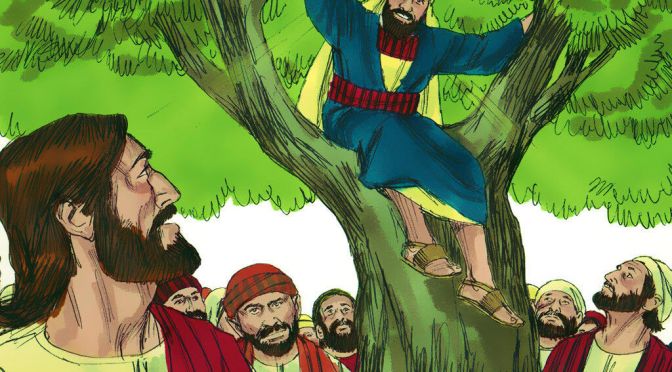
Nearly 2,000 years ago, a short guy got up into a tree to see and hear Jesus teach and then did something remarkable after being called out. Here’s what Luke reports about that guy and time (Luke 19:1-8):

He [Jesus] entered Jericho and was passing through. And there was a man called by the name of Zaccheus; he was a chief tax collector and he was rich. Zaccheus was trying to see who Jesus was, and was unable because of the crowd, for he was small in stature. So he ran on ahead and climbed up into a sycamore tree in order to see Him, for He was about to pass through that way. When Jesus came to the place, He looked up and said to him, “Zaccheus, hurry and come down, for today I must stay at your house.” And he hurried and came down and received Him gladly. When they saw it, they all began to grumble, saying, “He has gone to be the guest of a man who is a sinner.” Zaccheus stopped and said to the Lord, “Behold, Lord, half of my possessions I will give to the poor, and if I have defrauded anyone of anything, I will give back four times as much.”

Luke tells us that Zacchaeus was a Chief Tax Collector. Is that important to the story? Yep! He was a Jewish man who collected taxes from his people for the Roman government. Think of it as the ancient IRS! So, you can imagine that Zacchaeus wasn’t very popular with the townspeople! Strike one! Here’s the rub: tax collectors could collect as much as they wanted as long as the Romans received a certain amount. Collectors were to keep a small portion for their trouble. Anyway, the problem was that many kept more than was reasonable. Strike two!

Why did Zaccy’s homies think he was a sinner? It’s because he likely stole from them by keeping more than he should’ve. He all but admits to the defrauding in the final verse above. But what appears to be a story about a short guy and a tree is a beautiful lesson in true repentance—a change of behavior that came about because of a new heart. Zacchaeus could’ve, like many of us, just said something like, “Well, I’m sorry!” But he didn’t stop there, volunteering to give back more than he stole.

As a result, Zaccy is likely someone who stands tall in God’s Kingdom. How can we do the same? To start, we must turn “I’m sorry” into something useful by changing our behavior and making things right, as Zacchaeus did. Then, we learn about God’s ways and do them consistently! What about next week? Well, I think we’ll test our priorities in What’s in Your Wallet?

God’s blessings and peace to you,

Dr. Ron Braley

Godly Obedience

It’s July 8, 1741, in Enfield, Connecticut. Reformation preacher Jonathan Edwards turns the hearts of hundreds of listeners as he explains that their disobedience to God’s commandments [to honor Him and love people] has put them in a precarious position:

Your  Wickedness  makes  you  as  it  were  heavy  as  Lead, and to tend downwards with great Weight and Pressure towards Hell; and if God should let you go, you would immediately sink and swiftly descend & plunge into the bottomless Gulf, and your healthy Constitution, and your own Care and Prudence, and best Contrivance, and all your Righteousness, would have no more Influence to uphold you and keep you out of Hell, than a Spider’s Web would have to stop a falling Rock.

Don’t worry—this week’s article isn’t fire-and-brimstone teaching; however, there’s certainly great value in simple instruction about the consequences of obedience or disobedience to God’s commandments. But what are the commandments? Do we really need to do them?

Jesus reiterated two overarching commands from the Torah (the first few books of the Old Testament): Honor God with all we are and have, and love people (cf., Matthew 22:34-40). He stated that everything taught about God’s ways can be wrapped up in those two commands. He went on to say that:

If you love Me, you will keep My commandments. (John 14:15)

Jesus answered and said to him, “If anyone loves Me, he will keep My word; and My Father will love him, and We will come to him and make Our abode with him. He who does not love Me does not keep My words; and the word which you hear is not Mine, but the Father’s who sent Me.” (John 14:23-24)

Seems simple—right? Not really. If it were, we wouldn’t continually mess up, treat people horribly, and speed down that highway to hell so-to-speak. Here are a few abbreviated tips I pulled from the Bible that may help you obey, stay in the relationship with Father and Son, and inherit the Kingdom of God:

  • they love is pointless and deadly (James 2:14-26). So, help others; feed the hungry; be slow to speak and quick to listen; be slow to respond as you give reconciliation a chance (Matthew 5:39).

What about next week? Well, I think I’ll tell you about the short guy (not me!) who stands tall in the Kingdom of God: Wacky Zaccy!

Blessings and peace,

Dr. Ron Braley
Citizenship in the Kingdom of Heaven

“Hey, Ron – I just need to say that I believe in Jesus to go to Heaven, right?” Not exactly. Neither God our heavenly Father nor Son we call Jesus need or want our affirmation. They seek willing partners to introduce other people to the Kingdom of Heaven now and to join them in the age to come (2Corinthians 5:17-20, for instance). So, a better question might be: “Hey Ron – how do I become God’s partner?” Great question!

Anyone wishing to enter God’s Kingdom must be regenerated from above (a better rendering of the born again we find in John 3:1-15) through the Living Water Jesus offers and the Holy Spirit the Father gives in return for our devotion. Citizenship in God’s Kingdom begins with receiving the Living Water of Jesus by believing that He truly is the Son of God and then responding with complete dedication of self and resources. This is what ‘Jesus is Lord’ means. Devotion isn’t making God responsible for our choices or actions—it’s an offering to the King of Heaven of all we are and have. We are to put away our selfish nature—die to self (Luke 9:23-24; 1Corinthians 15:31). That requires obedience.

Obedience to what? In quoting the Old Testament (see Deuteronomy 6:5 and Matthew 22:34-40), Jesus said that we must honor the Father with all we are and have. He continued by demanding that we love others as we love ourselves (see my earlier post on love). If we love Him, we’ll obey those commandments (John 15:12 & 14:15; 1John 3:14). Everything the Old Testament teaches about what God desires, including about how to treat others, could be done just by putting others first and treating them like we wish to be treated as we live as servants and yet partners with the King.

To sum up, so far, applying for citizenship in God’s Kingdom requires belief, complete devotion, and loving action. When we do this and engage in the things of God through study, discipleship, and prayer, we are changed—transformed. The path of citizenship may seem challenging, if not impossible. But we have help! The Spirit in the born-again conversation Jesus had with Nicodemus is the Spirit of God. He teaches and comforts us and is our partner in devotion to the Father and loving others.  He also helps us change from the inside out, from mind to behavior. The Spirit also makes it possible for us to remain—abide— as a citizen of Heaven (see John 15:1-10, for example).

Believe. Devote. Receive the Spirit of God and move where He leads you! Have you already done and are doing that? Then, welcome, citizen of Heaven! Next week, we’ll continue to consider God’s desires as we delve further into Godly Obedience.

Blessings and peace,

Dr. Ron Braley

Playing With Fire!

God has always demanded allegiance and obedience. There’s no middle ground, no room for ‘fudging’ things, and no gray area. He commanded Adam and Eve not to eat the fruit of a particular tree. They disobeyed, and we lost our access to the Tree of Life (but only until God returns creation to the perfection it once enjoyed!). Lot’s wife played with fire and lost her life for taking one last peek at her old lifestyle (Genesis 19). There are many other examples in the Bible of people who ‘pushed the envelope,’ testing God’s commandments. We do the same today.

God tells us to stay away from interaction with the spirits of the dead, but we engage mediums and psychics (Deuteronomy 18:10-13). We indulge in astrology, relying on created things to determine our fate instead of trusting the Creator. And testing God’s commands where sexuality is concerned is a vast area where many Christians play with fire (literally and figuratively)!

God is clear about the destination of those who practice sexual rebellion, such as adultery and homosexuality (1Corinthians 6:9-10). We are also warned to carefully choose what we listen to and observe (Matthew 6:22-23; Job 31:1; Philippians 4:8). Here’s an interesting fact: people wanting to become Christians in the first couple of centuries couldn’t if they, at the same time, participated in the theater because of the sensuality and immoralities it often portrayed (just like today!). Why must we take care of what we watch? Because the input helps map the pathways in our brain and can cause us to ‘boil the frog’ as we slowly allow or condone or ignore—become desensitized to—the things God hates. This is where watching pornography comes in.

Pornography (Greek porneia and graphe) is a compound ‘catch-all’ word representing all kinds of sexual immoralities. Indulging in anything sexually immoral, even just visually, tests God’s commands and His desires for our conduct; it won’t end well. Here’s a shortlist of other ways Christians play with fire where God is concerned:

  • We must tell the truth—especially where the welfare of others is concerned (Exodus 20:16). But lying has become pervasive.
  • We must not idolize (covet) things, but we do it all the time (stuff, sports, people, multimedia—anything but God’s ways) (Exodus 20:17; 1 John 2:15-17).
  • We are commanded to rest one day each week (for many reasons, including physical, spiritual, and mental health) (Exodus 20:10; Mark 2:27-28); however, few do this religiously.

Just because the proverbial lightning hasn’t struck us down as we rebel against God doesn’t mean that our playing with fire won’t result in judgment and destruction. So, if you’re playing with fire by doing anything God is against, please stop and change direction—fast! Next week, we’ll continue to consider God’s desires as I outline the requirements for Citizenship in the Kingdom of Heaven.

Blessings and peace,

Dr. Ron Braley