Tag Archives: Holy Spirit

Cheap Grace

Now, I’m a Protestant Christian by default, but we live in a Protestant ‘get saved quick’ culture whereby someone may be told to say a silent and unbiblical ‘sinner’s prayer’ to avoid hell and go to heaven. There’s often an invitation to invite Jesus ‘in’ instead of an outward devotion of all we are and have to the King (e.g., Matthew 22:37; Romans 10:9-10). Few understand the cost of a relationship with God, so that’s where things usually stall. For about 85% of people who ‘get saved,’ there’s no discipleship, disciple-making, or charitable activity. This grace is one-sided and cheap, and it devalues our ransom paid by Christ. The Bible tells of costly grace, though—something about which Dietrich Bonhoeffer addressed in his book, The Cost of Discipleship:

Cheap grace is the grace we bestow on ourselves. Cheap grace is the preaching of forgiveness without requiring repentance, baptism without church discipline, Communion without confession, absolution without personal confession. Cheap grace is grace without discipleship, grace without the cross, grace without Jesus Christ, living and incarnate. Costly grace is the treasure hidden in the field; for the sake of it a man will gladly go and sell all that he has. . . . Costly grace is the gospel which must be sought again and again, the gift which must be asked for, the door at which a man must knock. Such grace is costly because it calls us to follow, and it is grace because it calls us to follow Jesus Christ.

What about the ‘get saved’ history? It was never a thing until after the formal Protestant Reformation. From the beginning of Christian history until then, converts were either part of the universal Church or not. They responded appropriately to God’s call through Christ and lived transformed lives within their communities until they died, or they didn’t. The idea of an instant and permanent one-sided passive salvation wasn’t, and still isn’t, a thing in many Christian circles, including Roman Catholic and Eastern Orthodox faiths. “So, Ron—then how do I become part of Christ’s universal Church?” Good question!

There’s nothing ‘quick’ about entering God’s rest now and rescuing from His wrath at the end of this world. The lifelong process appears to be: (1) become equipped for decision-making through things such as Scriptures and evangelism (e.g., John 20:30-31), (2) decide to respond to God’s call through devotion, love, and discipleship (Matthew 22:34-40; Romans 10:9-10), and (3) remain in the relationship (John chapter 15). In other words, understand well, choose well, and then stay and grow spiritually, no matter the cost.

What’s next? Well, I’m an end-of-the-world guy (Finding the End of the World, 2011) and recently ate some fig bars on a mini vacation. So, I’m motivated to write about Fig Trees & The End of The World. See you next week!

Blessings and peace,

Dr. Ron Braley

What’s in Your Wallet??

A wise man once prayed something like: “God – please provide enough for my family and me so that I’m not tempted to steal, and not so much that I forget what it’s like to be in need.” I like the prayer because it shuns gluttony but seeks ‘daily bread.’ It begs remembrance of the poor and hungry so that the one praying will then feed, house, and clothe the less fortunate, just as Jesus commanded.

The Son of God summarized the Old Covenant laws and prophecies with two statements from the ancient Jewish Torah: treat God appropriately and people charitably (Matthew 22:35-40). Do you know that we’ll be judged at the end of this age on whether we obeyed those commandments (Matthew 25:31-46)?

We often see two extremes when it comes to our treasures: those who give generously for their fellow humans and those who love wealth. In the first group, we find Jesus and other servants who have given their lives for people they often don’t know. They may have also given generously to help feed, clothe, or house others. These people reflect the face of our God who created the spirit within us; their focus isn’t on self and material things.

What about the other group? There, you’ll find people who horde resources despite the suffering around them. They love money and stuff and entertainment, and that’s their focus. Perhaps they’ll give a few dollars here and there for charity but then spend thousands on a new shiny bobble or the latest electronic thing. These people reflect not the face of our creator but passion and self-serving nature.

If we want to look more like the first group, we need to be content with what we have, avoiding the love of money, which is the “root of all sorts of evil” (1Timothy 6:6-11; Hebrews 13:5). If possible, stay out of debt to avoid becoming a slave (Proverbs 22:7) and don’t store up treasures on earth. Be charitable. In Matthew 6:19-21, Jesus also reminds us that “where our treasure is, there our heart will also be.” Where’s your heart? What’s in your wallet? Is it money earmarked to help the hungry or less fortunate? Or would we discover bountiful plastic or lots of cash destined for food, drink, entertainment, and the latest shiny thing?

What about next week? Let’s explore some of the challenges of our ‘get saved quick’ Protestant Christian culture in Cheap Grace.

Blessings and peace,

Dr. Ron Braley

Godly Obedience

It’s July 8, 1741, in Enfield, Connecticut. Reformation preacher Jonathan Edwards turns the hearts of hundreds of listeners as he explains that their disobedience to God’s commandments [to honor Him and love people] has put them in a precarious position:

Your  Wickedness  makes  you  as  it  were  heavy  as  Lead, and to tend downwards with great Weight and Pressure towards Hell; and if God should let you go, you would immediately sink and swiftly descend & plunge into the bottomless Gulf, and your healthy Constitution, and your own Care and Prudence, and best Contrivance, and all your Righteousness, would have no more Influence to uphold you and keep you out of Hell, than a Spider’s Web would have to stop a falling Rock.

Don’t worry—this week’s article isn’t fire-and-brimstone teaching; however, there’s certainly great value in simple instruction about the consequences of obedience or disobedience to God’s commandments. But what are the commandments? Do we really need to do them?

Jesus reiterated two overarching commands from the Torah (the first few books of the Old Testament): Honor God with all we are and have, and love people (cf., Matthew 22:34-40). He stated that everything taught about God’s ways can be wrapped up in those two commands. He went on to say that:

If you love Me, you will keep My commandments. (John 14:15)

Jesus answered and said to him, “If anyone loves Me, he will keep My word; and My Father will love him, and We will come to him and make Our abode with him. He who does not love Me does not keep My words; and the word which you hear is not Mine, but the Father’s who sent Me.” (John 14:23-24)

Seems simple—right? Not really. If it were, we wouldn’t continually mess up, treat people horribly, and speed down that highway to hell so-to-speak. Here are a few abbreviated tips I pulled from the Bible that may help you obey, stay in the relationship with Father and Son, and inherit the Kingdom of God:

  • they love is pointless and deadly (James 2:14-26). So, help others; feed the hungry; be slow to speak and quick to listen; be slow to respond as you give reconciliation a chance (Matthew 5:39).

What about next week? Well, I think I’ll tell you about the short guy (not me!) who stands tall in the Kingdom of God: Wacky Zaccy!

Blessings and peace,

Dr. Ron Braley

Citizenship in the Kingdom of Heaven

“Hey, Ron – I just need to say that I believe in Jesus to go to Heaven, right?” Not exactly. Neither God our heavenly Father nor Son we call Jesus need or want our affirmation. They seek willing partners to introduce other people to the Kingdom of Heaven now and to join them in the age to come (2Corinthians 5:17-20, for instance). So, a better question might be: “Hey Ron – how do I become God’s partner?” Great question!

Anyone wishing to enter God’s Kingdom must be regenerated from above (a better rendering of the born again we find in John 3:1-15) through the Living Water Jesus offers and the Holy Spirit the Father gives in return for our devotion. Citizenship in God’s Kingdom begins with receiving the Living Water of Jesus by believing that He truly is the Son of God and then responding with complete dedication of self and resources. This is what ‘Jesus is Lord’ means. Devotion isn’t making God responsible for our choices or actions—it’s an offering to the King of Heaven of all we are and have. We are to put away our selfish nature—die to self (Luke 9:23-24; 1Corinthians 15:31). That requires obedience.

Obedience to what? In quoting the Old Testament (see Deuteronomy 6:5 and Matthew 22:34-40), Jesus said that we must honor the Father with all we are and have. He continued by demanding that we love others as we love ourselves (see my earlier post on love). If we love Him, we’ll obey those commandments (John 15:12 & 14:15; 1John 3:14). Everything the Old Testament teaches about what God desires, including about how to treat others, could be done just by putting others first and treating them like we wish to be treated as we live as servants and yet partners with the King.

To sum up, so far, applying for citizenship in God’s Kingdom requires belief, complete devotion, and loving action. When we do this and engage in the things of God through study, discipleship, and prayer, we are changed—transformed. The path of citizenship may seem challenging, if not impossible. But we have help! The Spirit in the born-again conversation Jesus had with Nicodemus is the Spirit of God. He teaches and comforts us and is our partner in devotion to the Father and loving others.  He also helps us change from the inside out, from mind to behavior. The Spirit also makes it possible for us to remain—abide— as a citizen of Heaven (see John 15:1-10, for example).

Believe. Devote. Receive the Spirit of God and move where He leads you! Have you already done and are doing that? Then, welcome, citizen of Heaven! Next week, we’ll continue to consider God’s desires as we delve further into Godly Obedience.

Blessings and peace,

Dr. Ron Braley

Corroborating Apocalypses

What do you think of when you hear or read the word apocalypse? Nuclear war? Missiles, tanks, death, and other violent stuff? The basic form of the ancient word means “to reveal.” In the Revelation given by God to Jesus to give to John to pass on to the churches in Asia Minor (phew!) in about 90CE, Jesus revealed events to come later. That’s why Revelation is apocalyptic. But do you know that Jesus had already told much of the Revelation events or characteristics when He was on earth about 60 years earlier? It’s true!

During the week of His crucifixion, Jesus and perhaps several of His closest disciples walked from the Temple complex to the Mount of Olives. He had said that the Temple would eventually be destroyed and not one of its stones left in place (Matthew 24:1-2). On the Mount of Olives, His disciples asked several related questions: 1. When would this happen, 2. What will signal Jesus’ return to earth, and 3. When will be the end of the age (Matthew 24:3)?

Jesus answers their questions in Matthew chapters 24 and 25, which inform of the beginning of hard times (‘birth pains,’ according to Jesus (Matthew 24:5-8)) to the judgment at the end of this age (Matthew 25:31-46). He gave much more detail about the same timeframe in visions to John about 60 years later. Here’s a brief comparison of what Jesus revealed on earth to what He revealed to John in about 90CE:

  • False saviors (Christs):                                                                 Matthew 24:5 & Revelation 6:2
  • War/violence:                                                                                    Matthew 24:6-7a & Revelation 6:3-4
  • Famine/pestilence:                                                                         Matthew 24:7b & Revelation 6:5-6
  • Terrible time of trouble and persecution (Great Tribulation) by the Antichrist:   Matthew 24:10-13 & Revelation 6:7-12; 7:9-17; 12:17                                
  • Christ’s second coming (ending the Great Tribulation):                                Matthew 24:29-31 & Revelation 6:12-17
  • The Great Judgment:                                                                  Matthew 25:31-46 & Revelation 20:11-15

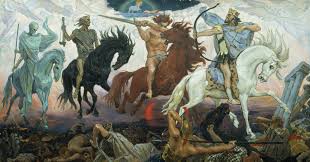
A final note about the False Christs of Matthew 24:5 and Revelation 6:2, which can seem confusing: The horse in Revelation is white and the rider wears a crown, which signifies righteousness and authority; however, his weapon is a bow, not a sword, which is the weapon of Christ (Matthew 10:34; Revelation 19:15 & 21).

In summary, Jesus, who came to earth to satisfy our debt to God, is the same Jesus who revealed end-times things again to John 60 years later. So, it makes sense that the information is related. It seems important! Shouldn’t we study the Bible and pray for illumination by God’s Spirit so that we can find out what God wants and do that before it’s too late??

Next week, we’ll leave the end-times and explore a dangerous practice by many Christians in Playing with Fire.

Blessings and peace,

Dr. Ron Braley
Exploring God’s Will

We often want to know God’s will—especially for us. His will is what He wants to do, primarily to keep us from destruction through our transformation and eventual salvation from His wrath. It is His plan for humankind. In the process, He desires us to be obedient, rejoice, pray, and spread the good news to others. Although we tend to think God’s will is some glorious plan for our individual lives, we should instead focus on helping God see His plan for creation through to completion. That’s all well and good. But what exactly does ‘will’ mean?

The word in the ancient language implies choice, desire, pleasure, or an inclination. So, God’s will can be something He desires (as in Matthew 18:12-14) or His plan for humanity (i.e., Matthew 26:42 or John 6:37-40).

Here are some of God’s desires:

  • That all people are saved from His coming wrath (2Peter 3:9)
  • Obedience, not legalism (Matthew 9:13)
  • Our good works, done because of our faith (1Peter 2:13-16)
  • That we rejoice and pray continuously (1Thessalonians 5:16-19)
  • That we proclaim the good news of His Kingdom & make disciples (Matthew 28:19-20)

What are some benefits of partnering with God to accomplish His desires?

  • Redemption and forgiveness; the reward of everlasting life (John 6:40; Ephesians 1:5-13; Hebrews 10:35-36)
  • We get His Spirit and intercession on our behalf (Romans 8:26-28)

How do we participate in God’s plan and accomplish His desires? First, we must obey His commandments to honor the Father and Son and be charitable to people (1John 5:3; Matthew 22:36-40). We must also abstain from sexual immorality (1Thessalonians 4:2-4). We are to imitate God (Ephesians 5:1-20), allow the Holy Spirit to lead us (Romans 8:14, Galatians 5:25). Making God’s priorities our priorities (Matthew 6:33) is critical, and we must obey our civil leaders and submit to them (Hebrews 13:17).

Whew! That seems like a lot of stuff! But, we can learn what we’re to do in accomplishing God’s will or discovering the answers to our prayers by doing these things:

•           Study the Bible, which teaches principles that help in decision-making (2Timothy 3:16-17).

•           Ask for wisdom (James 1:5-6).

•           Seek wisdom (from family, friends, spiritually mature, etc.) (Proverbs 13:10).

•           Pray!!!

But, we can hinder the accomplishment of God’s will or desires – even for us – through:

•           Bad motives (James 4:3).

•           Bad relationships (1Peter 3:7).

•           Unrighteousness due to disobedience and the lack of the Spirit (John 9:31).

Summary: God has a plan for humanity: salvation through Christ. He also desires fellowship and obedience from us in a pursuit of holiness. We can join in and help accomplish God’s plans or desires, or we can rebel and keep Him from using us or even answering our requests. Of course, this rebellion will result in death. Next week, we’ll take a look at demons with job titles & the ‘spirit’ of biblical abuse.

Blessings and peace,

Ron Braley

Dealing with Temptation

We’re often tempted to do or say unhealthy things. The temptation alone isn’t an issue. However, losing the battle in our mind by sinning or at least intending to sin (rebel against God’s ways) IS! Here’s what Jesus’ half-brother James had to say about this:

But each one is tempted when he is carried away and enticed by his own lust. Then when lust has conceived, it gives birth to sin; and when sin is accomplished, it brings forth death. —James 1:14-15.

So, we must learn to squash temptations before they become intentions and sinful actions. But, what is temptation? It’s a strong desire, but still in the mind. So, it isn’t a problem as long as it stays there. By the way: temptation is common.

No temptation has overtaken you but such as is common to man; and God is faithful, who will not allow you to be tempted beyond what you are able, but with the temptation will provide the way of escape also, so that you will be able to endure it. —1Corinthians 10:13.

We have the freedom to do what we ought—choose the right path and not let temptation lead to sin. We who have the Spirit of God can walk by that Spirit to ensure we don’t sin.

But I say, walk by the Spirit, and you will not carry out the desire of the flesh. For the flesh sets its desire against the Spirit, and the Spirit against the flesh; for these are in opposition to one another, so that you may not do the things that you please. —Galatians 5:16-17.

Reading the Bible daily and praying and meditating all the while can help us imitate Christ as we walk in His ways and away from temptations to do bad things.

Let us behave properly as in the day, not in carousing and drunkenness, not in sexual promiscuity and sensuality, not in strife and jealousy. But put on the Lord Jesus Christ, and make no provision for the flesh in regard to its lusts. —Romans 13:13-14.

And, we should avoid temptations we can’t control. For instance, anyone with a weakness to gamble should stay away from places that host gaming. Have a weakness for alcohol? Stay away from friends who drink and places that sell or serve alcohol. Tempted by sexual misconduct? Stay away from media that show nudity and sex.

Finally, pray, pray, pray!

Keep watching and praying that you may not enter into temptation; the spirit is willing, but the flesh is weak. —Matthew 26:41.

Next week, we’ll look at the concept of judgment by Christians.

Blessings and peace,

Ron Braley

Just Who Did Jesus Tick off, Anyway??

Politics and religion often polarize us. Recently, I’ve heard some people say Jesus was very political and enraged his culture. I disagree. Had He done that, He would’ve kept the unsaved—the ‘unholy’—from the Kingdom of God just as the Pharisees had. A holy war against the unreligious would’ve placed the Kingdom so far out of reach and unattractive (as is often the case today) that it would’ve been unattainable to those who needed to enter. But, in reality, the political background of the Pharisees just didn’t seem to matter to Jesus (nothing in the Bible suggests that it did). The only thing that He ‘raged’ against was the religious nature of some of the Pharisees—a force that kept people from the Kingdom of God. Let’s look at a few examples.

Jesus explained that the Pharisees in their religiosity kept people from His Father’s Kingdom:  But woe to you, scribes and Pharisees, hypocrites, because you shut off the kingdom of heaven from people … (Matthew 23:13). Considering that Jesus came to introduce the Kingdom to humankind, this makes sense.

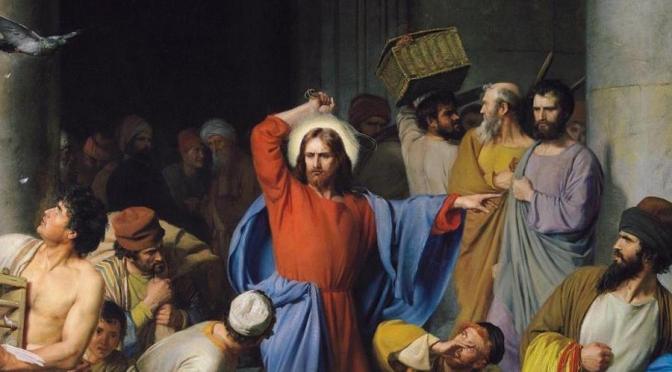
Jesus also overturned the money changers’ tables during Passover at the beginning and end of His ministry (John 2:13-22 & Mark 11:15-19). Why? They had commercialized the things of God—not unlike what we often see today in our consumeristic Christianity.

He also verbally attacked Pharisaical attitudes and behaviors in Matthew chapter 23 by pointing out their hypocritical nature (1-4). He calls them “blind guides” (23:16) and a “Brood of vipers” (23:33). Finally, He asks them, “How will you escape being condemned to hell?” (23:33). As I mentioned earlier, He challenged the forces that restricted access to His Father’s Kingdom while tending to teach the non-religious sinners patiently. Perhaps the religious Pharisees were unteachable whereas the nonreligious were.

Just to be clear: we must stand firm when confronting the immoralities of the day. But we must do it gently and lovingly as a witness to the unbelieving world. So, what’s my point, then? Don’t use Jesus as a fall guy for violent or subversive rhetoric, speech, or behavior. Instead, have compassion on the lost, don’t wage holy wars against the unholy, and focus on reforming unhealthy religious behavior starting with ourselves. Only then will we be godly models others will trust and listen to and mimic as we shine the light of Christ and shape cultures.

Next week, I’ll share with you the life and times of John Bar Zebedee – John ‘the Revelator,’ who was the only apostle not to be martyred as he honored Christ’s charge to care for Mary, fostered the church in Ephesus, and warned of things to come.

Blessings and peace,

Ron Braley

Love Yourself, Part III: How??

Last week, we learned that being Christian carries the responsibility of remaining healthy in body, mind, spirit, etc., to the best of our ability in obedience to the Father and Son so that we can honor them and help bring the Kingdom of God to others. The good news is that the Bible gives us much of what we need to figure this out in two distinct areas: spiritual formation and spiritual disciplines.

Spiritual formation. Once we say, “I do!” in response to God’s call through Jesus, we’re to embark on a journey of transformation—in all areas of life, which is possible with the Spirit of God. Our change matures and forms several areas:

  • Relationships. If we remember that we’re to treat others with the love of Christ and consider them better than ourselves, our relationships will likely flourish (Philippians 2:3-4). Don’t go to bed angry (Ephesians 4:26) and be sure to ‘turn the other cheek’ to allow reconciliation (Luke 6:29). Finally, remember the ‘golden rule’ (Matthew 7:12).
  • Finances. The Bible has a LOT to say about sound money management. Be cautious about borrowing money and be content with what you have (Hebrews 3:5).
  • Physical health. Eat and drink (if applicable) in moderation. Get off the couch and put your body to work, even if just a bit at first. Remember that God desires to move you to action in His plans.
  • Intellect. Stimulate the brain by reading, studying something interesting, playing games, or assembling puzzles, etc. Say “No!” to the electronic stuff more often!
  • Emotional and mental health. Do what you can to keep your emotions and mind healthy by tending to the body, relationships, finances, and intellect. But, again, do what’s within your control.

Spiritual disciplines.

  • Prayer. It is our communications with (not just at!) God. Use Jesus’ model (Matthew 5:6-13) and Adore God, Confess sins, offer Thanksgiving, and Intercede for others (healing, finances, salvation, etc.).
  • Study. Engage God’s words in the Bible and meditate on them—it’s how we ‘put on Christ’ and become spiritually mature.
  • Accountability. We must bear each other’s burdens and confess sins, at least to one person we trust.
  • Giving (money, time, talents, etc.). The Bible demands it (e.g., Matthew 6:1-4 and 25:31-40; 2 Corinthians 9:6-7). Not only is it a necessary outcome of the Christian faith, but it can also help emotional health too. Giving stimulates the brain and makes us feel better physically and emotionally. It’s also a great way to take our eyes and minds off our troubles.

So, move toward emotional, physical, relational, financial, and spiritual health one baby step at a time in God’s direction as you love yourself. Next week? We’ll put self-love to work as we dive into how to love our ‘neighbor.’

Questions or comments? Email publisher@taylorpress.net.

Blessings and peace, Pastor Ron Braley, Northview Christian Church

Love Yourself, Part I: What??

Early in His ministry, Jesus said something interesting to the religious Jews interrogating Him:

And He said to him, “’YOU SHALL LOVE THE LORD YOUR GOD WITH ALL YOUR HEART, AND WITH ALL YOUR SOUL, AND WITH ALL YOUR MIND.’ This is the great and foremost commandment. The second is like it, ‘YOU SHALL LOVE YOUR NEIGHBOR AS YOURSELF.’ On these two commandments depend the whole Law and the Prophets.” (Matthew 22:37-40).

What?!? Love your neighbor as yourself?? Just what does that mean, and why should I do it?

First, we must understand that this love of self and others is NOT an emotion that comes and goes with the wind. It’s the kind of unconditional love that is actionable and not negotiable or optional. It’s doing the right thing for the right reason, no matter how we feel.

Second, doing the right things for yourself sets you up for doing the right things for others, to love them with the love of Christ. If you’ve flown on a commercial aircraft, you’ve probably heard something like, “If you have small children, please put on your mask first and then assist your child.” Why? Because you’d be of no use to your child if you’re passed out or dead. Loving yourself is sort of like that—you can be of little or no benefit to others if you’re emotionally, relationally, spiritually, financially, or mentally unhealthy.

So, we love ourselves in that agape action-type love by tending to our relationships, body, mind, spirit, and finances as God has taught through His prophets, our Christ, the apostles, and others in the Bible. And we learn to like ourselves through healthy living and walking by the Holy Spirit, who reminds us of who we are in God and Christ. We can also observe godly examples which, in loving themselves, can now love others properly.

In summary, Jesus has commanded that we love ourselves and, in self-love (care and feeding of our body, mind, and spirit), love others appropriately. Next week, we’ll dig deeper into how we can make this happen.

Blessings and peace,

Ron Braley